How to ask someone to be your Valentine
Most Valentine’s advice skips the asking. It tells you what to buy, what to book and what to write in the card, all of which assumes the person has already said yes to something. The harder part is the question itself — saying out loud that you want this to be a thing, to someone who may or may not have been thinking the same. That is a different problem from gift-buying, and it is the one worth getting right.
Decide what you are actually asking first
"Will you be my Valentine" means at least three different things depending on who is saying it, and the confusion is where most of these go wrong. It can mean be my partner. It can mean spend the fourteenth with me. It can mean I like you and I am finally saying so.
Pick one before you write anything. The wording barely changes but the stakes do, and so does the answer you are hoping for. Someone who thought they were agreeing to dinner and discovers they agreed to a relationship has every right to feel managed.
If you are already together, you are proposing a plan, and the romance is in the effort rather than the risk. If you are not, you are telling someone how you feel with a deadline attached, which is a much bigger thing to do and deserves a clearer sentence.
The date does the work either way. February the fourteenth gives you a reason to say something you might otherwise have carried around until March, and that is genuinely useful. It is also the single most predictable day of the year to say it, so the date buys you permission, not originality.
Ways that work, roughly in order of nerve required
Ask in person, plainly. Still the best version if you can manage it, and the shortest. One sentence, said to their face, with no run-up: the lack of production is the point, and it is the version people remember years later.
Write it down and hand it over. A card, a note, a folded piece of paper. Writing lets you get the words right, which matters a lot if speaking is where you fall apart, and handing it over keeps the moment real rather than remote.
Ask with the thing they actually like. A specific book, the coffee they always order, tickets to the thing they mentioned once. The gift is not the ask — the gift is proof you were paying attention, and the ask is the sentence attached to it.
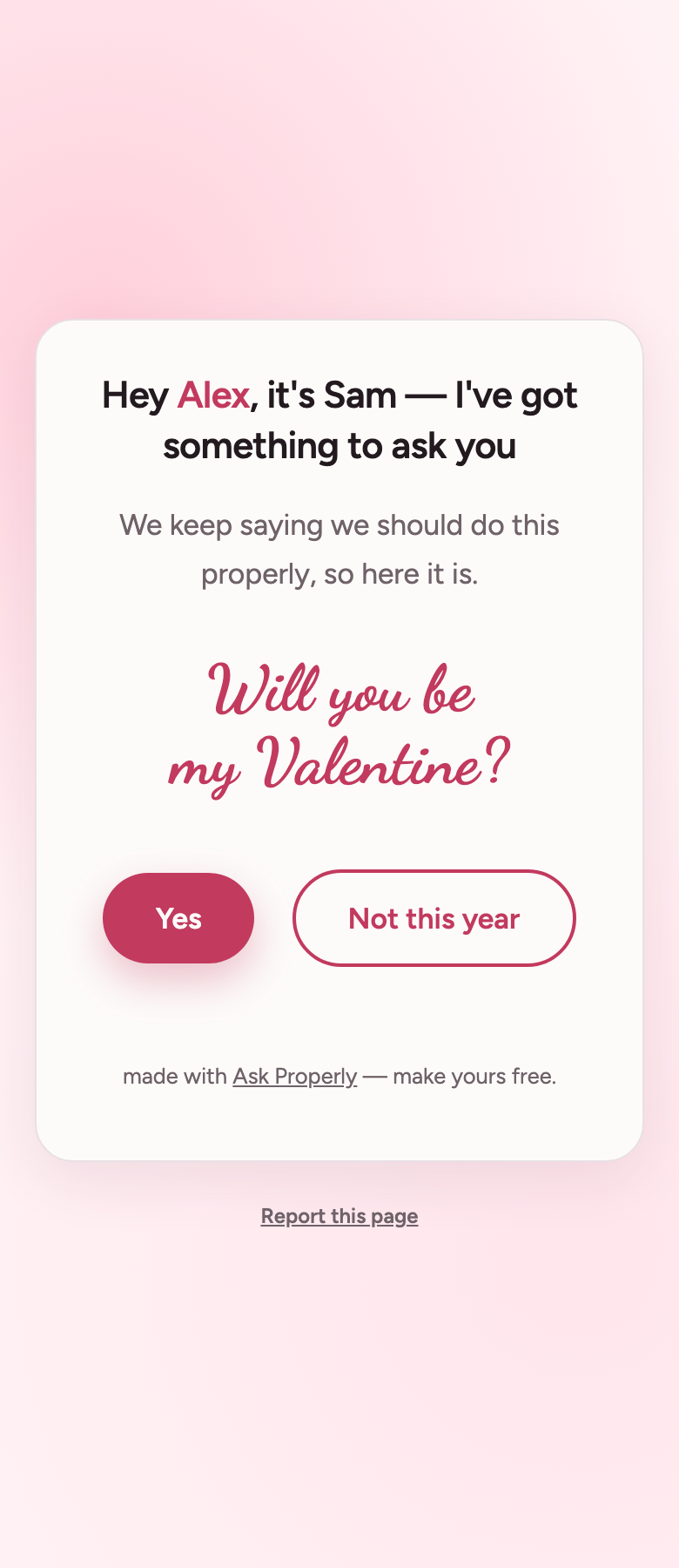
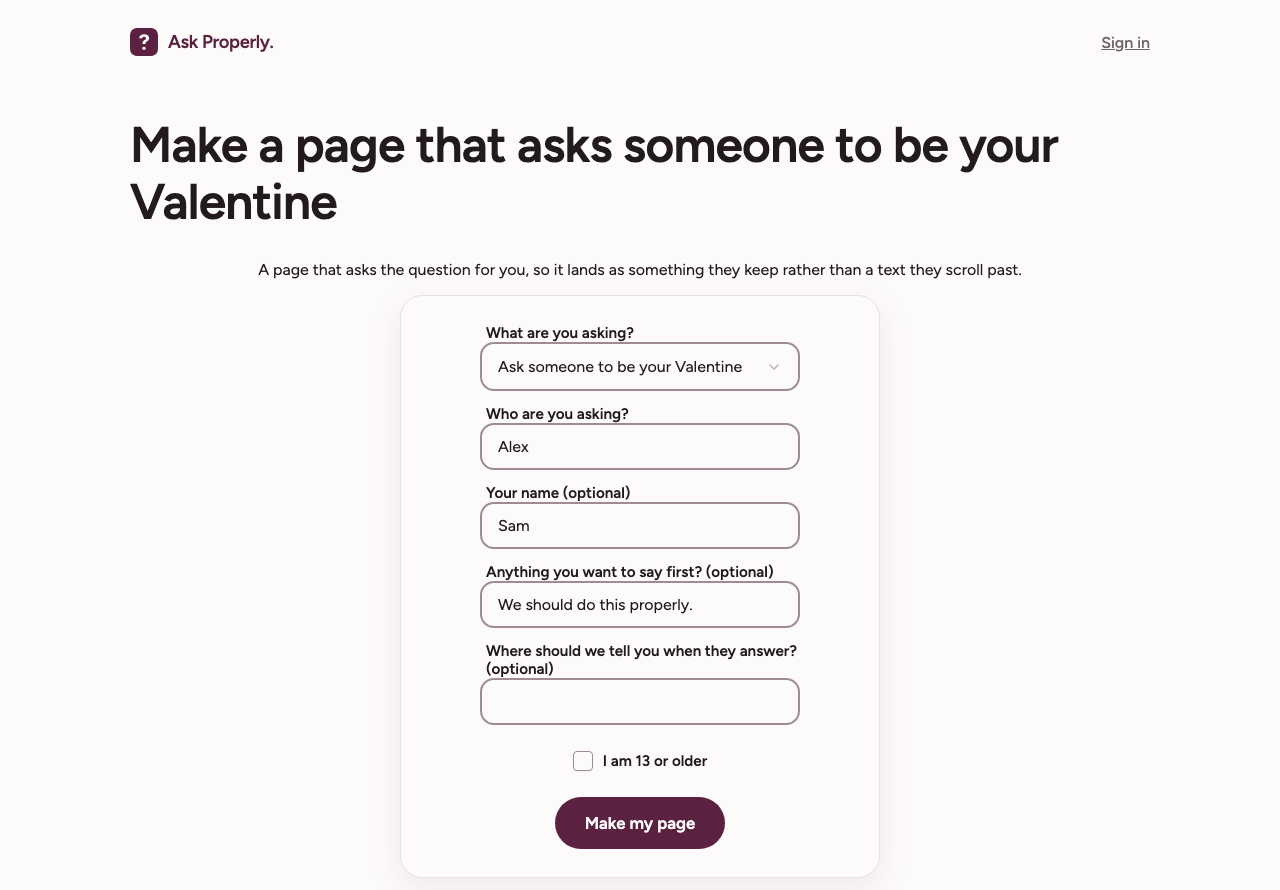
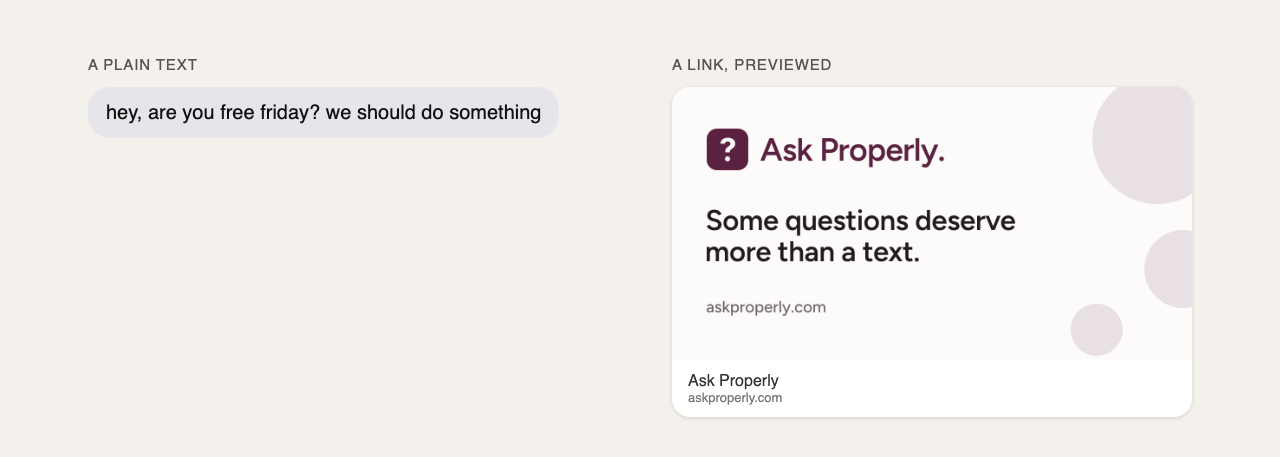
Make a page and send one link. This is the version that works when you cannot be in the same room, when you would freeze saying it out loud, or when you want the question to arrive as something they keep rather than a message that scrolls away. The page asks for you, they answer with a tap, and nobody has to compose a paragraph at midnight. Pick the Valentine occasion on the Valentine page linked below and the question is already written.
Ask through a shared joke, if you have one. The thing only the two of you find funny, used as the frame for a real question. It lowers the temperature enough to make the asking possible, which is its whole job. Make sure the real question survives the joke — if they could plausibly read the whole thing as a bit, you have not asked yet.
What to skip: anything that asks in front of an audience who did not consent to being there, anything that requires them to perform delight on camera, and anything that takes a week to arrive when the fourteenth is on Friday.
When to send it
Earlier than the fourteenth. The day itself is the worst time to ask a question you have never raised before: everyone is already braced, the plans are already made, and a question that arrives at eleven in the morning on Valentine’s Day reads as an afterthought even when it is the opposite.
Two or three days out is the sweet spot for an ask with a plan attached. It gives them room to say yes and still arrange their week, and room to say no without ruining the day for either of you.
If this is a confession rather than a plan, consider not using the fourteenth at all. The twelfth carries the same meaning with none of the pressure, and it tells them you were going to say it anyway rather than because the calendar told you to.
Avoid the midnight send. It feels romantic while you are typing it and reads as unhinged at nine the next morning, which is when they will actually see it.
And if you are sending rather than saying, aim for their early evening — after whatever their day was, with a phone in their hand and space to reply properly.
Leave them a way to say no
The best versions of this question are the ones a person can decline without the friendship collapsing, and that is a thing you build into the wording rather than hope for afterwards.
Make the no cheap. "No pressure either way" is not a weak ending — it is the sentence that lets them tell you the truth. Without it, you may get a yes you cannot trust, which is worse for both of you than a clean no.
Do not stack the odds with an audience. A question asked in front of their friends is a question answered in front of their friends, and the answer you get is the one the room expects rather than the one they mean.
Give them time. A question that demands an answer in the next ten minutes is a question about your nerves rather than their feelings. If they want to think, that is them taking it seriously.
And decide, before you send it, what you will do with a no. Not what you will say — what you will do. Knowing that in advance is what stops a no turning into an argument you did not intend to have.
If they say yes
Reply like a person. The gap between the yes and your response is the loudest silence of the whole thing, and leaving it open for two hours because you were composing something perfect reads as regret.
Then make the plan concrete quickly. A yes to "will you be my Valentine" is a yes to a feeling; a time and a place turns it into an evening. Vagueness after a yes is how a good moment quietly becomes nothing.
Keep it proportionate to what you asked. If you asked for dinner, do not escalate to a weekend away — that reads as having asked for something smaller than you meant. Honour the question you actually asked.