Valentine’s ideas when you’re not dating
There is a specific kind of February problem: you are seeing someone, it is going well, and neither of you has said what it is. Then the fourteenth appears on the calendar and every option looks like a statement. Do nothing and you look uninterested. Do a lot and you have defined the relationship by ambush. The way through is to be deliberate about scale, rather than hoping the day passes without requiring a decision.
The real problem is scale, not whether to do anything
Almost everyone gets this wrong in the same direction: they treat it as a yes-or-no question about marking the day at all, when it is actually a question about how much.
Doing nothing is a message. In early February, with someone you have been seeing for two months, silence on the fourteenth reads as a deliberate choice, because it is one. That may be the right choice, but do not imagine it is neutral.
Doing a lot is also a message, and a louder one. Flowers at their work, a booked restaurant, a card that says the word "boyfriend" — these are all fine in a defined relationship and all enormous in an undefined one.
The useful question is: what is one notch above ordinary for us? Not what does Valentine’s Day normally involve. The day is a scale, and the only sensible place to stand on it is just slightly above where you already are.
If you have been seeing each other three weeks, one notch above ordinary is a good message and a drink. If it has been six months of effectively being together, one notch above ordinary is dinner you planned. The absolute size is irrelevant; the relative size is the whole thing.
Things that work when it is undefined
Suggest the day itself casually, early. "Are you doing anything on the fourteenth?" asked a week out is a low-stakes question that gets you most of the information you need — including whether they had been quietly hoping you would ask.
Do something that is not Valentine’s-shaped. The same evening you would have had anyway, on that date, is the lowest-pressure version that still marks it. A walk, a film, the place you always go.
Give something small and specific rather than romantic and generic. The book they mentioned beats roses, because it says you were listening rather than that you performed the holiday.
Write something short and true. One honest sentence with no label in it does more than a card with a printed verdict on the front.
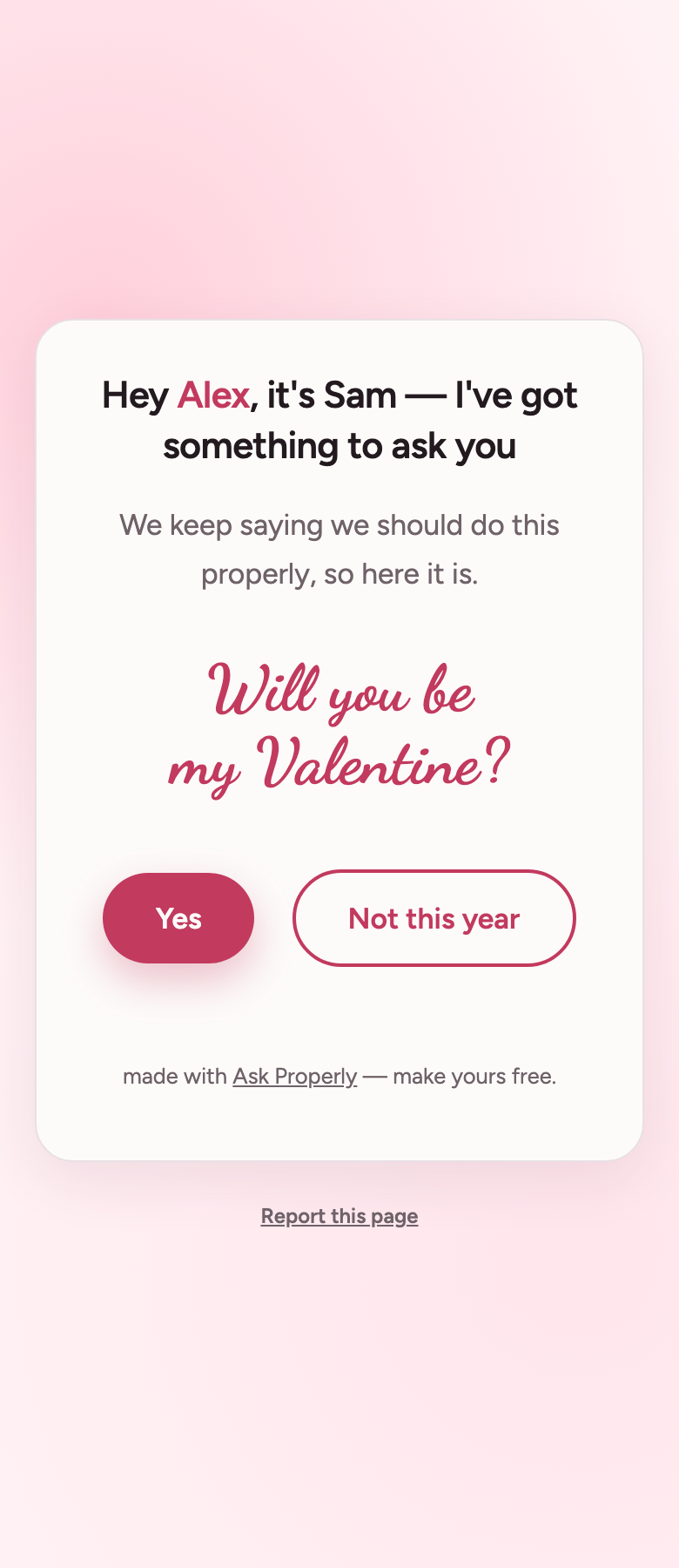
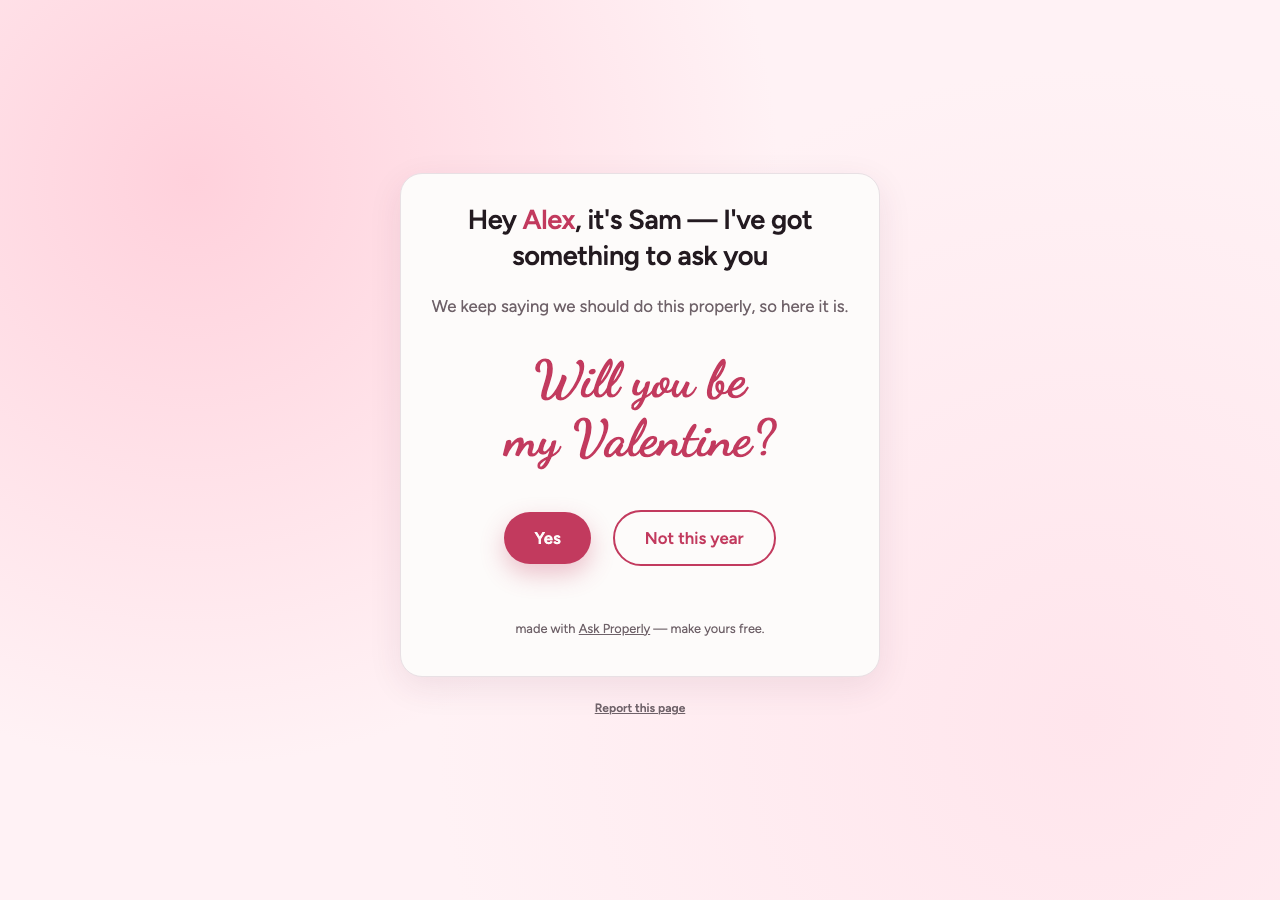
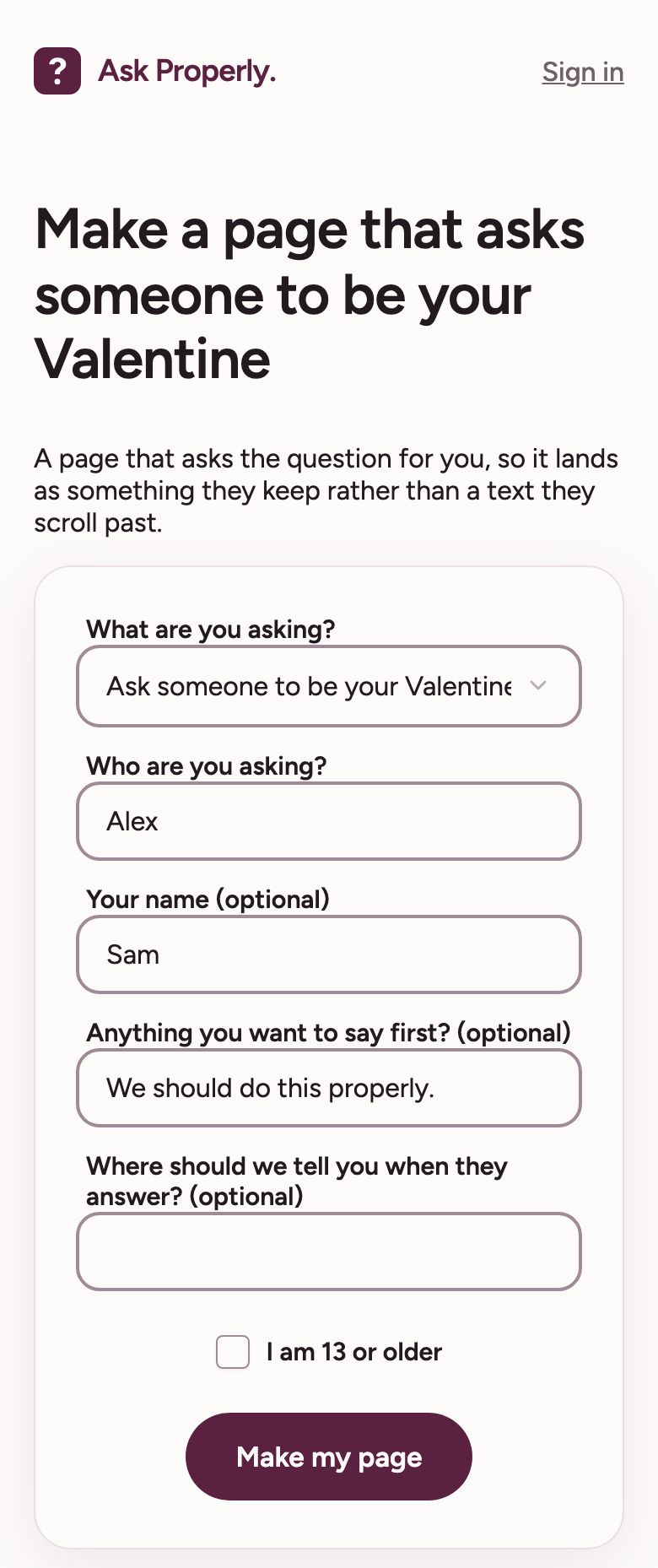
Ask the actual question, if you want to. This is the honest option and it is underrated: the day is a reason to say "I would like this to be a thing" without it coming from nowhere. If that is what you want, the fourteenth is a reasonable excuse to say so. A page is one way to ask it that does not require you to get the sentence out while looking at them — the Valentine page below writes the question and the answer comes back as a tap.
What to skip: anything with a label printed on it, anything that requires their friends or colleagues to witness it, and anything that costs enough to need acknowledging.
What to say, and what to avoid saying
Avoid the labels, unless you are deliberately raising it. "Girlfriend", "boyfriend", "partner" — on this specific date, in an undefined situation, these land as a decision announced rather than a question asked.
Avoid the joke-shield, mostly. "Happy Valentine’s, lol, not that we are anything" protects you and tells them their reading of the last two months was wrong. If you need the joke to say it, the joke is doing too much work.
Say something specific instead. The thing you like about them that is theirs alone. Specific is warm without being a commitment, which is exactly the register this needs.
If you do want to define it, say so separately from the gift. A conversation about what this is should not arrive attached to a present, because it makes the answer feel owed.
And if they bring it up, answer honestly rather than reflexively deflecting. The deflection is usually what makes the next three weeks strange, not the question.
What to send on the day itself
If you are not seeing each other that evening, the fourteenth still needs one message, and it is worth getting the size of it right.
A few weeks in: "Happy Valentine’s. No pressure on any of it, but I am glad I met you this year." Warm, specific enough, and it defines nothing.
A couple of months in: "I know we have not said what this is, and I am not asking today. I just wanted you to know I was thinking about you." It admits the ambiguity instead of pretending it is not there, which most people find a relief.
If you want to see them: "Doing anything tonight? If not, the usual place at seven?" An ordinary plan on an unusual day is the lowest-pressure way to spend it together.
Send it during the day rather than late at night. A message at eleven in the evening on the fourteenth carries more weight than the same words at lunchtime, and the extra weight is not the kind you want here.
And send one. Not one, and then a follow-up when they take an hour to reply. The silence is them getting on with their day, and it is not a verdict.
Reading what they do
If they mark it slightly, mark it slightly back. Matching their scale is the single most reliable move in this whole situation, and it requires no interpretation.
If they do a lot, they have told you something. Not necessarily that they want a label, but that they are more invested than the ambiguity suggests. Respond to the information rather than the gesture.
If they do nothing at all, resist reading it as a verdict. Plenty of people find the day embarrassing and would rather skip it, and that is not the same as not being interested. Judge it on the week either side instead.
And if they explicitly say they would rather ignore it, believe them and ignore it. Overriding a stated preference to deliver a surprise is not romantic; it is not listening.
When to just ask properly
Sometimes the honest answer is that you are tired of the ambiguity, and arranging an evening around not mentioning it is more work than the conversation would be.
If so, pick a different day for the conversation. The fourteenth is crowded with expectation, and a real talk about what this is deserves an evening where neither of you is performing a holiday.
Keep it short and lead with what you want rather than what you fear. "I like this and I would like it to be a proper thing" is a complete sentence. It is also much easier to answer than a paragraph about where things stand.
Then accept the answer you get. The point of asking is to find out, and a clear no is more useful than another three months of reading gestures.