How to ask someone out on Valentine’s Day
Asking someone out on the fourteenth is the highest-difficulty version of an already difficult thing. The date announces your intentions before you have said a word, everyone is watching the calendar, and a no has nowhere to hide. It can still be the right day to do it — but only if you understand what the date is doing to the question, and adjust for it.
What the date does to the question
It raises the stakes without you choosing to. "Do you want to get coffee" asked on the eleventh is a small question. The same words on the fourteenth are a declaration, because the day supplies the meaning whether you wanted it or not.
It removes deniability for both of you. Normally an ask can be read as casual by either side, which is the escape hatch that makes asking survivable. Valentine’s closes it: they know exactly what you meant, and they know that you know.
It adds an audience. Even with nobody in the room, the day is public. Their friends will ask what they did. A no on the fourteenth is a no they may have to explain, which makes it harder to give honestly.
And it supplies a deadline you did not set. The question has to be asked by a particular evening or it stops making sense, which is the opposite of how most good asks happen.
None of that makes it a bad day. It makes it a loud one, and the way to use a loud day is to make the question itself quieter than usual.
Should you use the date at all?
Use it if there is already something between you that you both half-know about. The day gives you permission to say the thing you have been not-saying, and that is exactly what it is good for.
Use it if you can be light about it. "It feels ridiculous to ask this today of all days, but" is a complete and good opening, because it shows you can see what the date is doing.
Do not use it as a first move on someone who has given you nothing to go on. The fourteenth turns an ordinary ask into a big one, and a big one from nowhere asks them to manage your feelings in public.
Do not use it if you are hoping the date does the persuading. It does not. It only makes the answer louder in whichever direction it was already going.
The eleventh or twelfth is almost always the better day for a first ask, and it says something good about you: you were going to ask anyway, and not because the calendar told you to. You can still have the fourteenth — you just will not be asking on it.
Ask for something small and specific
The single most useful adjustment: shrink what you are asking for. On the fourteenth, "dinner" is an event. "Coffee on Saturday" is a question, and a question is answerable.
Be specific about the thing, the day and roughly the time. Vague invitations put the work of making it real onto them, and on this day that work doubles as pressure.
Avoid booking anything first. A table you have already reserved converts a question into an arrangement they have to dismantle, and nobody wants to be the reason a booking gets cancelled. Ask first, book after.
Do not make it a surprise. Surprises on Valentine’s Day assume a yes you have not been given yet.
And keep the plan proportionate to what you actually know about them. An elaborate evening designed for someone you have had four conversations with is a plan about you, not about them.
How to keep the pressure off
Ask privately. Not in front of their friends, not in a group chat, not where anyone can see the answer being given. A private question is the main thing you can do to make the no survivable, and a survivable no is what makes a yes trustworthy.
Say the no is fine, and mean it in the wording. "No pressure at all, I will not be weird about it either way" is not a weak ending. It is the sentence that lets them tell you the truth.
Give them the day itself off. If you ask on the twelfth about the sixteenth, nobody has to decide anything about the fourteenth, and the whole thing deflates to a normal size.
Do not stack it with a gift. A present handed over while asking is a question with an obligation attached, and it makes a no expensive.
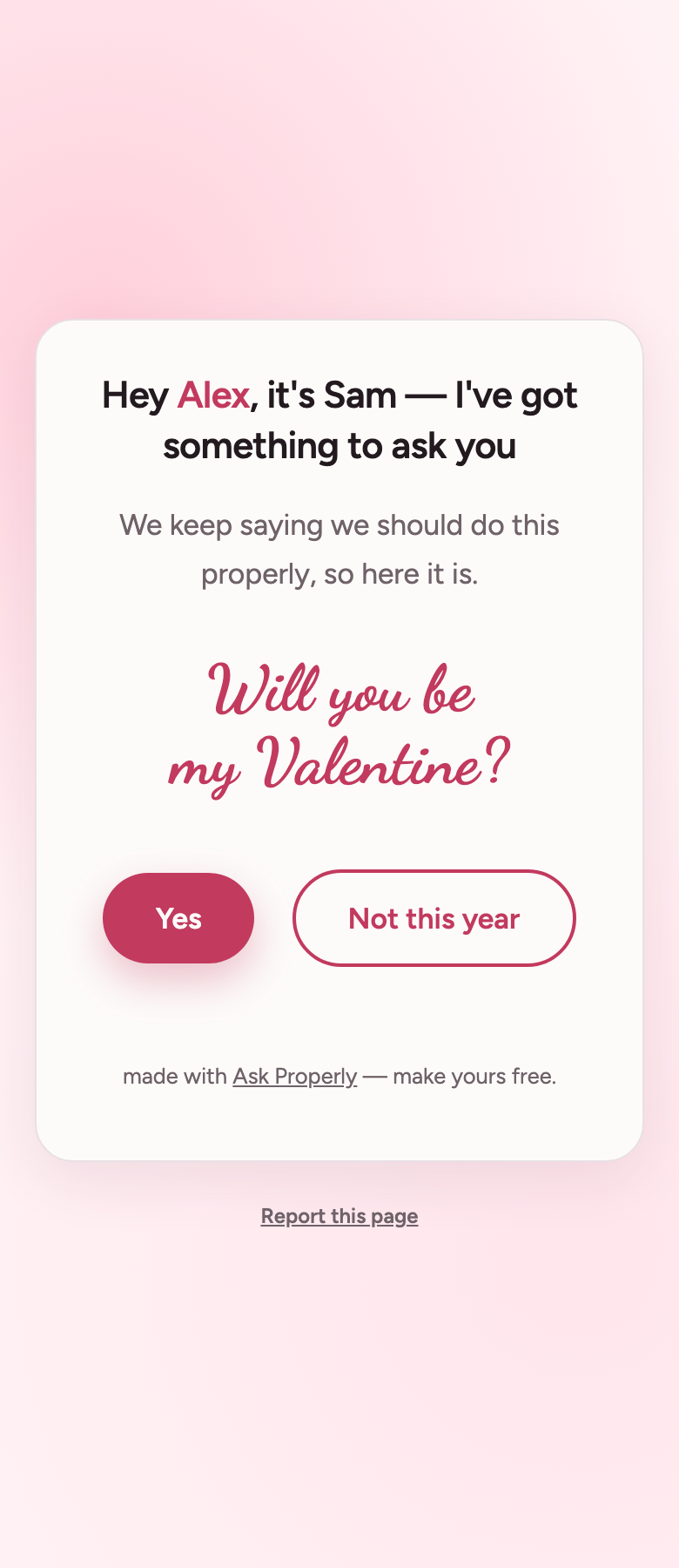
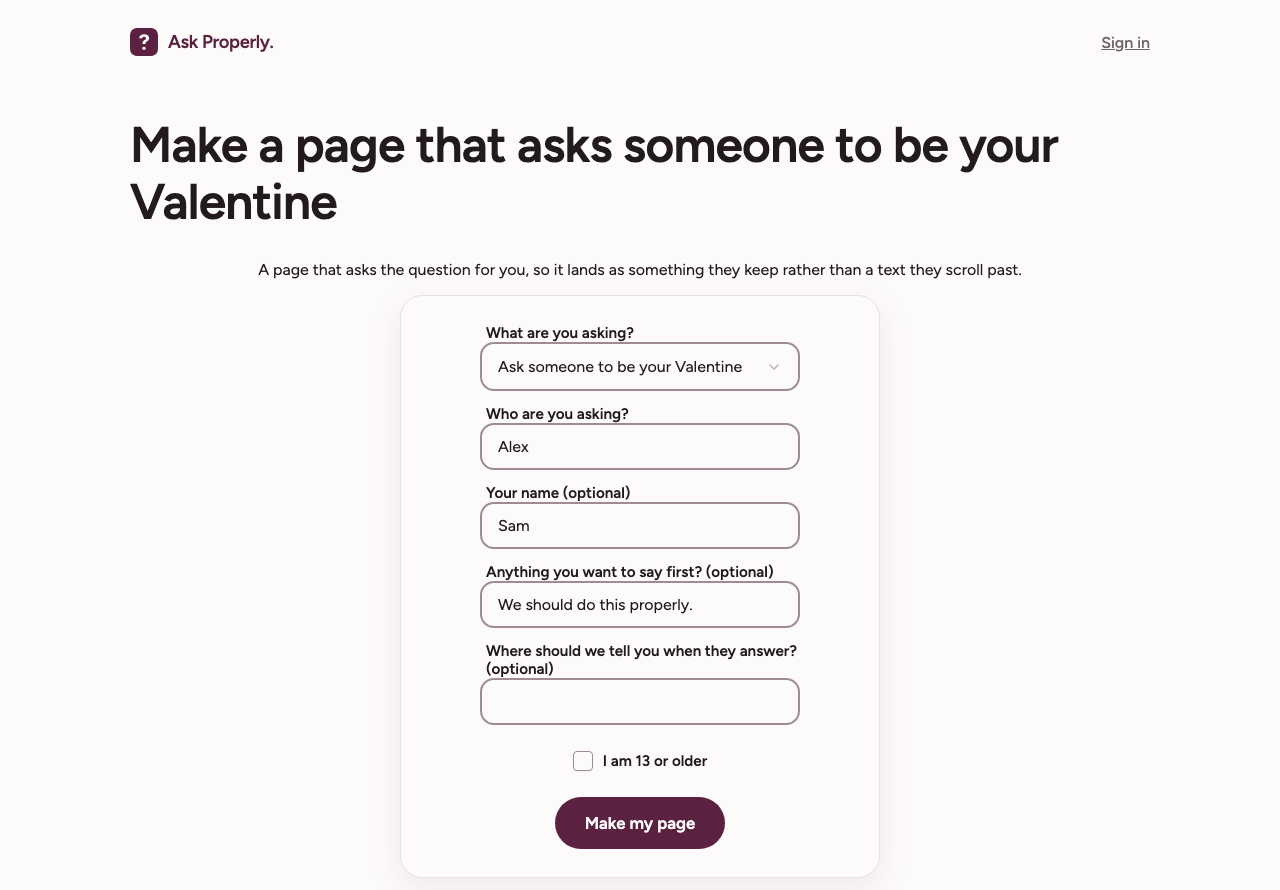
If saying it out loud is where you fall apart, send it instead of performing it. A page carries the question on its own, arrives as something they open in their own time, and comes back as a tap rather than a sentence they have to compose on the spot — which is usually easier for them too. The Valentine page below builds one in about a minute.
What to actually say
The wording matters more on this date than on any other, because the day has already made the question loud. The aim is a sentence that is plainly an ask and still small enough to answer.
If there is already something between you: "I know what day it is, and I am asking anyway. Do you want to get dinner on Saturday?" It names the obvious thing, which takes the weight off it, and it asks for one specific evening.
If you are asking a few days early: "Not a Valentine’s thing, or not only one. Coffee on the sixteenth?" It tells them the fourteenth is not part of the deal, which is the kindest thing you can do for someone who has not decided how they feel yet.
If you would rather it were a joke that is also real: "This is a ridiculous day to ask, so I am asking ridiculously. Be my Valentine? No is allowed." The joke works only if the question underneath it is still a question.
What not to say: anything about how long you have liked them, anything that asks them to justify a no, and anything that begins "I just thought, since it is Valentine’s". That last one hands the decision to the calendar, and they will answer the calendar instead of you.
Then read your version out loud. If it sounds like a speech, cut it until it sounds like a question.
If they say no
Answer once, briefly, and warmly, and then let it go. "No worries at all — see you Thursday" is the whole correct response. Anything longer asks them to look after your feelings on a day already loaded with them.
Do not ask why. The reason is theirs and requesting it turns a decision into a negotiation.
Do not re-ask on the fifteenth. Giving the same question a second run at it reads as not having heard the first answer.
And expect it to be a bit awkward for a week, because it will be, and that is survivable. The thing that makes it last longer than a week is almost always what happens after the no rather than the no itself.