Cute ways to ask someone out
Cute is the easy part. The hard part is the moment after you ask, when someone has to answer you with their face while you watch them do it. That is the bit people are actually afraid of, and it is why most lists of cute ways to ask someone out are really lists of stunts. A stunt is a way of not having to say the thing. What follows are ideas that still say the thing, how to choose between them, and how to write one by hand once you have.
Eight ideas that are not stunts
A note, left where they will find it alone. In a book you lent them, in their bag, folded under a coffee lid. Handwriting carries effort that typing cannot fake, and finding it alone means they get their honest reaction before they have to produce a polite one.
The drink they already order. Hand it over and ask while they are holding it. It is small and specific and it proves you have been paying attention, which is most of what anyone wants to hear. The holding matters more than it sounds — someone with their hands full has something to do while they think.
A plan built from something they said. They mentioned a film, a market, a place they have never been. Ask them to that exact thing. It turns "do you like me" into "are you free Thursday", which is a far smaller question, and it is the one idea here that gets easier the better you know them.
A photo with the question on the back. Print one — a shop will do it in an hour — write on it, hand it over. It becomes an object they can keep in a drawer or quietly recycle, and either way they are not deciding in front of you.
The walk. Side by side, no eye contact required, nothing either of you has to sit through afterwards if it goes badly. For a lot of people this is the easiest version there is, and most lists leave it out because it does not photograph.
Two tickets to something cheap. Not an expensive thing, which arrives as a debt, and not a surprise, which arrives as a trap. Buy two of something small and offer the second one. The ask is implied by the object, so you only have to manage one sentence out loud.
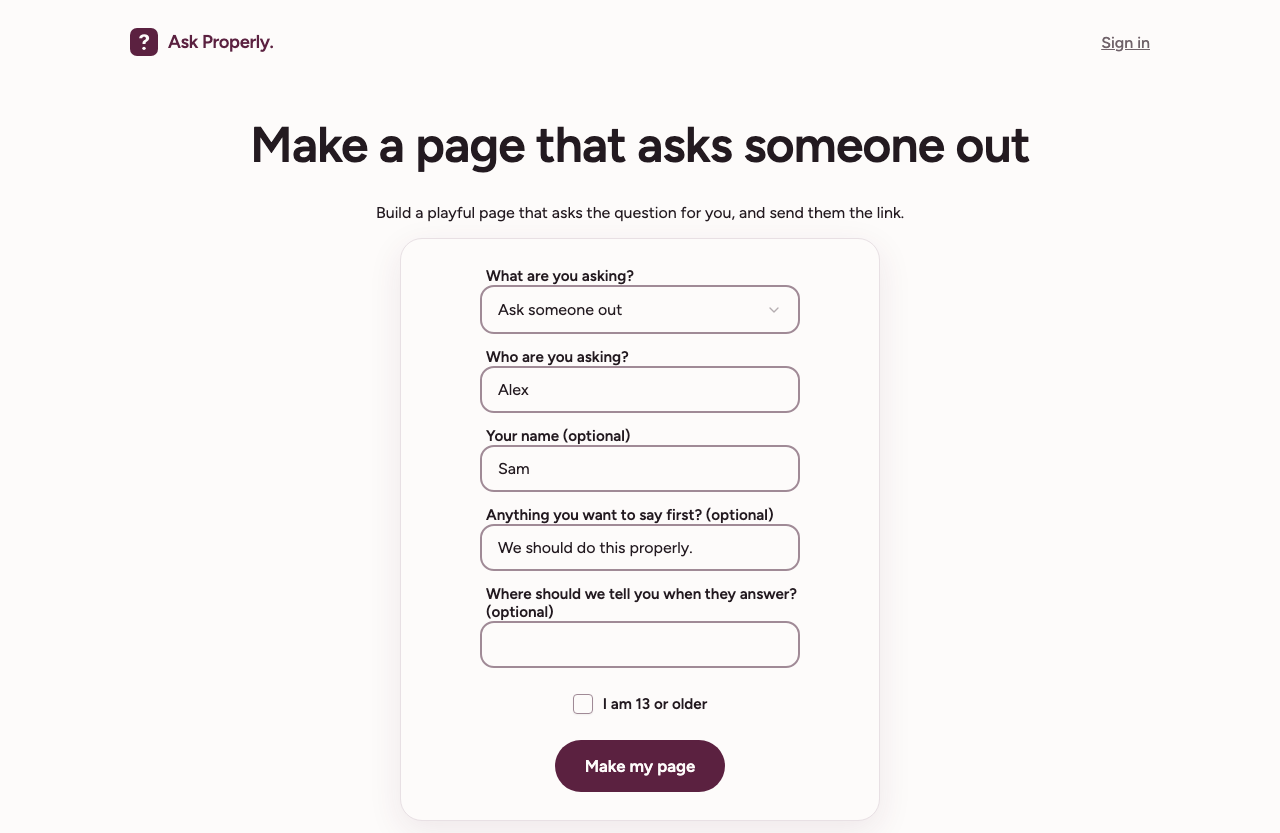
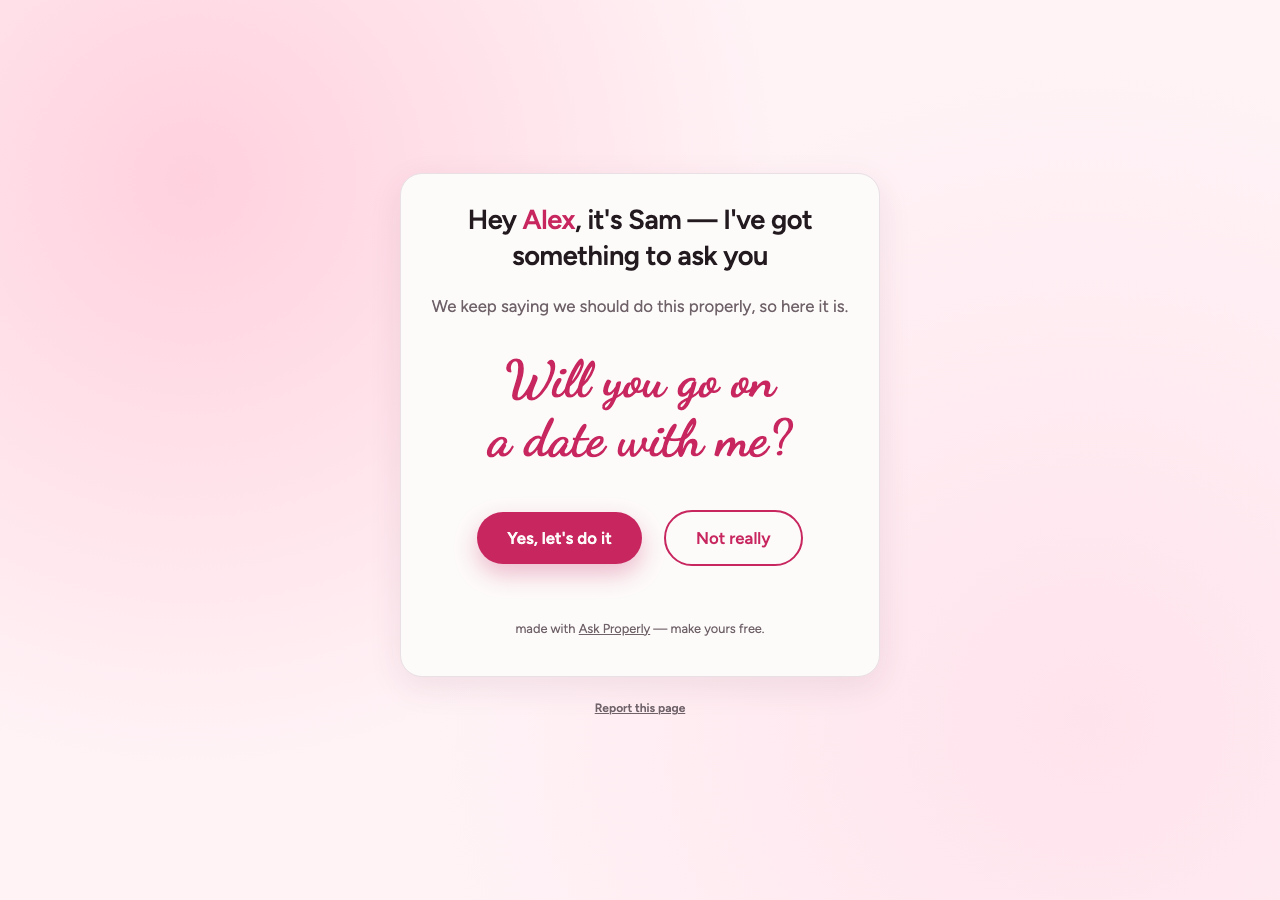
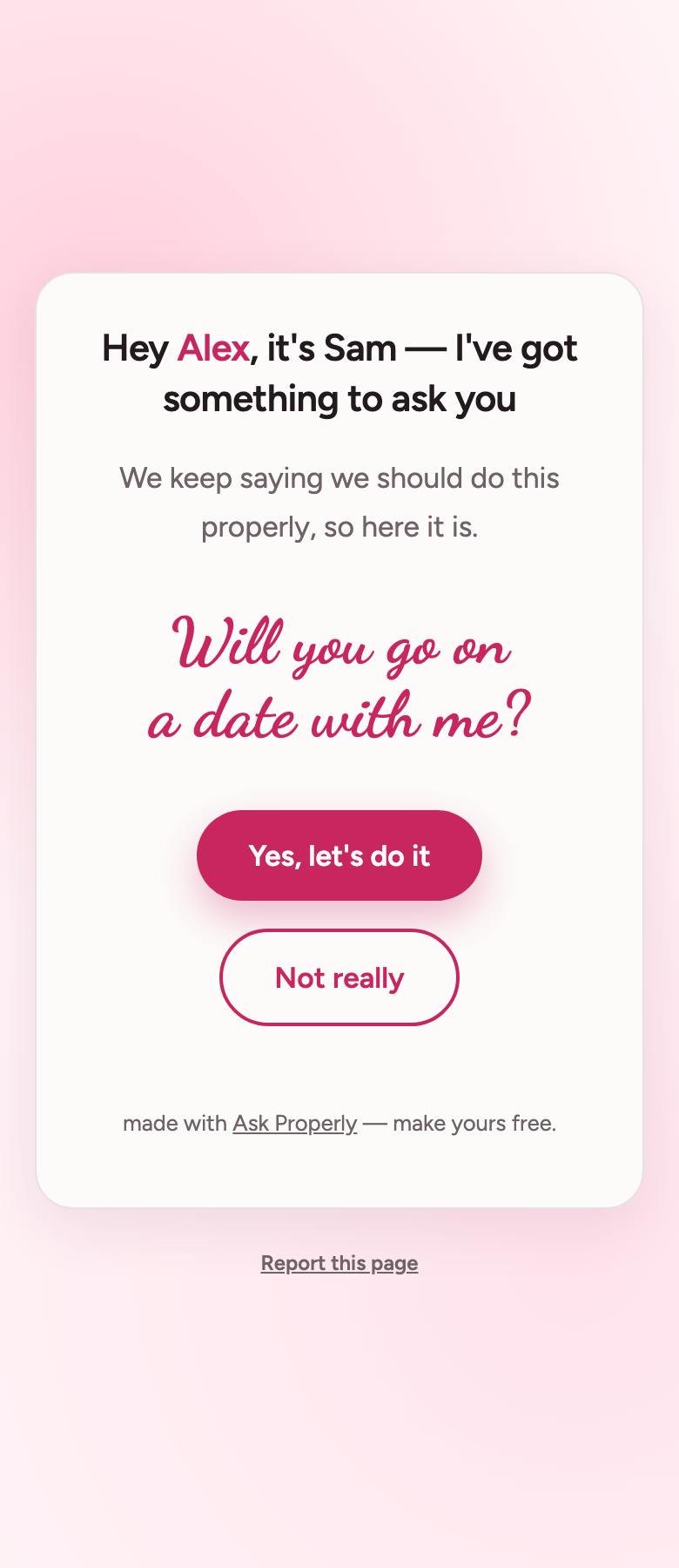
An ask page. Build one on the page linked at the end of this piece, and send them the link, so they open it alone — a No button that runs away from the cursor keeps the whole thing light, and nobody is trapped, because they can simply close the page and say the rest to you in person. It is free (a free page is deleted 30 days after you make it), and the page carries one quiet line about what made it and nothing else, which is why it reads as something you made rather than something you bought.
Or say it out loud, in one sentence, to their face. Nothing here beats this if you can do it. Everything here exists because most of us cannot, most of the time, and a question actually asked beats a perfect one you never get round to.
Matching the idea to the person
Choose for them, not for you. Most asks that go badly were chosen because they would look good, which is a decision about an audience rather than about a person.
Someone private will not enjoy a thing that happens in front of their friends, however well it is done. They will manage it, and they will remember managing it. For them the note, the walk and the page are the whole list, and the hallway with the sign is off it.
Someone who genuinely likes an audience is rarer than the internet suggests, and you will already know if they are one. Even then, keep the audience small and known. Strangers watching is a different thing from friends watching.
If you cannot tell which they are, that is useful: ask in private. Nobody has ever been upset by being asked quietly, and a quiet ask can always be celebrated loudly afterwards if they want it to be.
Match the size of the gesture to the size of the thing. An elaborate ask from someone they barely know reads as being watched rather than being wanted. A small, specific gesture from someone they already like reads correctly every time.
Writing the thing itself
A card, the back of a photo, the inside cover of a book: you are writing into a small space, and the small space is doing you a favour. Four sentences is the entire budget, and most of these only need two.
Open with the line that is about them and could not be about anyone else. Not an adjective — a thing that happened. "You are the only person who laughed at that" is a sentence with evidence in it, and evidence is what separates a note from a greetings card.
What goes between — the question, the day, the easy no — is worked through in the piece on asking over text, linked below, and none of it changes for being handwritten. What changes is that nothing can be added afterwards.
Then stop, which is the hard part. Handwriting makes the fourth sentence visible in a way a message thread never does: you can literally see it eating the space. If the words do not fit on the card, they would not have fitted into the moment either.
Write it twice. Once on anything to get the words out, once properly to send, because ink does not forgive a crossing-out the way a draft does. Nothing on a handwritten ask looks worse than a sentence that ran out of room.
And say it out loud before you copy it over. If you would be embarrassed to speak the sentence, it reads worse on paper, where they can go back over it as many times as they like.
Then stop editing. Past a certain point the rewriting is not making the ask better, it is just delaying it, and the version you hand over tonight is worth more than the perfect one you get to in three weeks.
Where and when
Somewhere they can leave. That is the single rule, and it rules out the car on the way home, the end of a night out, and the middle of a group activity nobody can exit politely.
Earlier in the week is better than Friday night. A question on a Tuesday is a question. The same question at eleven on a Saturday is a question plus a mood, and they have to separate the two before they can answer.
Not in a group chat, not over a shared screen, and not in a thread you both know other people read over. Privacy is not secrecy here. It is just the absence of an audience neither of you invited.
And not immediately after something hard in their week. This sounds obvious and is the most commonly ignored piece of timing advice there is.
If the answer is no
Then you know, which is better than the six weeks of wondering you were going to spend otherwise. Say thanks, mean it, and do not make them manage your disappointment. What turns a no into something worse is almost always what happens in the ten minutes after it.
It is worth remembering that a no to this question on this day is a smaller fact than it feels like. People are busy, people are seeing someone, people are having a bad month, and almost none of that is about you. You asked properly, which is the part you controlled.