How to ask someone out over text
Texting is where most people ask now, and it is not a lesser way to do it. It is a harder one. A text has to survive a lock screen, a half-read glance and a thread it did not ask to be in, and it has to do that while sounding like a person rather than a draft. What follows is what to type, what to delete before you send, and the one change that does more than any amount of rewording.
Three ways a text goes wrong
It gets buried. Your message arrives between a parcel notification and a group chat about a car, and it is read while they are walking somewhere. Nothing about the medium says this one is different from the forty before it, so it gets answered at the speed of the forty before it.
It is ambiguous on purpose. "We should do something sometime" protects you, and it does that by moving the risk onto them: now they have to decide whether you meant it, then answer the version they guessed. Most people answer the safest reading, which is the one where you did not mean it.
It gets long. When you cannot show effort any other way, the only lever is more words. Four paragraphs is a lot to receive before breakfast, and length reads as pressure even when it is meant as care.
What to actually send
One question, one reason, one easy exit. That is the whole shape, and it fits in two lines.
The question has a day in it. "Do you want to get dinner Thursday" can be answered yes or no. "We should get dinner sometime" cannot be answered at all, only acknowledged, which is why it so often is.
The reason is a single clause about them, not about you. "You are the only person I know who would sit through that film" is a reason. "I have been thinking about this for ages" is about you, and it quietly hands them a second job: managing how long you have been thinking about it.
The exit is one short clause that makes no easy. "No pressure either way" sounds like a formality and is not one. It is the difference between a question and a request, and people answer questions more honestly.
Worked example, someone you already talk to: "There is a thing at the market Saturday and you are the person I want to go with. Want to come? No pressure either way."
Worked example, someone you barely know: "This might be out of nowhere, but I would like to buy you a coffee sometime this week. Totally fine if not." The hedge is allowed here, once, because the context genuinely is thin — and it is one clause, not a paragraph.
Worked example, a friend, where the risk is the friendship: "I want to ask you something and I do not want it to be weird either way. Would you want to go out, properly, on a date? If the answer is no we never mention it again and nothing changes."
In all three the question is one sentence and the exit is the last sentence. That order matters. An exit offered before the question reads as an apology for asking.
What to delete before you send
The word "just". "I just wanted to ask" is three words of apology attached to a question that does not need one. It is the single most common thing in a nervous message and the easiest to remove.
"This is random but" — it is not random, you thought about it for a week, and saying otherwise is the one obviously untrue sentence in the message.
The escape joke. The line you add so that if it goes badly you can claim you were not serious. They can see it doing that job, and it makes the real part harder to trust.
Any apology for texting at all. Also "sorry if this is weird", "feel free to ignore this", and anything that pre-forgives them for a no you have not been given yet.
Double punctuation, trailing ellipses and a question mark doing the work of a tone. If a sentence needs "haha" to be safe to send, send the sentence without it and see whether you still mean it.
What survives the deleting is usually short, and short is correct. A two-line message that says one clear thing reads as confidence, whether or not you felt any while typing it.
Timing, and the double text
Send it when they can reply without hiding their phone. Early evening tends to work. The middle of a workday and anything after midnight both change how a message reads before a word of it is open, and neither change is in your favour.
Then leave it alone. A follow-up an hour later asking if they saw it converts a question into a deadline, and a deadline is answered differently from a question.
If a day passes with nothing, one light message is fine — something that gives them an easy on-ramp rather than asking why they have not replied. After that, the silence is the answer and it deserves to be taken as one. Taking it well is the part they will remember, and it is the part that keeps the door open at all.
The change that does more than the wording
Send a link instead of a paragraph.
A text lives in the thread, which is the problem. A link does not: it takes a deliberate tap to open, so it gets opened when they have a minute, and what opens is one question on a whole screen with nothing competing for the next line. The question is identical. The frame around it is doing the work.
It also solves the length problem. A text can only look considered by being long, and long is the thing that reads as pressure. A page can be three lines and still obviously made on purpose, because the effort is visible in the object rather than in the word count.
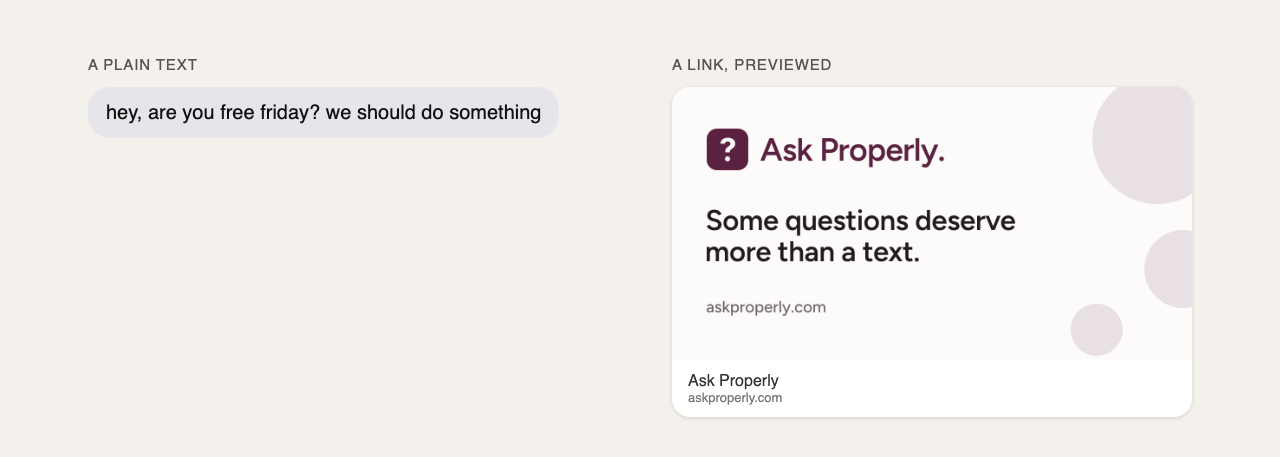
The first figure below shows both: on the left the question as a plain message bubble, on the right the same question as a link, as a chat app previews it before anyone has opened anything. Notice what the preview does not say. No name, no question, nothing about who it is for, so if that card is ever seen by someone it was not meant for, it gives nothing away.
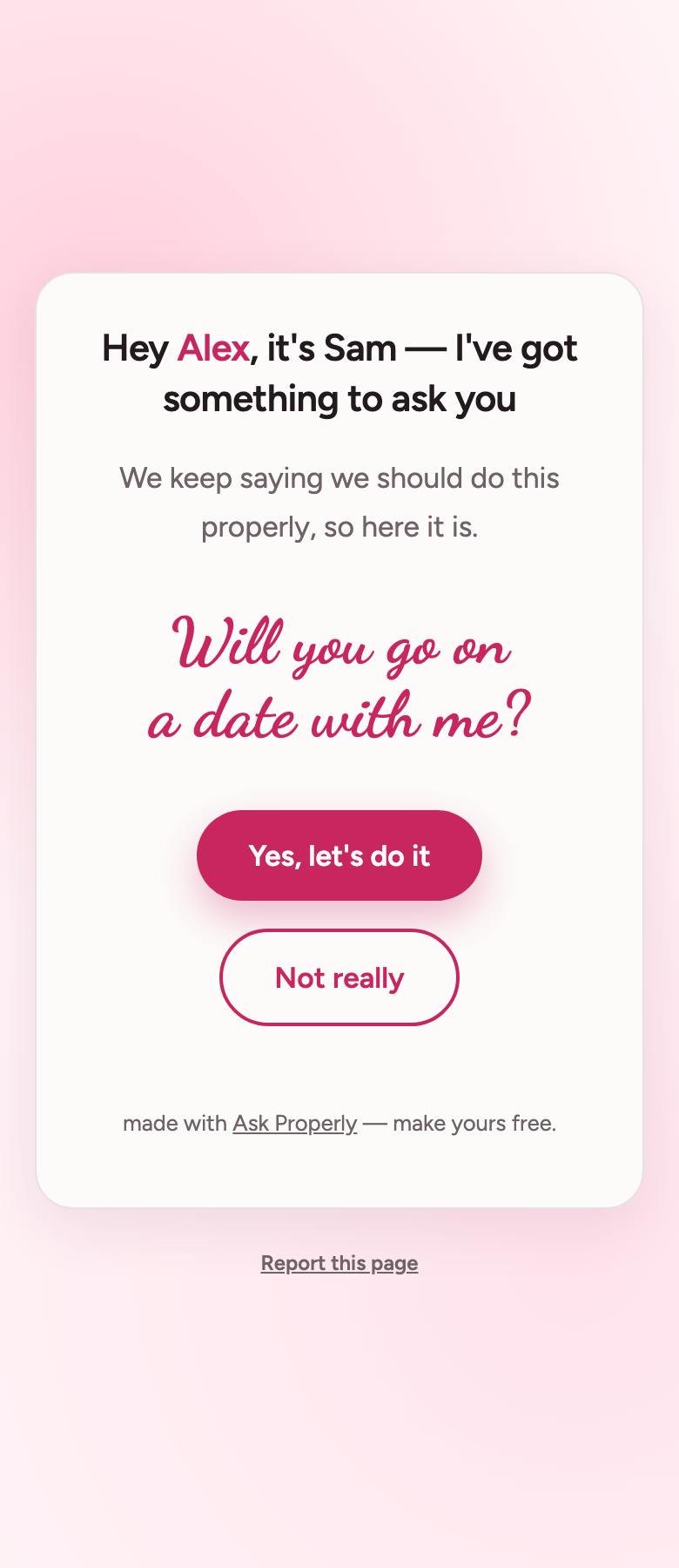
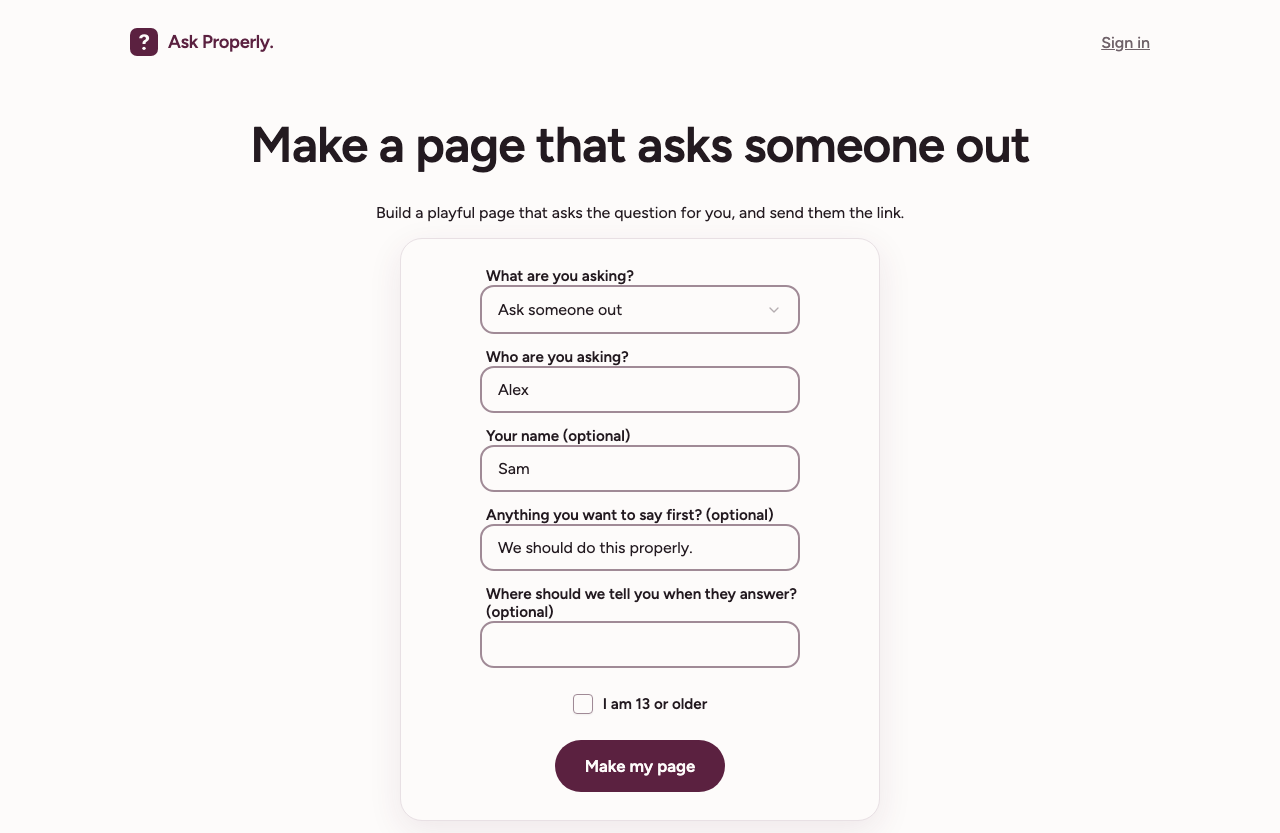
The builder sits on the page linked below, takes a first name and a sentence, and hands you a link. There is no account for them and nothing to install. Be deliberate about where that link goes: the page is not listed and not indexed, but the link is the only lock on it, so anyone holding it can open the page — send it to them directly, not into a group chat. Put it in the thread you were already in, with no preamble. "Made you something" is plenty, and anything longer undercuts the thing you just made.
If they say maybe, or nothing at all
"Maybe" and "I am really busy at the moment" are usually answers. Not always, and the way to find out is one specific follow-up, once: name a different day. If that does not land, you have your answer and you got it without making anyone say a hard word out loud.
A yes needs pinning down the same day. Agree a day, a time and a place while the yes is fresh — a vague yes decays into nothing within a week, and nobody involved will quite know when it died.
An enthusiastic reply that avoids the question is the same as a maybe. Treat it that way, kindly, and do not read the enthusiasm as the answer.
After you send it
Put the phone down. Watching the thread does not change the answer, and it does change how you behave for the next hour.
Turn off whatever would have you checking read receipts, go and do something with your hands, and let them have the time you would have wanted. You asked clearly, you made it easy to answer, and you left them a way out. That is the whole job, and most people skip at least one of the three.