Asking a Valentine for the first time
The first time you ask someone this, the question feels enormous and the sentence is tiny, and the gap between those two facts is most of what makes it hard. Everything you read says be confident, which is advice that only works on people who already are. What follows is the practical version: how much to say, what goes wrong most often, and what to do with the part nobody warns you about, which is the waiting.
Say less than you think you need to
The commonest first-time mistake is length. Nerves produce explanation, explanation produces paragraphs, and a paragraph turns a question into a case being argued.
The whole thing can be two sentences. One that says something true about them, one that asks. Anything beyond that is usually you reassuring yourself, and the person reading it can feel the difference.
Do not explain why you are nervous. It is the most natural thing to write and it moves the subject from them to you, so they end up managing your feelings before they have answered.
Do not list your qualifications either. "I know I am not really your type, but" is an argument against yourself placed directly above a question, which makes the question harder to say yes to.
Write the long version if you need to — it genuinely helps to get it out — and then send the two sentences hiding inside it. The long version was for you, not for them.
What first-timers get wrong
Asking in front of people. It feels braver and it is actually the opposite: an audience makes a no expensive, so what you get back is the answer the room expects. Ask privately and you will get the truth, which is what you actually wanted.
Hinting instead of asking. Three weeks of increasingly obvious hints is harder on both of you than one clear question, and it has a failure mode where they genuinely do not notice and you conclude they said no.
Making it enormous. Scale is read as pressure. A large gesture from someone they have not thought about that way is a thing they have to escape rather than answer.
Asking at midnight. The hour makes everything feel urgent and significant, which is exactly the feeling that produces messages people regret at nine the next morning.
Attaching a gift to the question. It converts an answer into an obligation. Ask first; the gift, if there is one, comes after a yes.
And re-sending it. One question, then silence, is the correct shape. A follow-up an hour later reads as pressure even when it is anxiety.
Choosing how to ask
In person is the strongest if you can do it without the words deserting you. Short, private, unrehearsed-sounding. The lack of production is the thing people remember.
Written beats spoken if speaking is where you fall apart. There is no prize for the harder format, and a clear written question is better than a mumbled spoken one that they half-hear.
Avoid the group chat entirely. Even a question meant for one person lands in a group as performance, and it puts the audience problem back in by accident.
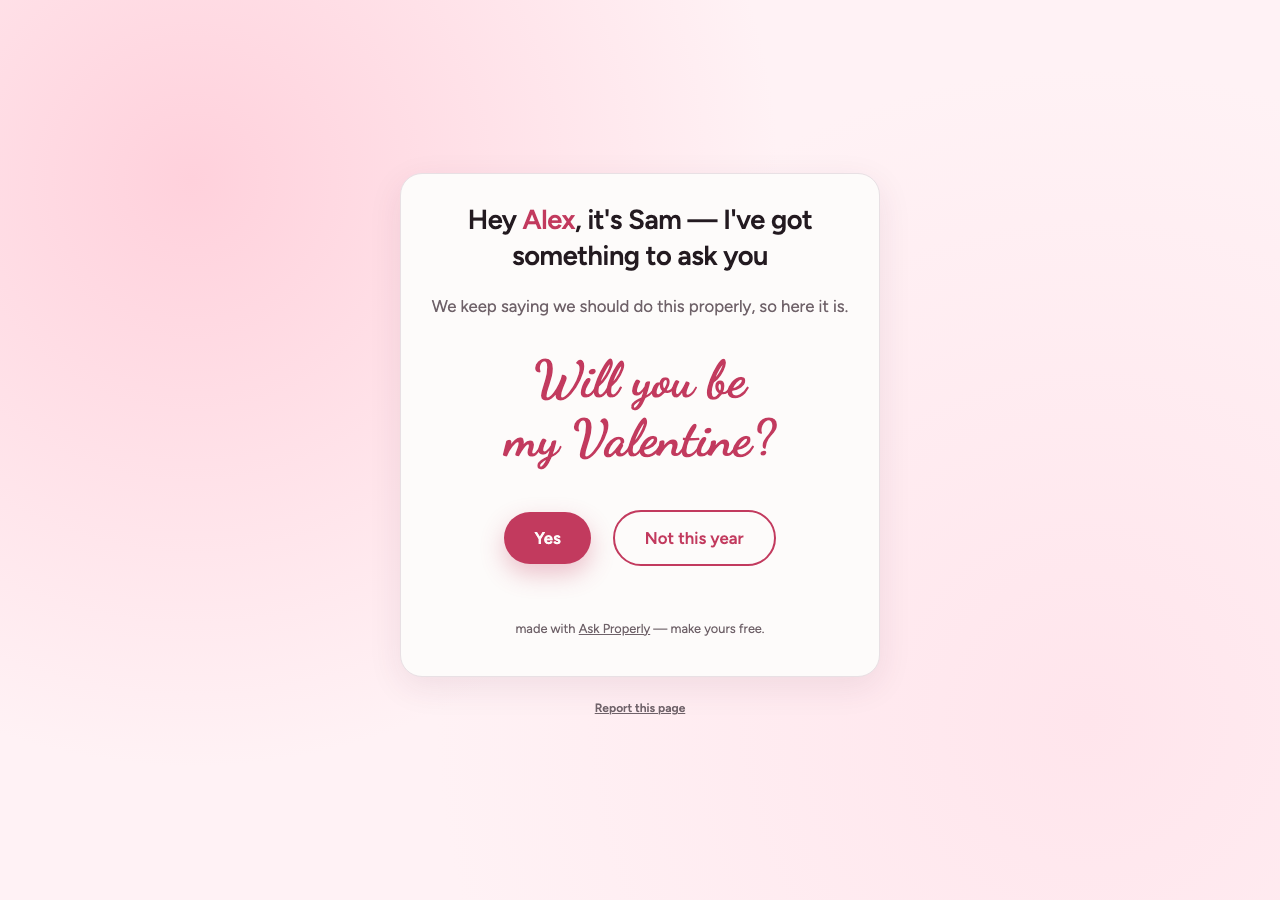
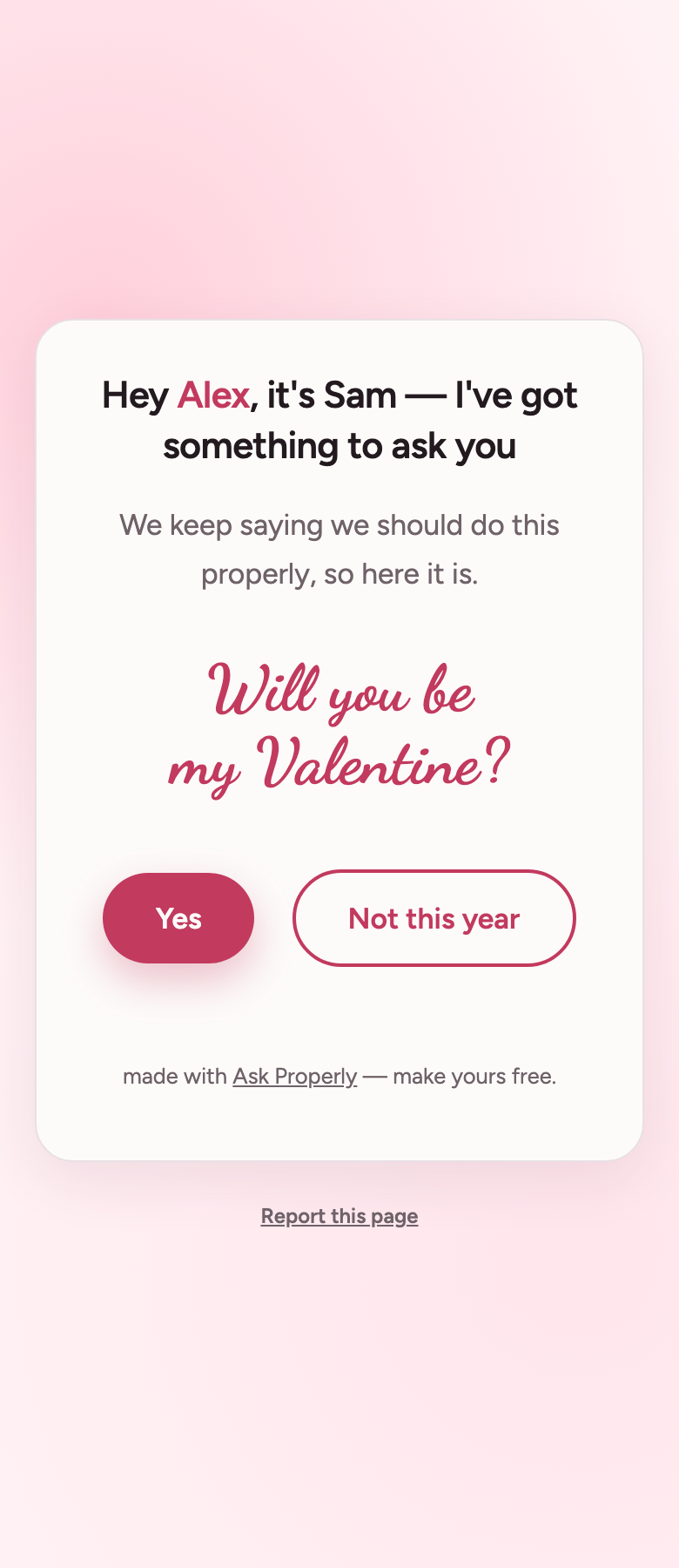
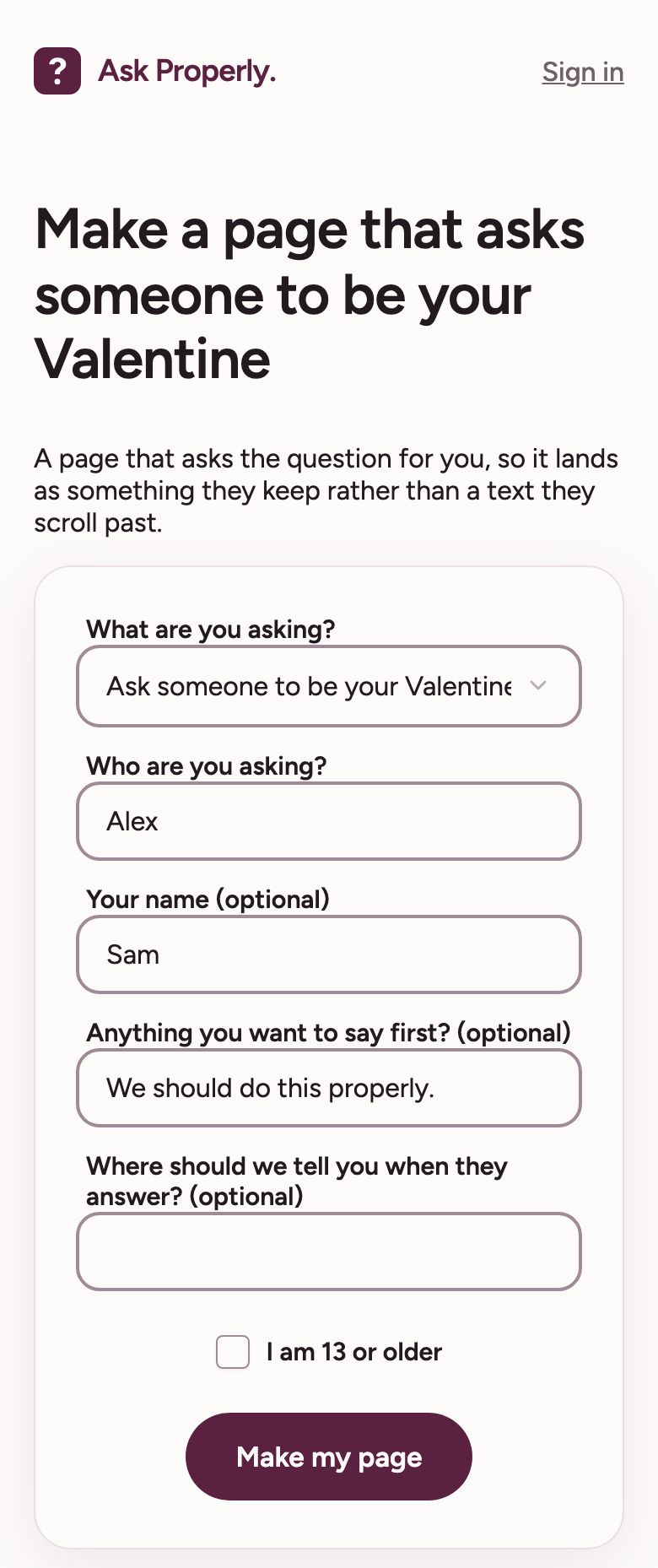
A page is the version that removes the two worst parts for a first-timer: you do not have to get the sentence out while looking at them, and they do not have to compose a reply on the spot. The question arrives on its own, and the answer is a tap. For a lot of people that is the difference between asking and not asking at all, which is the only comparison that matters. The Valentine page below writes the question for you.
Whatever you choose, do not change format halfway. Asking in person and then sending a long clarifying message afterwards undoes the asking.
Wording you can borrow
Two sentences is the target. Here are a few that hold up, depending on how well you already know them.
If you are friends already: "This might change things, and I am asking anyway because I would rather know. Will you be my Valentine?" It says the risk out loud once, which is braver and calmer than pretending there is none.
If you mostly know them from school or work: "We only ever really talk in passing, and I would like to change that. Be my Valentine — coffee on Saturday?" It gives a reason that is about them, and a plan small enough to say yes to.
If you want it light: "Fair warning, I am about to be brave. Will you be my Valentine?" It acknowledges the moment in a few words without turning the message into a story about your nerves.
If you are asking with a page, put one true sentence in the line above the question and let the page do the asking. The question is already written, so your sentence only has to be about them.
Whichever you use, say it the way you would actually say it. Wording that does not sound like you is the one thing they will notice.
The waiting, which nobody warns you about
The gap between sending and hearing back is the hardest part of the whole thing, and it is almost always shorter than it feels.
Assume a reply takes hours, not minutes. People have jobs, school, trains and families. A slow answer is overwhelmingly a logistics fact and not a verdict being composed.
Put the phone somewhere else. Watching for a reply turns twenty minutes into an afternoon, and nothing you do in that window changes the answer.
Do not send a follow-up. Not a "no worries if not", not a joke to defuse it, not a second message of any kind. The silence is uncomfortable for you and perfectly normal for them.
Tell one person what you did, if it helps. Carrying it alone is what turns a few hours into a crisis.
And if the answer comes back while you are asleep or in a lesson, it will still be there. Nothing expires.
Either answer, and what happens next
If it is yes: reply like a person rather than composing something perfect. A fast, warm, ordinary reply is better than a polished one that arrives two hours later and reads as hesitation.
Then make it concrete quickly. A yes is a feeling; a day and a time is an evening. Most first yeses that quietly evaporate do so because nobody turned them into a plan.
If it is no: answer once, briefly, kindly, and stop. "That is completely fine — see you Thursday" is the whole correct response, and it is the thing that preserves the friendship.
Do not ask for a reason, and do not explain why you asked. Both turn a decision into a negotiation and make the next three weeks harder than they need to be.
Expect it to be slightly awkward for a week. That is normal and it passes. What makes it last longer is almost always what happens after the no, which is the part you control.
And for what it is worth: having asked is better than the alternative version of this February, where you did not, and spent it wondering. That is true whichever answer you get.