What to say in a Valentine’s message
Every list of Valentine’s messages has the same problem. The lines are fine, and they are not yours, and the person reading them can tell. A message assembled from a list reads as effort spent in the wrong place — you looked for words instead of finding your own. This is about writing the short thing you actually mean, which is harder than it sounds and much shorter than you think.
The one line that does the work
Almost every good Valentine’s message has exactly one line that matters, and it is the specific one. Not "you mean so much to me" — the thing only you would know to say.
The test is simple: could this sentence be sent to anyone else? If yes, it is filler. "You are amazing" passes to half the people you know. "You are the only person who texts me about the bins" belongs to one person.
Specific does not mean grand. The detail you reach for should be small and true: something they say, a thing they always do, the argument you always have about the same film. Small and true beats large and general every time, because large and general is what a card already says.
Find yours by remembering a particular minute rather than a feeling. Feelings produce adjectives and adjectives are interchangeable. A minute produces a detail, and the detail is the message.
Then write around it as little as possible. One specific line, a sentence either side, and you are done. The specific line is doing all the work and everything you add is dilution.
What to cut
Cut the apology. "Sorry this is cheesy", "sorry for being weird", "ignore me if this is too much" — all of it tells them how to receive the message before they have read it, and it asks them to reassure you about a thing you chose to send.
Cut the hedging. "Kind of", "sort of", "I guess", "maybe". Each one is a small withdrawal of the thing you just said, and together they make a sincere message read as a draft.
Cut the quote. A borrowed line at the top of a personal message is a stranger standing between you.
Cut anything that lists what you have done for them. Gratitude inverted is a bill, and a Valentine’s message is not the place to present one.
Cut the second paragraph, usually. Most Valentine’s messages are twice as long as they should be, and the back half is almost always the writer reassuring themselves rather than saying anything new. Read it back and ask what the last three sentences add. Often it is nothing.
When you are asking, not telling
A message that ends in a question is a different object from one that ends in a statement, and it has one extra job: making the answer easy to give.
Ask one thing. A message that asks whether they will be your Valentine and also what they think about the weekend and also whether they got your last text is a message that gets answered in the wrong order, if at all.
Put the question last, on its own line. Buried in the middle of a paragraph it reads as rhetorical, and they reply to the paragraph instead.
Say what a yes would mean in practice. "Will you be my Valentine" is charming and vague; "be my Valentine — dinner on the Saturday, I will book it" is charming and answerable. Vagueness is only kind when the other person already knows what you mean.
Then give them an exit. One short sentence that makes a no survivable is worth more than three that make a yes sound urgent.
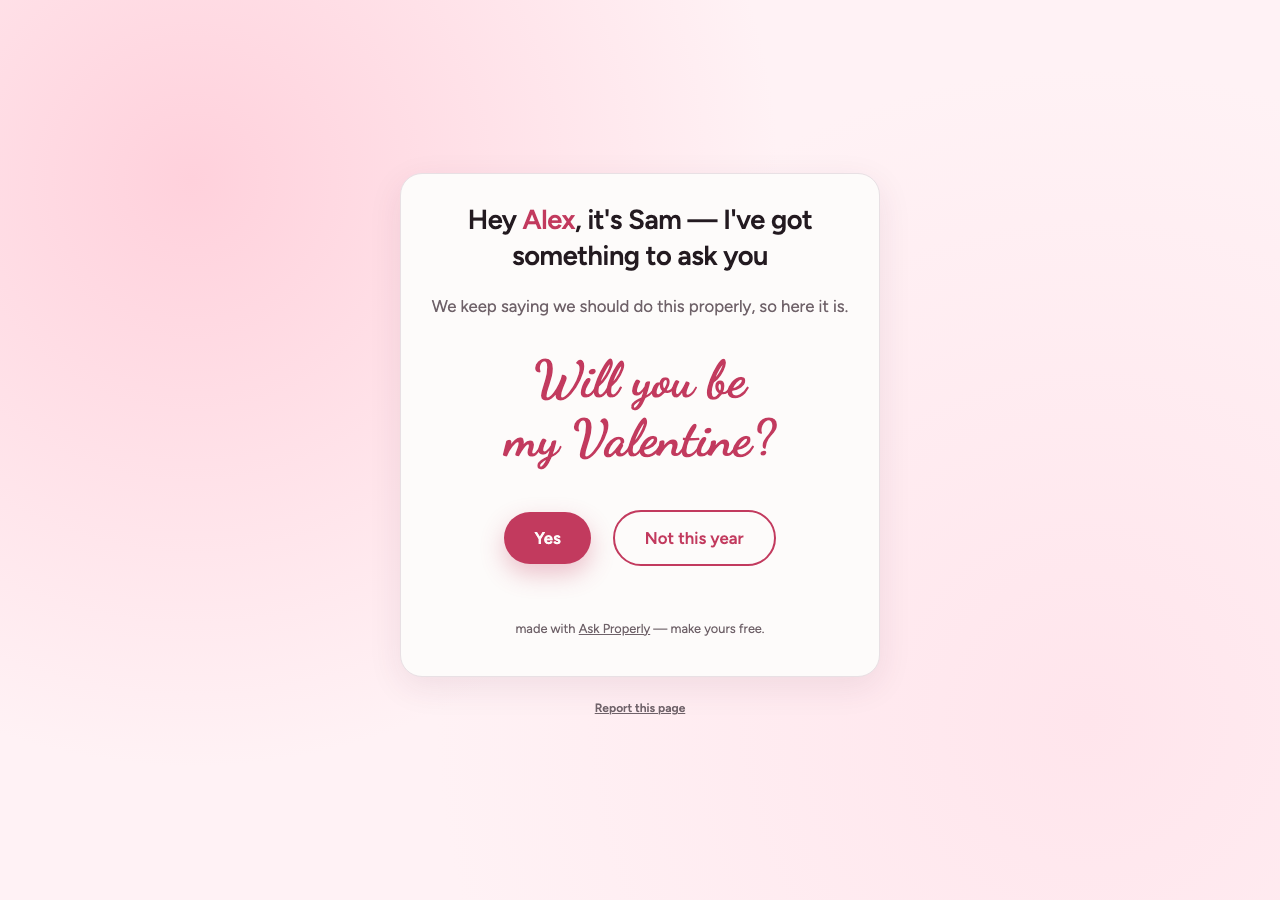
If the question is the whole point, consider not typing it into the thread at all. A page carries the question on its own, with a yes and a no they can tap, and it does not sit in a conversation where every subsequent message looks like chasing. The Valentine page below builds one in about a minute.
Length, and the medium you are using
A text should be three or four lines. The thread is a conversation, and a conversation does not contain an essay without becoming something else.
A card can be longer, but not much. The space on the page is not an instruction to fill it, and a card that runs to the back is usually three sentences of meaning followed by a lot of running out of things to say.
A voice note is the most underrated version and the hardest to get wrong, because your voice carries the things your writing keeps flattening. Record it once and send that take. The second take always sounds like a second take.
If you are writing a line that will sit on a page they open, shorter still. One or two sentences before the question, because the question is what they came for and everything above it is throat-clearing.
Whatever the medium, read it out loud before you send it. The sentences you cannot say without wincing are the ones to cut, and you will not notice them by reading silently.
Examples to adapt, by situation
These are shapes rather than lines to copy. Each one has a gap where your own detail goes, and the message only works once the gap is filled.
Someone you are seeing: "Happy Valentine’s. I still think about [the specific minute]. Dinner on Saturday?" One memory, one plan, nothing else.
Someone you have been with for years: "[The thing they always do] is still my favourite part of most days. Happy Valentine’s." A long relationship does not need a question. It needs proof that you still notice.
Someone you are asking for the first time: "I like talking to you more than almost anyone, and I would like to do it over dinner. Will you be my Valentine?" Then stop. If you want an exit line, "a no is completely fine" is enough.
A friend: "You are the person I call when things go wrong. Happy Valentine’s, in the friend way." Specific, warm, and the label says exactly what it is.
Someone far away: "It is [their time] there, and I wanted this to arrive before you fell asleep. I miss [one specific thing]." Across timezones, when it arrives is part of what it says.
If none of these fit, that is a good sign. It means your situation is particular, and the particular detail is the one to write.
If you genuinely cannot find the words
Say that. "I have rewritten this four times and none of it sounded like me, so: I like you, and I would like to take you out on Saturday." That is a real message and it is better than anything on a list.
Or say the thing you are actually afraid of, which is usually the honest centre of the message you have been avoiding writing. "I have been meaning to say this for a while and kept not doing it" is one line and it does more than a paragraph of adjectives.
And if nothing comes, send less rather than more. A short true message is never the thing that goes wrong on Valentine’s Day. A long performed one occasionally is.