Galentine’s and friend Valentine ideas
Galentine’s started as a joke on a sitcom and became a real fixture, which is the usual route for the better traditions. The thirteenth, or the fourteenth, or whichever evening everyone can actually make — spent with the friends who are the reason the year worked. The ideas are the easy part. The part that quietly decides whether it happens is the invitation, which is where most of these die.
Why most Galentine’s plans die in the group chat
The plan is almost never the problem. The problem is that "shall we do something for Galentine’s?" in a group chat of seven people produces four enthusiastic replies, two silences and no date, and then it is the sixteenth.
Open questions do not survive group chats. "What does everyone fancy?" asks seven people to coordinate, which is seven times the work of one person deciding.
So decide first and invite second. Pick the evening, pick the thing, and send it as a proposal with an answer required. People are far more willing to say yes to a plan than to help build one.
Ask for a yes or a no, not a discussion. The single most useful sentence is "say yes or no by Thursday and I will book it". It feels bossy to write and everyone is relieved to receive it.
And invite individually where it matters. A group message is efficient and easy to ignore; a message addressed to one person gets answered. For the friends you actually want there, send the second one.
What to actually send
Most invitations fail on the wording rather than the plan. The shape that gets answered is the day, the thing, the cost and a deadline for replies, in that order and in about two lines.
"Galentine’s at mine on the thirteenth. I am doing pasta, bring something for afterwards. Yes or no by Monday so I know how much to make." That is the whole message. Everything anyone needs in order to decide is in it, and nothing in it asks them to help plan.
For a group, say who else is coming. People decide partly on the room, and "it is the four of us from last year" answers the question they were going to ask anyway.
For the friend who always says maybe, ask them on their own and leave no room for a maybe. "I would really like you there. Can you do the thirteenth, yes or no?" A direct question to one person is much harder to leave unanswered than a message to seven.
For a friend who lives far away, the invitation is the event. Send it on the night rather than the week before, so it arrives while everyone else is together — a short message, or a page with the question on it that they can answer from wherever they are.
And do not send a poll. Polls feel fair and produce a tie between two dates, one of which three people cannot make. Pick the date yourself. That is the favour you are doing everyone.
Things to actually do
Dinner at someone’s flat, with the cooking split. Cheaper than a restaurant on the one night restaurants are impossible, and nobody is being rushed off a table at nine for the second sitting.
Book the thirteenth instead of the fourteenth. Everywhere is available, nothing is marked up, and the people with partners can still come. This is the single best piece of Galentine’s logistics there is.
Do the thing you all keep saying you should do. The walk, the gallery, the terrible film series. The day is an excuse to finally schedule it, which is most of what these occasions are for.
Make it low-stakes for the people who are having a bad February. Not everyone arrives in a celebratory mood on this particular date, and an evening that requires relentless fun is an evening some people cannot attend.
Keep the gift element small or absent. A Galentine’s that develops a gift expectation becomes a second Christmas, and the people quietly worrying about money will stop coming.
And if someone cannot be there — different city, different timezone, working — send them something that arrives on the night rather than writing them out of it.
Asking one friend properly
There is a smaller version of this day that nobody writes lists about: telling one friend that they are the friend. Not a group, not an event — one person, told plainly.
It is worth doing because friendships rarely get a formal moment. Romantic relationships have anniversaries and milestones; a fifteen-year friendship usually has none, and the fourteenth is the one day of the year when saying something out loud is not strange.
Say the specific thing. "You are a good friend" is a greeting card. "You are the person I call when something goes wrong, and you have never once made that feel like a burden" is a message somebody keeps.
Asking them to do something is a decent format for it. "Be my Valentine, in the entirely platonic sense, dinner on the thirteenth" is funny and real at the same time, which is the right register for a friendship.
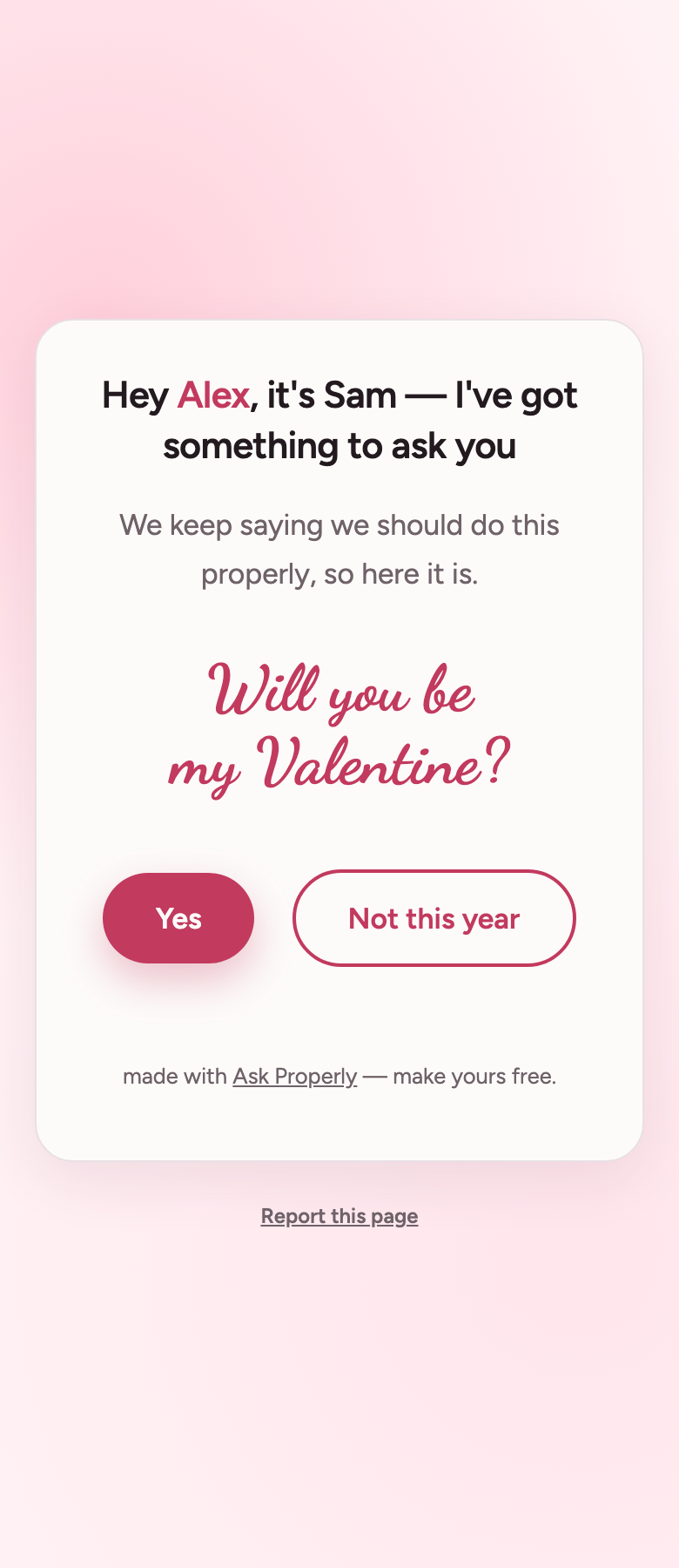
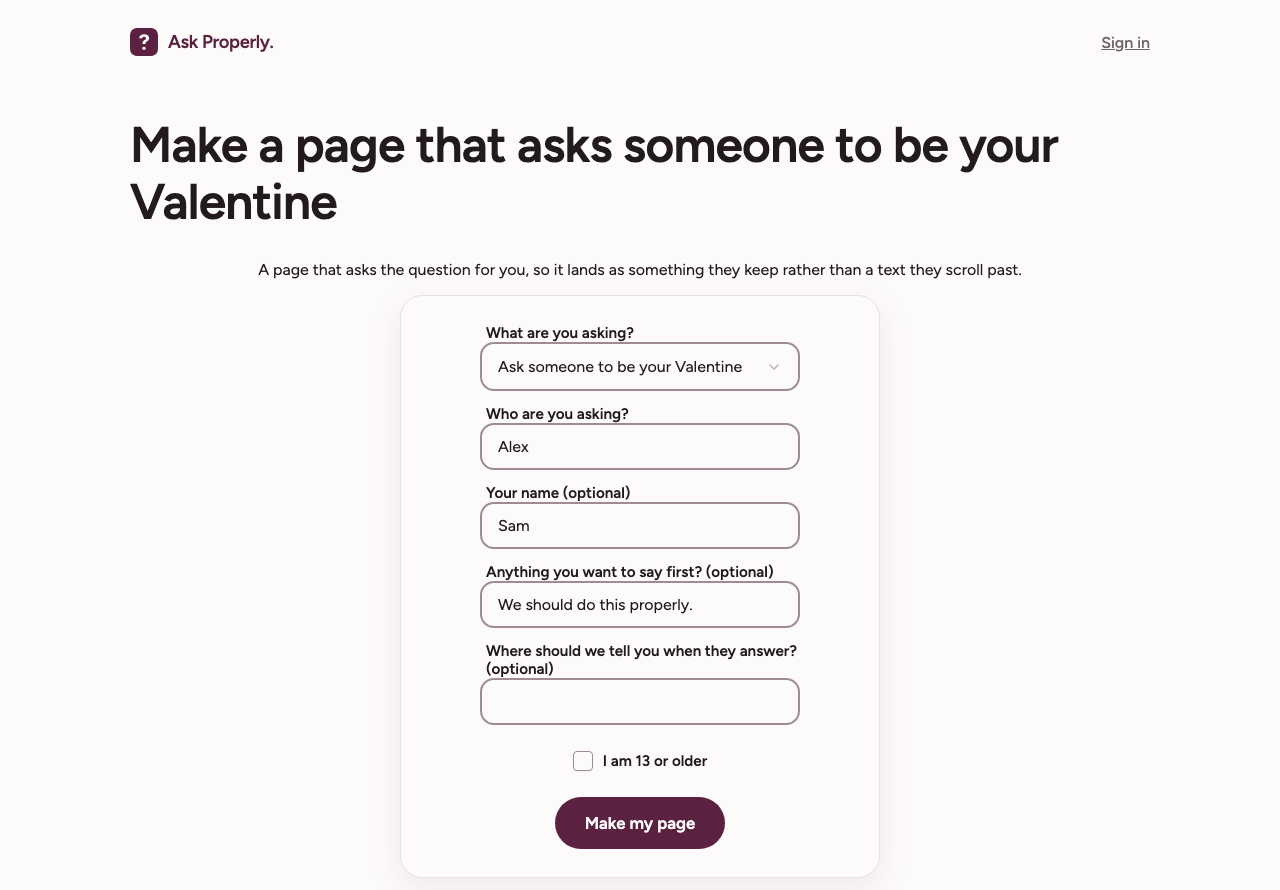
A page works well for this precisely because it is slightly ridiculous. The question arrives looking like the romantic version, which is the joke, and underneath it is a genuine invitation they answer with a tap. The Valentine page below builds one in a minute.
Keeping it kind
Watch who is not in the group. Galentine’s has an edge of exclusion built into the name, and the person left off a list on this particular day notices more than they would in June.
Do not make it a singles table. An evening framed as consolation for not having a partner is an evening that tells everyone what you think the default is. The framing is: these are my friends, and this is an evening with them.
Let people leave early without a negotiation. February evenings, long weeks, and a date that carries weight for some people — a plan that permits an early exit is a plan more people will come to.
Split the money openly, before the night rather than at the end of it. The awkward ten minutes with a calculator and a card machine is the part everyone remembers badly, and it is entirely avoidable by saying what it will cost when you invite people. If someone is quiet about it, let them be quiet about it — a plan with a cheap version built in is a plan everyone can attend.
And follow it up. The thing that makes a tradition is the second year, which means someone has to be the person who says it again next February. Usually that is whoever organised the first one, and usually they are waiting for somebody else to suggest it. Be the one who suggests it.