Long-distance promposal ideas
Every promposal idea assumes you can stand in front of them. Poster board, their locker, a crowd in the cafeteria, a friend filming it from the stairs. Take away the standing in front of them and most of the list stops working, which is why searching for long-distance promposal ideas turns up the same crowded-hallway photographs with nothing changed. The distance changes what the ask has to do and when it has to arrive, so it is worth being clear about what it actually takes away first.
What distance takes away, and what it does not
It takes away the moment. In person you get one shared minute with a beginning and an end. Over distance the ask arrives whenever their phone is in their hand, and whatever you built has to hold its own against whatever else is happening in a room you cannot see.
It takes away the object. Half of the standard promposal is physical: a sign, a box of doughnuts, flowers in a locker. Posting something works and it takes three days, and three days is a long time to wait when someone else might ask them first.
It takes away the witnesses, which is more of a loss than it sounds. A lot of the promposal tradition is the telling afterwards, and over distance nobody at their school saw it happen. Build in something they can show people — a photo, a card, a page they can hold up — or the asking stays entirely private whether they wanted that or not.
It does not take away the thing that matters. A promposal is a question asked on purpose with enough effort behind it that the effort is visible. That survives distance perfectly. It just has to be made of something other than cardboard.
Ideas that survive the distance
Post a real object, and tell them it is coming. A card, a photograph, a small thing they mentioned once. The warning matters: an unannounced parcel gets opened next to the bins on a Tuesday. This works when prom is a month out and not when it is Friday, so count the postal days backwards before you commit to it.
Arrange a call and ask on it. Not a surprise call — an arranged one, which sounds less romantic and is much kinder. They get to be somewhere they can hear you, in a room they chose, reacting how they actually feel rather than how the room expects. Pick the time together. Letting them pick it is already a small kindness.
Use a friend as a proxy. If someone you both know is physically near them, a sign held by a friend is still a sign, and it restores the witnesses the distance removed. Agree the moment in advance with the friend, and tell them not to film it unless they have asked first.
Send a voice note instead of typing. It is the cheapest way to put a person back into the message, and over a long distance a recorded voice does something a paragraph cannot. Record it once. The second take always sounds like a second take.
Make a playlist and let the last track ask. Over distance it does something a parcel cannot: you can both start it at an agreed moment and listen to the same thing at the same time, which is the nearest this gets to being in a room together.
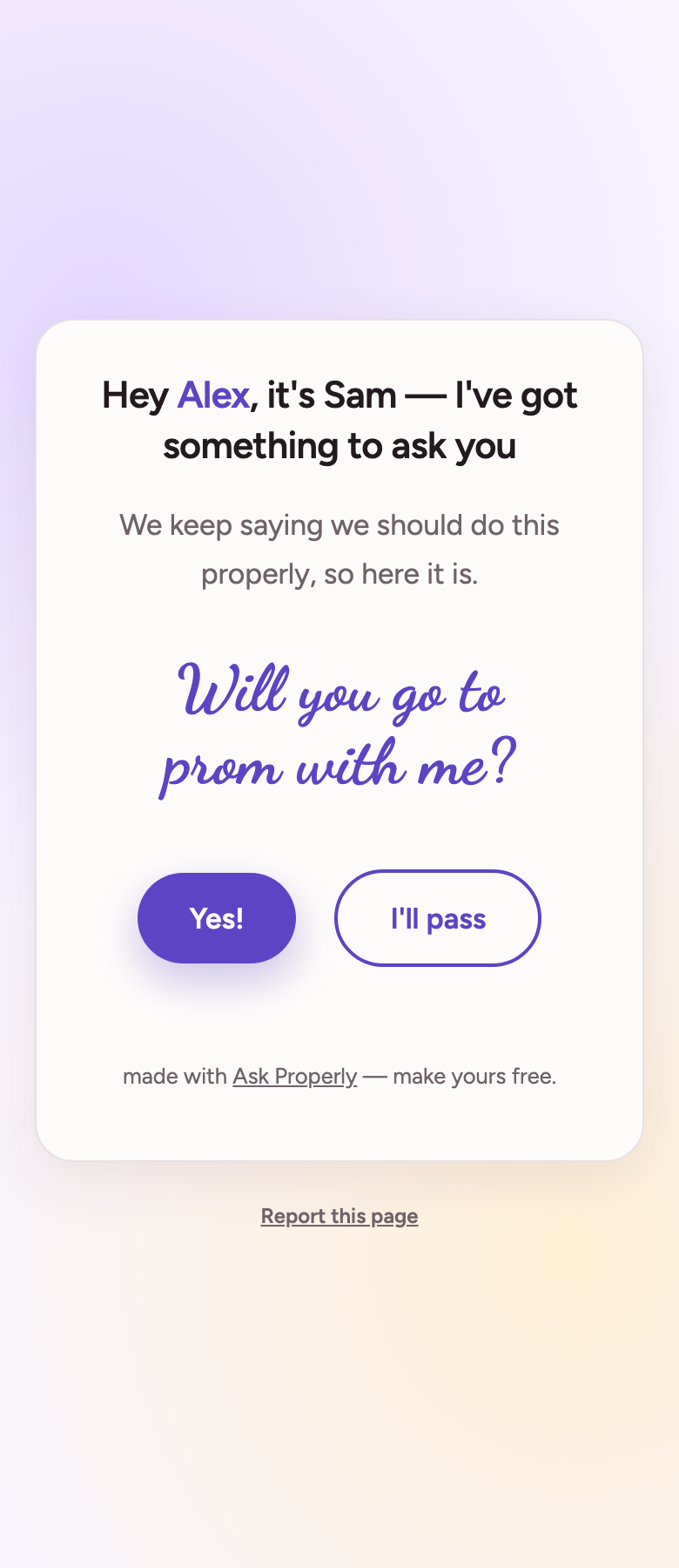
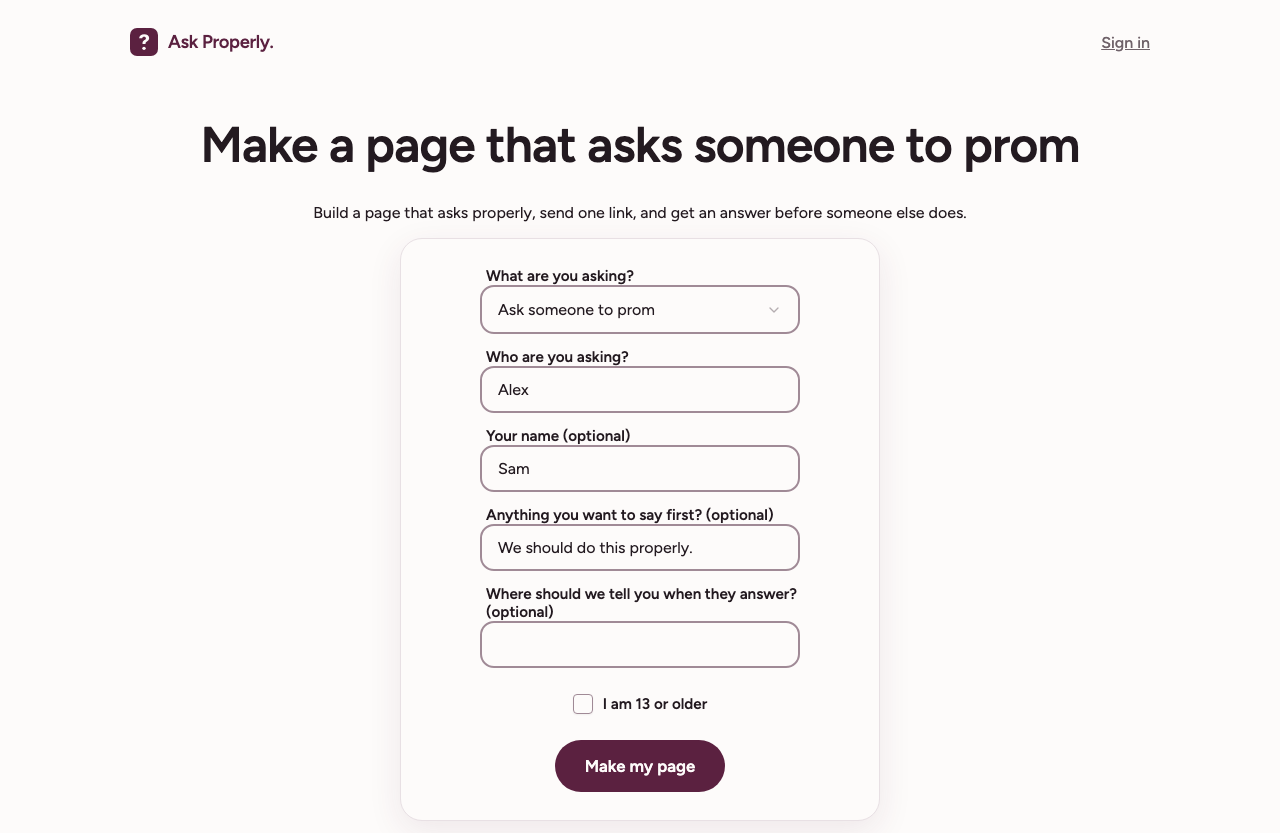
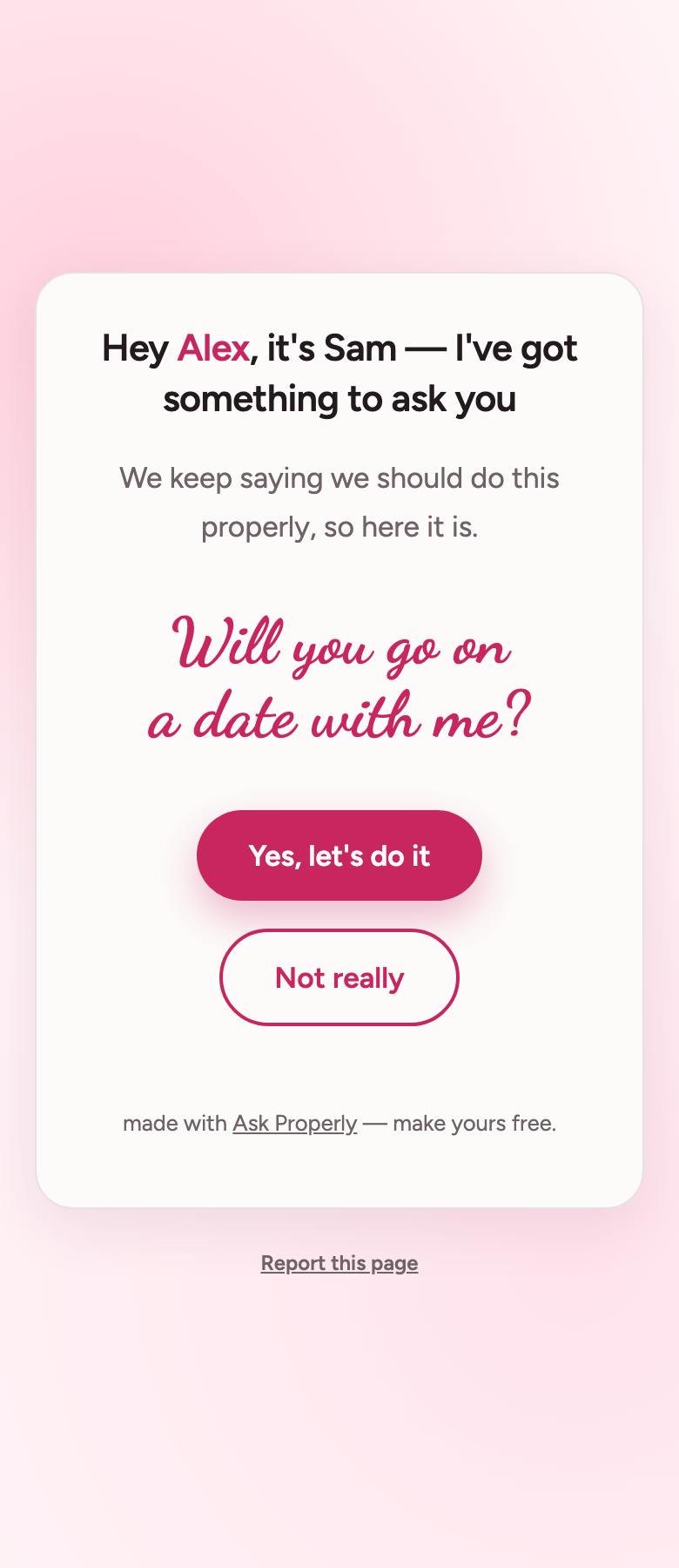
A page, sent as one link. They open it wherever they are, on whatever they have, and the answer comes back as a tap rather than a paragraph they have to compose at midnight. It is the only idea here that works at a week’s notice from another timezone, with nothing in the post and no three-day wait. Choose the promposal occasion on the promposal page, linked at the end of this piece, and the question is already written.
The hour it lands matters more than the wording
Long distance usually means a different hour, and the hour is the part people get wrong. A question that arrives at two in the morning gets read half asleep, if it gets read at all, and then it sits unanswered while you are awake assuming the worst.
Work out the offset before you send, not after. Write down their local time for the moment you intend to send, and sanity-check it against something you know about their day — when their school ends, when they usually go quiet. If those two disagree, trust the one you have observed.
Aim for their early evening. School is done, the phone is in their hand, and there is space to reply properly rather than from under a desk. Avoid their school hours entirely: a question they cannot answer for six hours is a question that sits in their pocket all afternoon.
Watch the day boundary, which is the error that actually bites. If you are far enough apart, your Friday evening is their Saturday morning, and "are you free this weekend" means two different weekends. Name the date, not the day of the week.
Then account for your own hour. There is a specific misery in sending a question and sleeping through the answer, and a worse one in staying awake until four waiting for it. If the reply is going to land while you are asleep, put an email address in when you build the page, so the answer is waiting for you instead of you waiting for it.
And do not ask during their exam week, their tech week, or the three days before anything they have been dreading. Over distance you cannot see any of that on their face, so you have to have asked.
What to say when you cannot be there
Name the distance once, early, and then stop talking about it. "I wish I could ask you in person" is one honest sentence. Repeated, it turns the ask into an apology for the circumstances, and they end up reassuring you instead of answering.
Say why it is them, with something only distance could have taught you. The call you both stayed on too long, the thing you save up to tell them. That line is the whole substance of a long-distance ask, and nothing in the post can replace it.
Then make room for the kind of no that only distance produces. Prom across a few hundred miles is expensive and complicated, and a no may be about trains and money rather than about you — say that in the message, so they can tell you so without it sounding like an excuse they invented.
The logistics are part of the ask
Long-distance prom has a second question hidden inside the first one: can they actually get there. None of that belongs on the page, and all of it belongs in the conversation immediately after, because it is what decides whether the yes survives.
The list is short and nobody enjoys it. Who is travelling, and how. Who is paying for the ticket and the travel. Where the visiting one sleeps, and which adult has agreed to that. Whether their school lets a guest from outside attend at all — many require a form and a name in advance, with a deadline weeks before the night.
Ask early enough to clear that deadline. The guest-form date, not the prom date, is the real one, and it is the thing most long-distance asks discover too late.
There are smaller ones that still matter: the colour, so nothing clashes in the photographs, and what time you would actually arrive after travelling. If one of you is flying or getting a late train, the answer to "what time are you picking me up" is a real answer, not a joke.
Sort all of it within the week. A yes that goes a month with no plan behind it turns quietly into a no that nobody ever had to say out loud.
If it is a no
Distance makes a no feel bigger than it is, because you cannot see their face and you have nothing to do with the next ten minutes. Thank them once, say it is fine, and mean it. Do not send the long follow-up at one in the morning, when the time difference has already done enough damage.
And check which no it was. "I cannot get there" and "I do not want to" are different answers, and over a distance they arrive in the same sentence. The first one is a logistics problem you can solve next year. The second one is an answer, and the kind thing is to hear it the first time.