Making a long-distance ask feel real
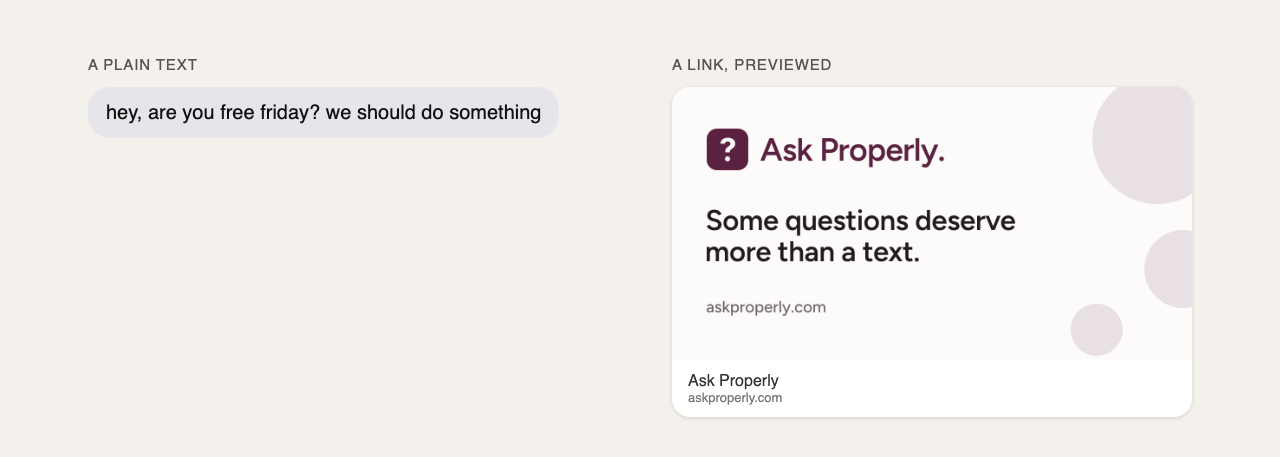
A question asked across a distance has one specific problem, and it is not the wording. In the same room, an ask has edges — a beginning, a held breath, an answer, and the minute afterwards that both of you remember. Sent as a message it has none of those. It arrives between a delivery notification and a group chat, gets read in a queue, and is answered an hour later with the phone in one hand. The task is not to write a better message. It is to put the edges back.
Why a message does not feel like a moment
There is no shared clock. A moment needs both people inside it at the same time, and a text is read whenever the phone is picked up — which is to say, inside their day rather than inside anything you built.
There is nothing to hold. Half of what makes an in-person ask memorable is physical: the sign, the envelope, the thing handed over. A message leaves nothing behind except scrollback.
There is no frame. In a room, everything stops for a second and both people know the next sentence matters. In a thread, your question sits in the same typeface as "can you send me that link", and the format flattens it.
And there is no witnessed afterwards. Part of what fixes a moment in memory is telling someone about it. Over distance nobody saw it, so unless you make something that can be shown, the whole thing stays invisible.
Each of those is fixable, and none of them is fixed by writing more. In fact writing more usually makes it worse, because length reads as nervousness rather than occasion.
Build a shared hour
Arrange the time rather than ambushing them. "Are you free at eight on Thursday, I want to ask you something" sounds less spontaneous and it is dramatically better, because it puts both of you in the same minute on purpose.
Saying you want to ask something is not a spoiler. It is the thing that makes them sit down, put the laptop away and be present, which is exactly the condition a moment requires.
Let them pick the hour. Choosing the time is a small transfer of control, and over distance those are the available kindnesses.
Start something together at the same second — a track, a film, the same episode. It gives you a shared timeline, which is the thing distance deleted.
And protect the minute after. The worst version of a long-distance ask is the one where somebody has to leave for work ninety seconds after answering. Leave room on both sides of the question.
Give them something that stays
Send something that outlives the conversation. A card, a photograph, a small object that means something specific — anything that is still there in a week when the thread has scrolled.
If you are posting, say it is coming. An unannounced parcel gets opened next to the bins on a Tuesday, which is the exact opposite of a moment. "Something is arriving, open it on Saturday" turns a delivery into an event.
Count the postal days backwards and add slack, especially across a border. A gesture that arrives late is a gesture that arrives into a different week than the one it was for.
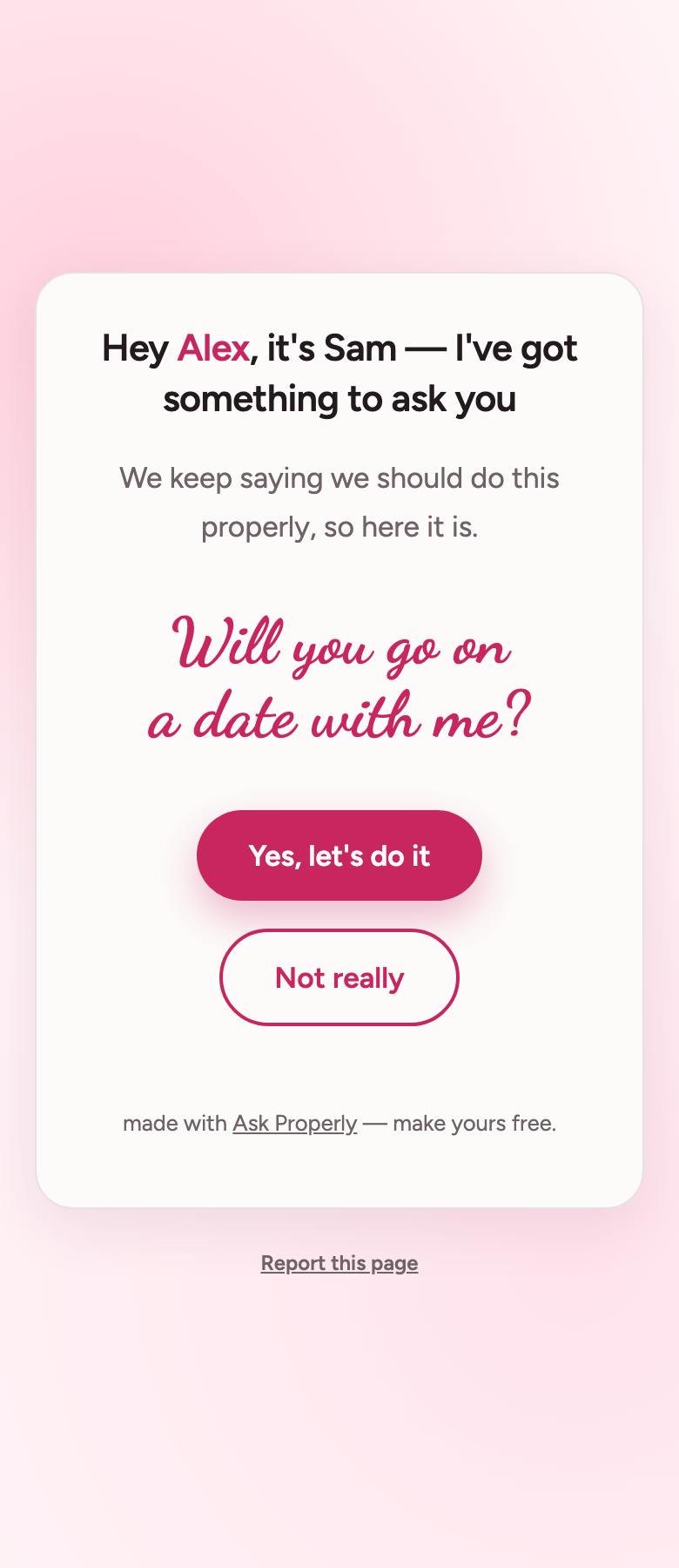
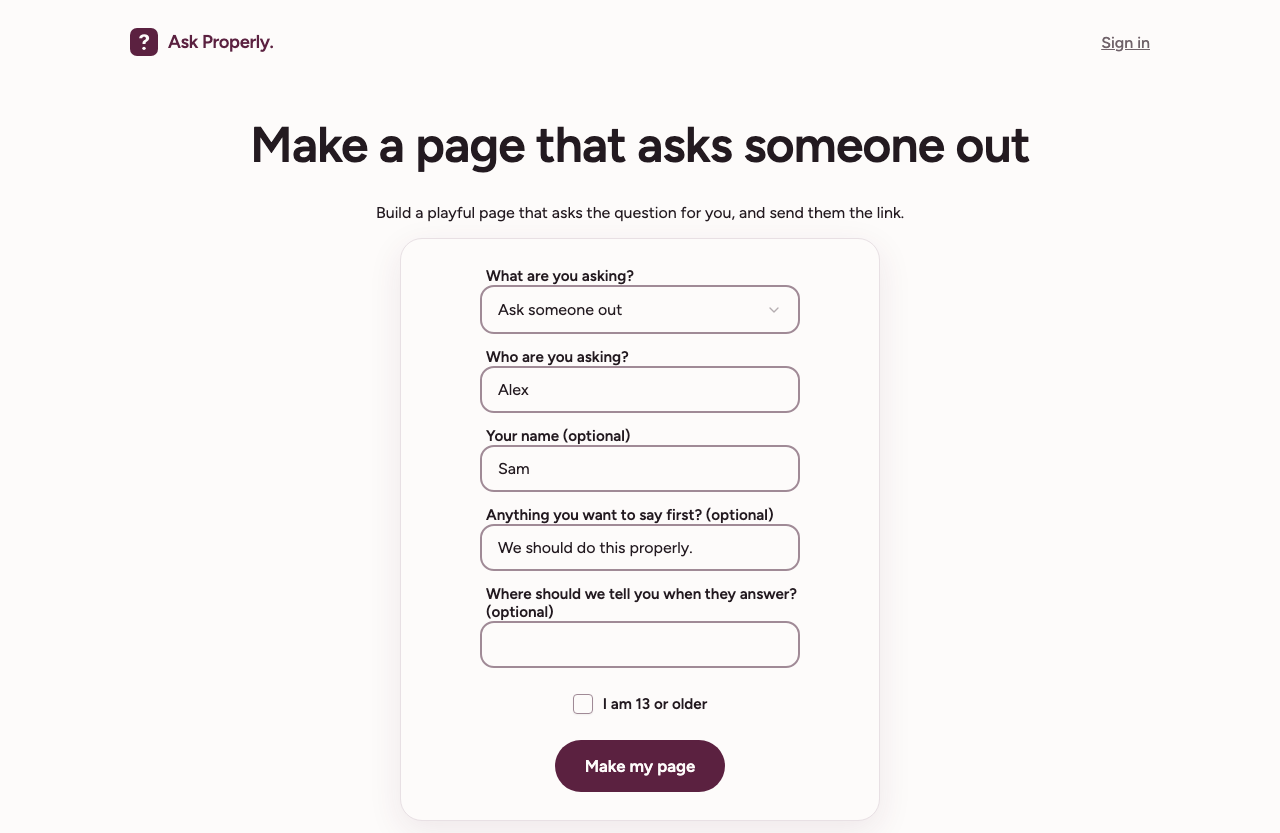
A page is the version that needs no postage and still leaves something behind. The question sits on its own, at its own address, in the occasion’s own colours — not in a thread, not competing with anything — and it is still there afterwards. They open one link, the question is the only thing on the screen, and the answer comes back as a tap rather than a paragraph they have to compose at midnight. Of everything here it is the only option that works at a day’s notice from another timezone.
Give them something they can show someone. Over distance there are no witnesses, so the thing that can be screenshotted and shown to a friend is doing the job the hallway used to.
The arithmetic, which is where most of these go wrong
Write their local time down rather than holding it in your head. Most long-distance mistakes are arithmetic rather than romance, and they are entirely preventable.
Sanity-check it against something you know about their day — when work ends, when they usually go quiet. If the clock and your observation disagree, trust the observation.
Watch the day boundary. Far enough apart, your Friday evening is their Saturday morning, and "this weekend" means two different weekends. Name the date, not the day of the week.
Aim for their early evening. Day finished, phone in hand, room to reply properly rather than from under a desk.
Account for your own hour as well. If the answer will land while you are asleep, arrange it so the answer waits for you instead of you waiting for it. Putting an email address in when you build a page does that — the reply is there in the morning rather than you being awake at four for it.
And do not ask during their exam week, their deadline, or the three days before something they have been dreading. Over distance you cannot read any of that on their face, so you have to have asked first.
Say the thing only distance taught you
Name the distance once, early, and then stop. "I wish I could ask you in person" is one honest sentence. Repeated, it becomes an apology for the circumstances, and they end up comforting you instead of answering.
Then say the specific thing. The call you both stayed on too long. The thing you save up to tell them. The hour you keep free without mentioning it. That line is the entire substance of a long-distance ask, and no object in the post can substitute for it.
Keep it to one line. Over distance the temptation is to compensate with volume, and volume is precisely what makes it read as a letter rather than a question.
Then ask, plainly, and stop writing. The question should be the last thing on the screen, with nothing after it to soften or qualify it. Everything you add below the question is you talking yourself out of having asked.