What to write in a bridesmaid proposal
The card is easy to leave until last. The box, the robe and the thing with her initial on it get the attention, and the sentence is the part she can read again. Left until the night before, it tends to become six identical copies, and six identical copies is precisely the thing a group chat would have done anyway. What follows is how to write one line that is actually about her, and how to do it five more times without it becoming an exercise.
One line, and what it has to do
It has to name why her. Not that she is a good friend, which she knows, but the specific thing: what she did in a bad year, the room you look for her in, the fact that she is the person you tell first. One observed detail beats any amount of warmth.
It has to be short. A card’s worth of writing reads as effort in the wrong direction, so aim for one sentence.
It should sound like you talking. If you would never say “cherished” out loud, it does not belong in a sentence addressed to someone who knows how you speak.
It does not need to mention the wedding at all. The wedding is the occasion, not the subject. The subject is her.
And it should be true of only her. The test is simple: if the line could be moved to another friend’s card without changing a word, it is not finished.
How to write six without writing one six times
Start by writing the names down and, beside each, one memory you did not have to search for. Start with the ones that arrive immediately, even if they are small and slightly odd.
Write all six lines in one sitting, not one per evening. Done together, you can see when two of them have come out the same, which is the failure you are trying to avoid and is invisible from inside a single card.
Vary the register deliberately. Your sister gets a different kind of sentence from the friend you met at work, and if all six sound the same it is because you wrote to the role rather than the person.
Allow one of them to be funny. There may be a friendship where sincerity would read as strange, and forcing it there is worse than a joke that lands.
And do not sign off six times with the same phrase. The closing line is the one people copy and paste without noticing, and it is the clearest tell that a set was mass-produced.
Sample lines, and what they have in common
These are written for this article, not taken from anyone’s proposal. A plain one: “You have been in every important room of my life so far and I am not starting this one without you.” It names a pattern rather than a feeling.
A specific one: “You drove four hours for me on the worst week of my twenties. I would like you next to me on one of the best ones.” The detail does all the work, and nobody else could have written it.
A short one: “It was always going to be you. Will you stand with me?” This suits the friendship where more words would be a performance.
A funny one, where it fits: “I need someone to hold the flowers and tell me the truth about the dress. The job is yours.” It still names a role only she holds.
What they have in common is that none of them is about the wedding and all of them are about something that already happened. A bridesmaid proposal is a description of a friendship with a question on the end, and the description is the part worth writing.
Where the line goes if there is no card
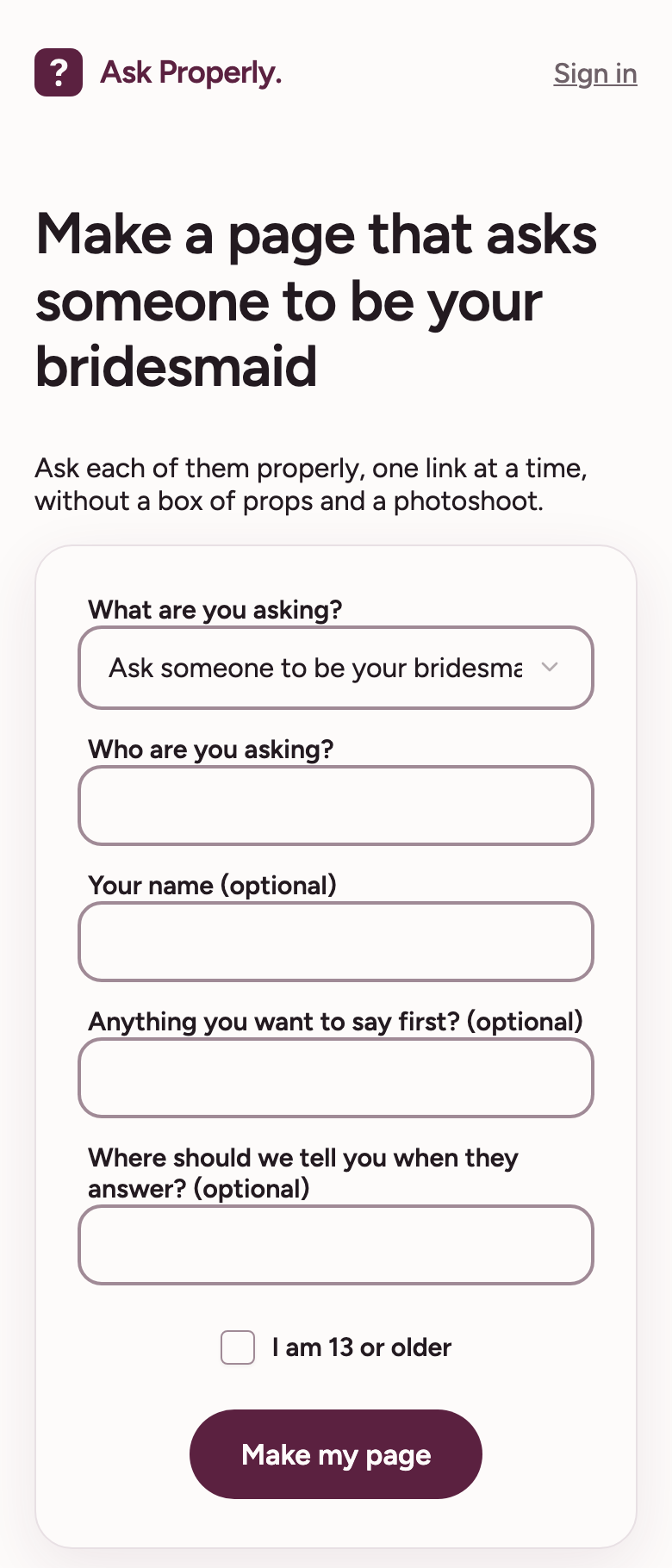
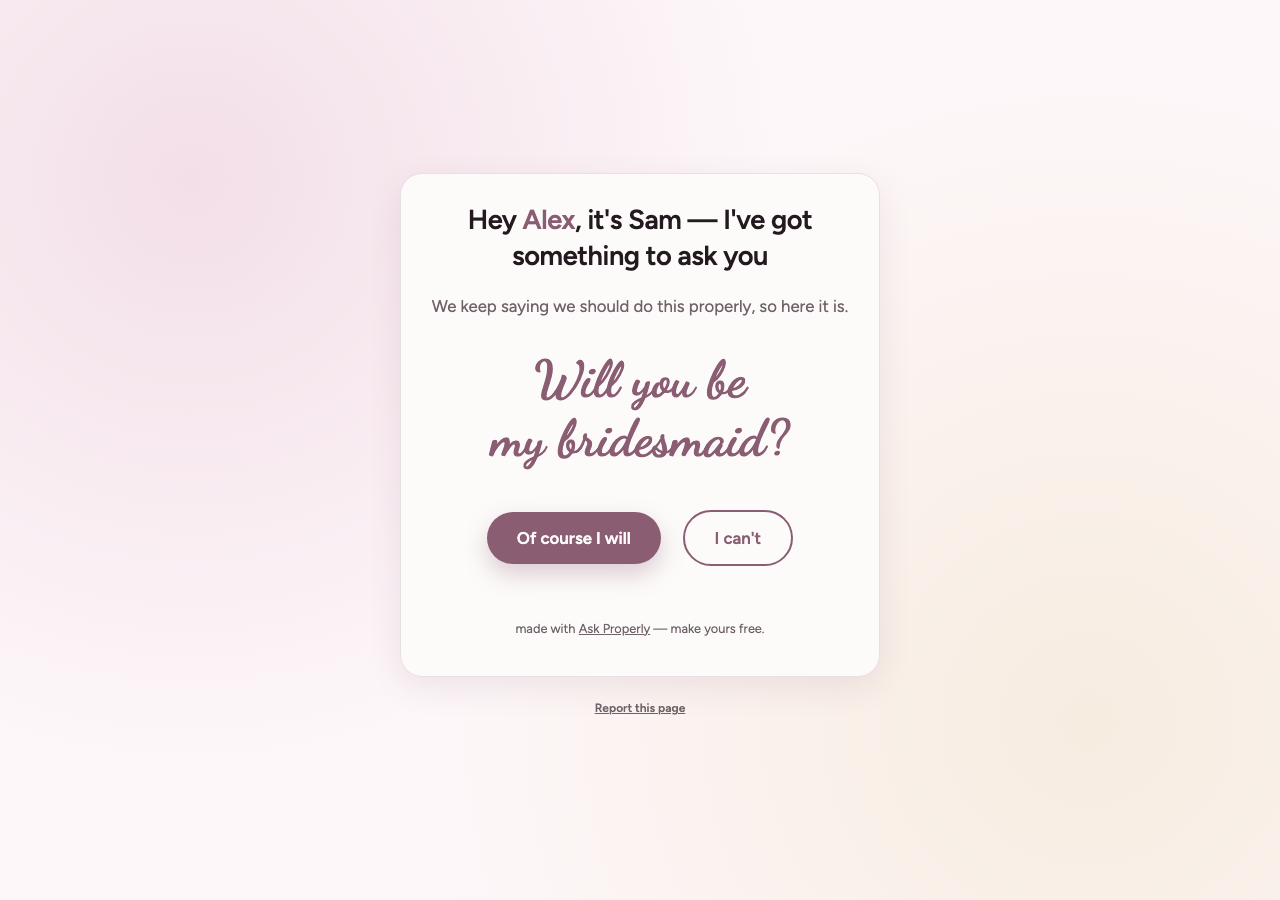
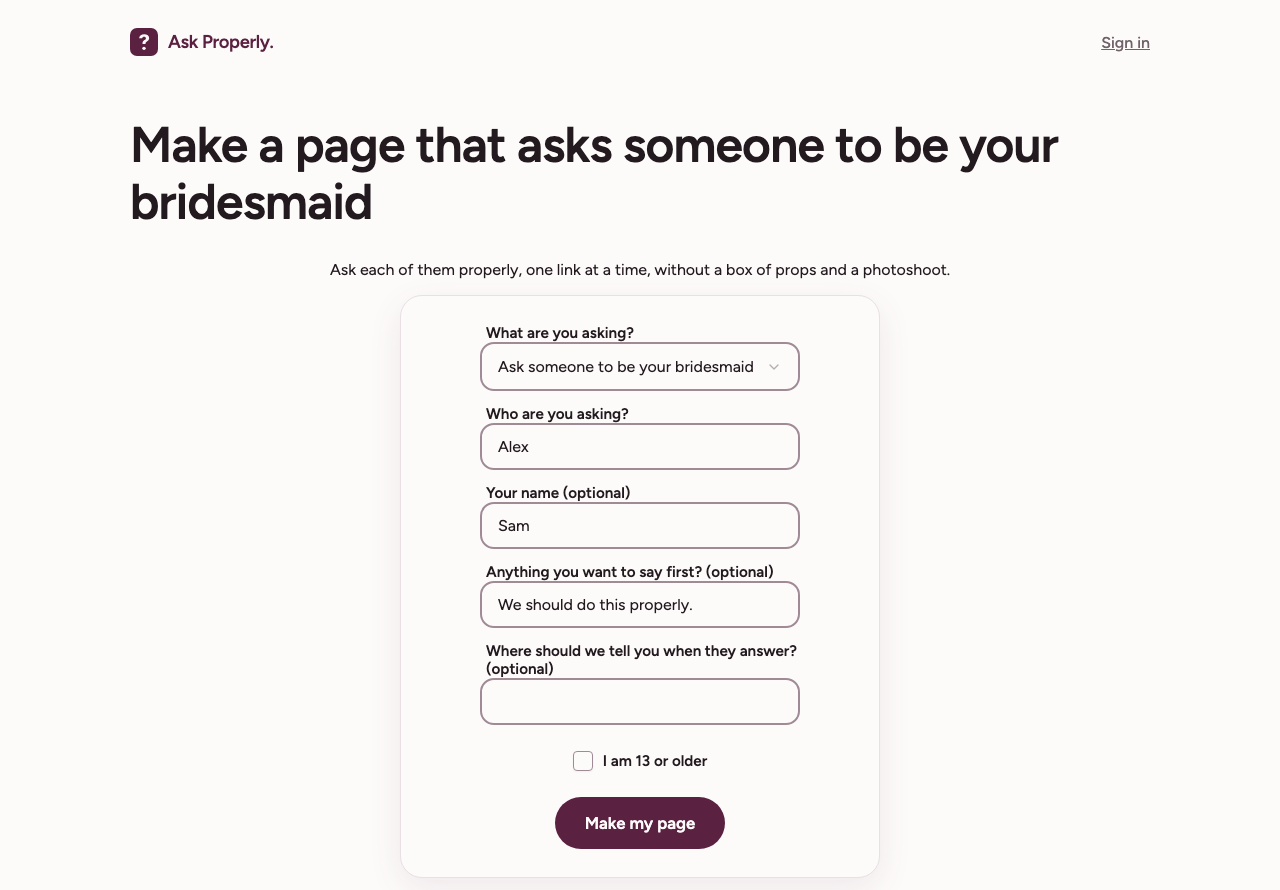
An ask page is a page with one question on it, at its own address. There is a field above the question for the thing you want to say first, which is where this line goes, and then the question with two buttons under it and nothing else on the screen.
Writing it there rather than on a card has one specific advantage: the line reaches her at the same moment as the question. On a card inside a posted box, the words and the asking arrive whenever the parcel does, and often after she has already worked out what is happening.
It is one page per person, so each line stays hers. Nobody reads six variations side by side, which is the thing that makes a set of cards feel like a set of cards.
You can keep the card as well. You can write the long version by hand for the day itself and put the one line on the page that does the asking. The handwriting is a gift; the line is the ask.
And the page holds the words for a while. A card gets kept if she is the sort of person who keeps cards; a free page stays up for 30 days, so she can screenshot it if she wants to keep it.
The maid of honour, and the one who might say no
Write the maid of honour’s separately and ask her separately. If her line reads like the other five with one extra sentence bolted on, the distinction you meant to make has not been made.
Say what you are actually asking of her. Maid of honour means something different in every wedding, and the kindest version of the ask includes a sentence about what you have in mind.
For anyone you think might hesitate, make the no sayable in the line itself. “If the timing is wrong for you, say so and nothing changes between us” is one sentence and it is the sentence that lets someone be honest.
Do not write anything that assumes the answer. “I knew you would say yes” is meant warmly and reads as pressure, particularly to the friend already worrying about the cost.
And write something to the person who says no, afterwards, properly. That may be the hardest card in the set, and how it is written decides whether she comes to the wedding feeling like a guest or like a friend.