Bridesmaid proposal ideas
The phrase has drifted. A bridesmaid proposal now often means a box — a robe, a candle, something with her initial on it, photographed from above on a white blanket. That is a gift, and gifts are good. It is not the asking. The asking is the part where one person finds out that you want her standing next to you, and it can end up in a group chat with five other people in it, because the boxes are slow to arrive and the news cannot wait. Separating the two solves most of this. The question can happen properly today. The box can happen whenever the box happens.
The group chat is the one place not to do it
Asked in a group, nobody gets asked. Each person reads the message already knowing that five others are reading it, so the reply she writes is partly for them. That is a performance, not an answer.
It also removes the ability to say no. Declining in front of an audience is close to impossible, which means a group ask does not actually tell you who is in — it tells you who felt able to say so publicly.
And it flattens the order. There may be someone you asked first in your head, and a group message erases that completely. She finds out at the same second as everyone else, in the same sentence.
The fix is not elaborate. Ask each person separately, on her own, in whatever order you meant. Six separate asks take an evening and are the difference between being included and being cc’d.
Keep the group chat for afterwards. It is genuinely good for the part that comes next — dates, dresses, who knows whom — and it works far better once everyone in it has already said yes.
What the box is actually for
The box is a gift and a thank-you, and it is lovely. It is also a thing you give to someone who has already agreed, which is why it does not have to arrive before you ask.
Treated as the ask itself, it causes two problems. It sets the date of the asking to whenever the slowest parcel arrives, and it means the question reaches her inside a cardboard box, which is a strange medium for a question.
There is a cost argument too, and it is worth stating once plainly: a made-up box is bought once per person, so the cost multiplies by everyone you ask. That is a real line in a budget, and for some people it is the line that quietly decides how many bridesmaids there are.
None of that is an argument against boxes. It is an argument against letting the box be the question, because then the question has a price and a lead time, and the question should have neither.
If you want both, the order that works is ask, then give. She says yes this week, the box arrives when it arrives, and it lands as a present rather than as a delivery she has to decode.
Ideas that ask one person at a time
Ask her in the room, if she is in the room. The oldest version is still the best one and it costs nothing. The only reason it gets skipped is that people wait until they have something to hand over.
Give her the thing you would have put in the box, and ask while she is holding it. A single object — not a hamper — works perfectly, and it means the gift and the question happen in the same minute without the question waiting three weeks.
Ask her somewhere that belongs to the two of you. The pub you always go to, her kitchen, the walk you do. Shared history is the thing a bought box is trying to imitate, and you already have it.
Write it. A letter or a card she can keep is more durable than anything said out loud, and it suits the friend who would rather read something than be looked at while she decides.
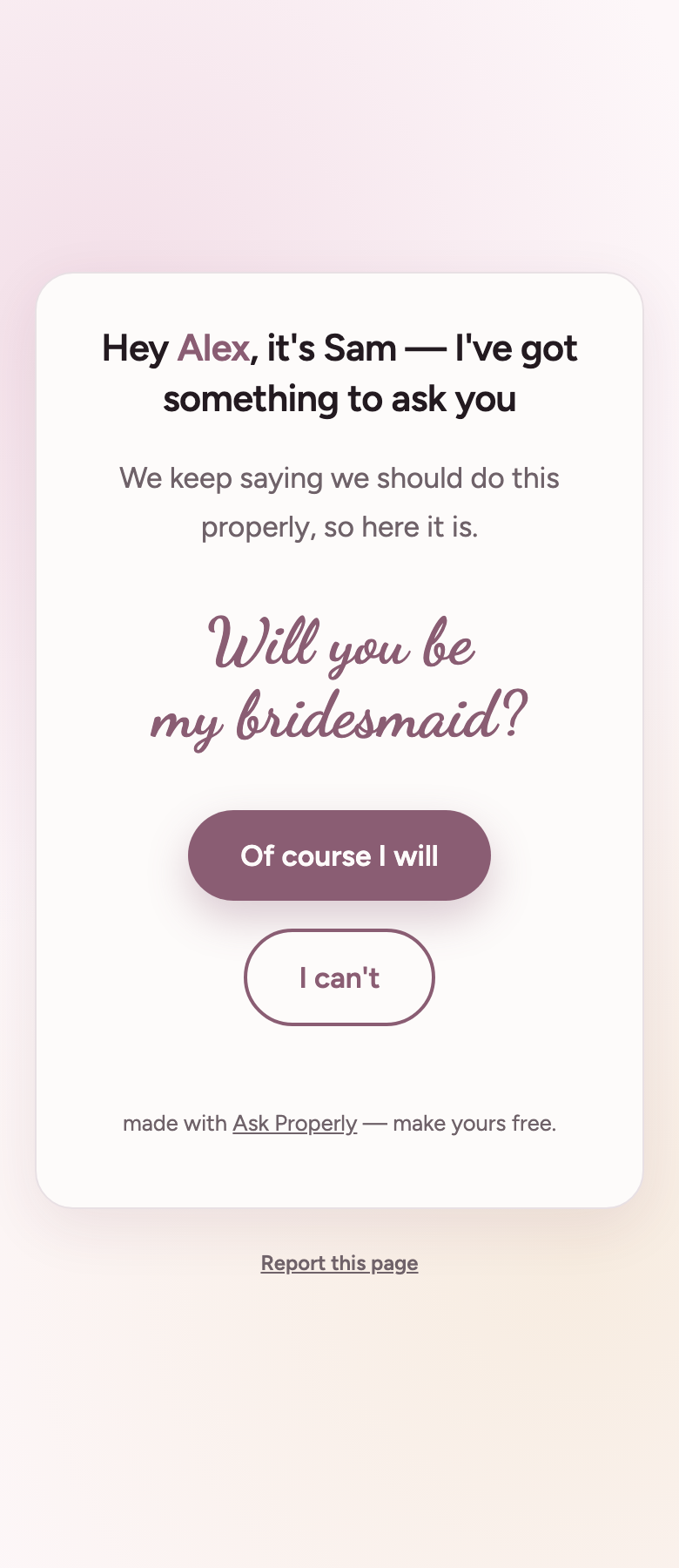
Send her a page with the question on it. One link, one question, and she answers with a tap. It is the version that works when she is three hours away, when you are asking six people in one evening, or when you want her to have a second before she answers.
And ask the person you most want first, on her own, before anybody else knows. The order can matter to people, even if they never say so.
One link each, and one answer each
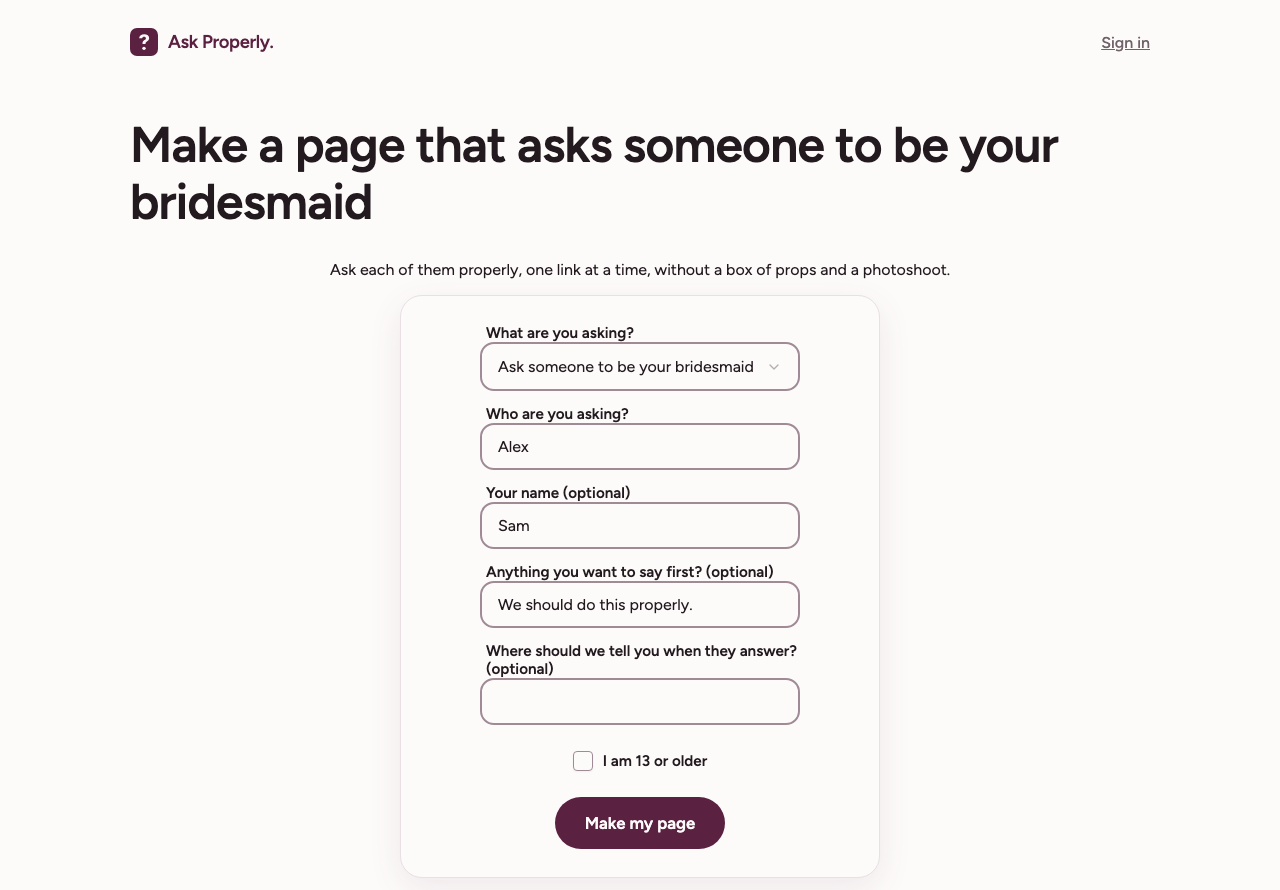
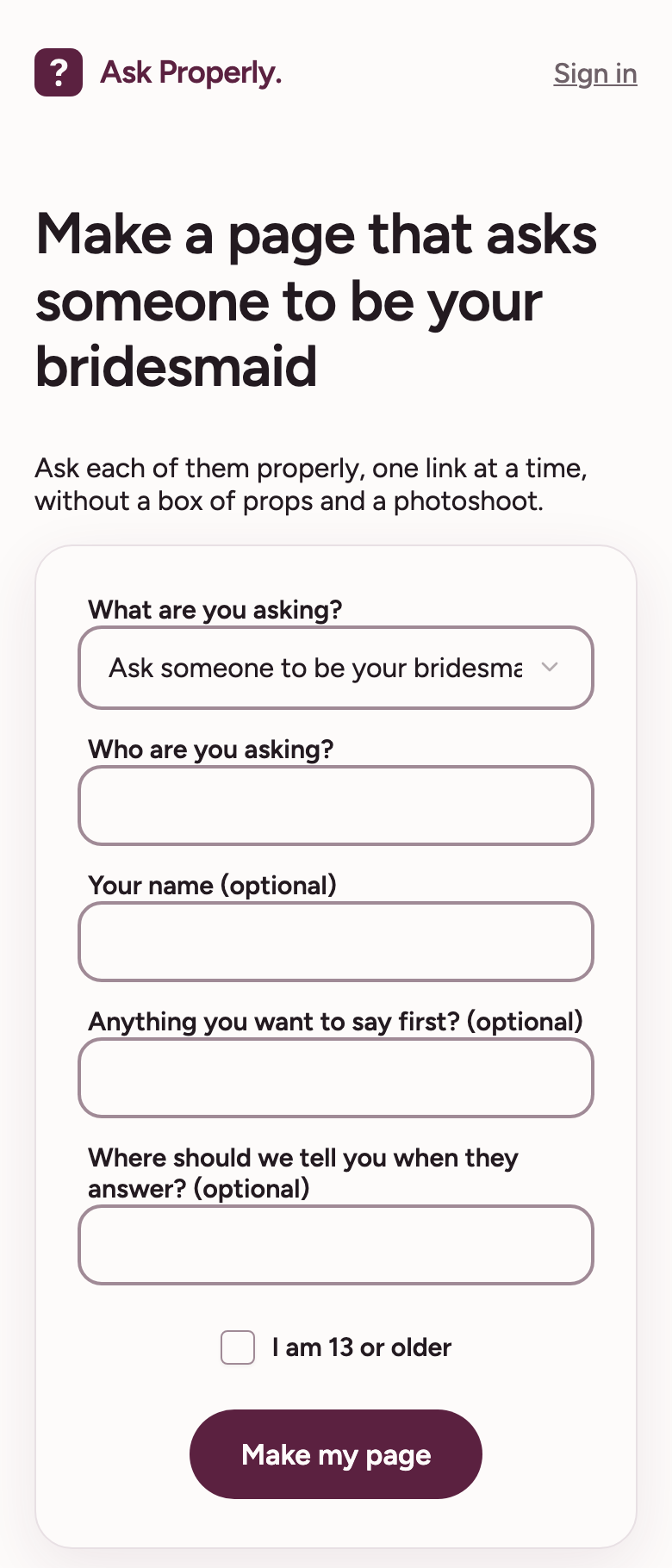
An ask page is a page with one question on it, at its own address, in nothing but the occasion’s colours. You make it in about two minutes, you send her the link, and what she sees is the question and two buttons with nothing else on the screen.
It is one page per person, deliberately. Each page asks one person and takes one answer, so everyone gets her own link and her own moment, and nobody is reading over anybody else’s shoulder. Six bridesmaids is six pages, at about two minutes each.
You can say something different to each of them in the line above the question, which is the part the group chat makes impossible. What you would say to your sister is not what you would say to the friend you met at work, and both of them know it.
Her answer comes back to you and to nobody else. That matters most for anyone who has to say no because of money or a due date or a job.
There is nothing to post and nothing to print, so the asking is ready the evening you decide to do it rather than three weeks later.
What to do once they have said yes
Tell them what they are agreeing to, soon and in writing. Rough date, rough location, whether there is a hen weekend, and the honest cost of the dress if you know it. Someone can say yes to the friendship and only find out the price in month four, and that is a hard way to find out.
Say out loud that money is allowed to be a reason. A friend who cannot afford a destination weekend may say nothing and quietly dread it. Naming it first makes the no sayable.
Do not announce the full line-up until everyone has answered. Someone may need a day, and a public list makes a private hesitation into an awkward absence.
Give the maid of honour her own conversation. Asking her in the same breath as the others makes that particular ask smaller.
And thank the one who says no properly. A friend who declines being a bridesmaid is still a friend coming to your wedding, and how that first week goes decides which of those two facts everyone remembers.