Long-distance bridesmaid proposal
The friend who lives furthest away is often the one you most want standing next to you, and she is the one the usual approach serves worst. A posted box arrives on a Tuesday next to the bins, gets opened alone, and asks a question nobody is there to hear the answer to. Meanwhile the friends who live nearby were asked over coffee. She can count, and she will. Distance does not have to mean a lesser version of the ask — but it does mean the thing you post and the thing you ask have to be separated, because only one of them can travel at the speed of the decision.
Why the posted box lands badly
It can arrive at the wrong moment. There is no way to control what she is in the middle of when a parcel turns up, and the question inside it does not wait for a good hour.
She opens it alone, which is the opposite of the intention. The whole appeal of a box is the face someone makes, and over distance nobody is there to see it, including you.
Across a border it may not arrive at all, or it arrives with a customs charge, which is a genuinely awful way for an invitation to land. Anything with a declared value is a risk, and the more thoughtful the box, the higher the value.
And it fixes the date of the asking to the speed of a courier. If you decide on a Sunday that you want her, she finds out eleven days later, and by then two local friends already know.
If you do send something, say it is coming. “Something is arriving this week, open it when you have a minute to yourself” turns a delivery into an event, and it costs one message.
Ask at the speed of the decision, post at the speed of the post
Separate the two completely. The question goes now, by whatever means reaches her today. The gift goes whenever it goes, and it arrives as a present to someone who already said yes.
This also fixes the order problem. The friend three time zones away can be the first person you ask rather than the last person to find out, and that may be what you actually meant.
Do not wait until you have something to hand over. Waiting for the object is an easy way to ask a distant friend late, and being asked late can feel like being an afterthought.
Count the postal days backwards and add slack, especially across a border. A gesture that arrives late arrives into a different week from the one it was meant for.
And if the parcel is going to be slow, tell her that too. Knowing a thing is on its way is most of the pleasure of it arriving.
The timing, which is where these go wrong
Write her local time down rather than holding it in your head. It is an easy mistake to make, and an easy one to prevent.
Watch the day boundary. Far enough apart, your Friday evening is her Saturday morning, and “this weekend” means two different weekends. Name the date, not the day.
Aim for her early evening — day finished, phone in hand, room to react properly rather than from under a desk.
Check the clock change. The two countries may not move their clocks on the same weekend, and when they do not, the usual difference is wrong by an hour for a while.
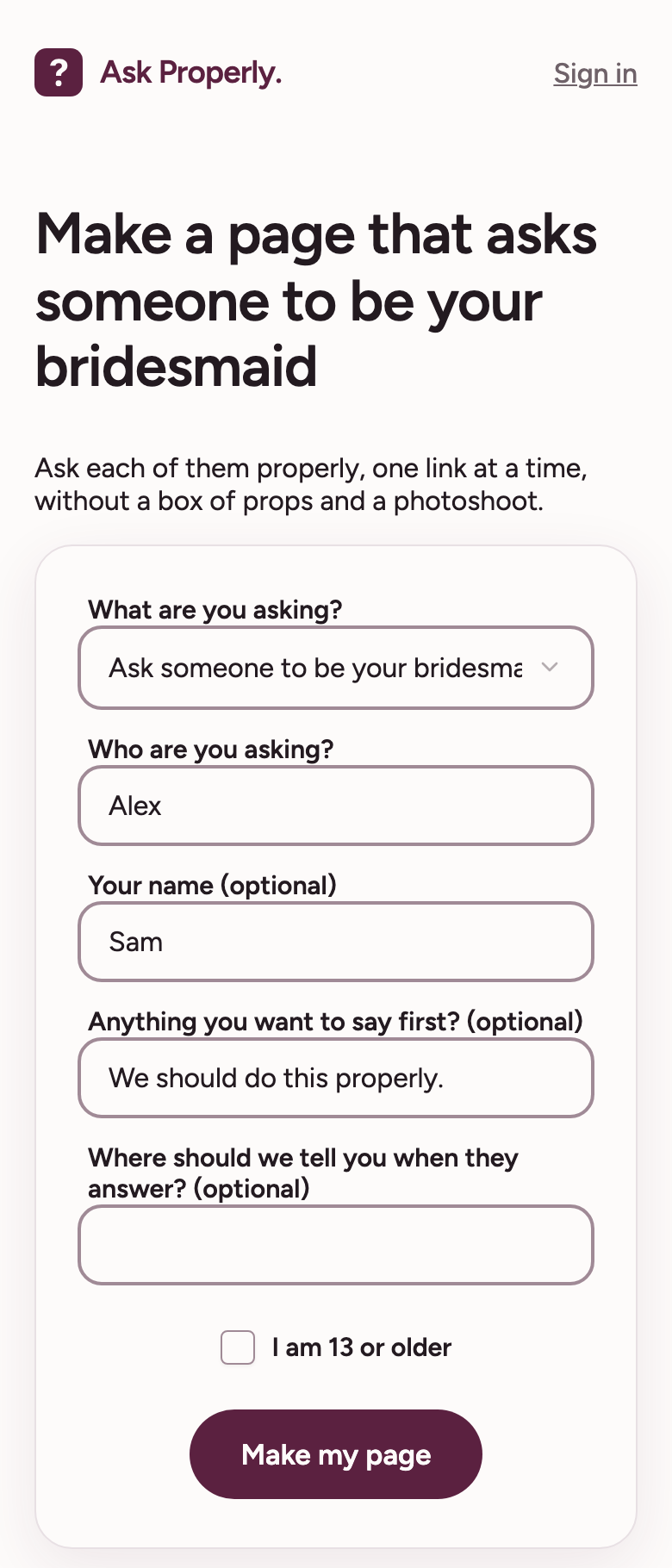
And account for your own hour. If you ask at a time when her reply lands at four in the morning for you, you will be awake for it badly. Leaving an email address when you build the page means the answer waits for you instead.
Send her a page rather than a message
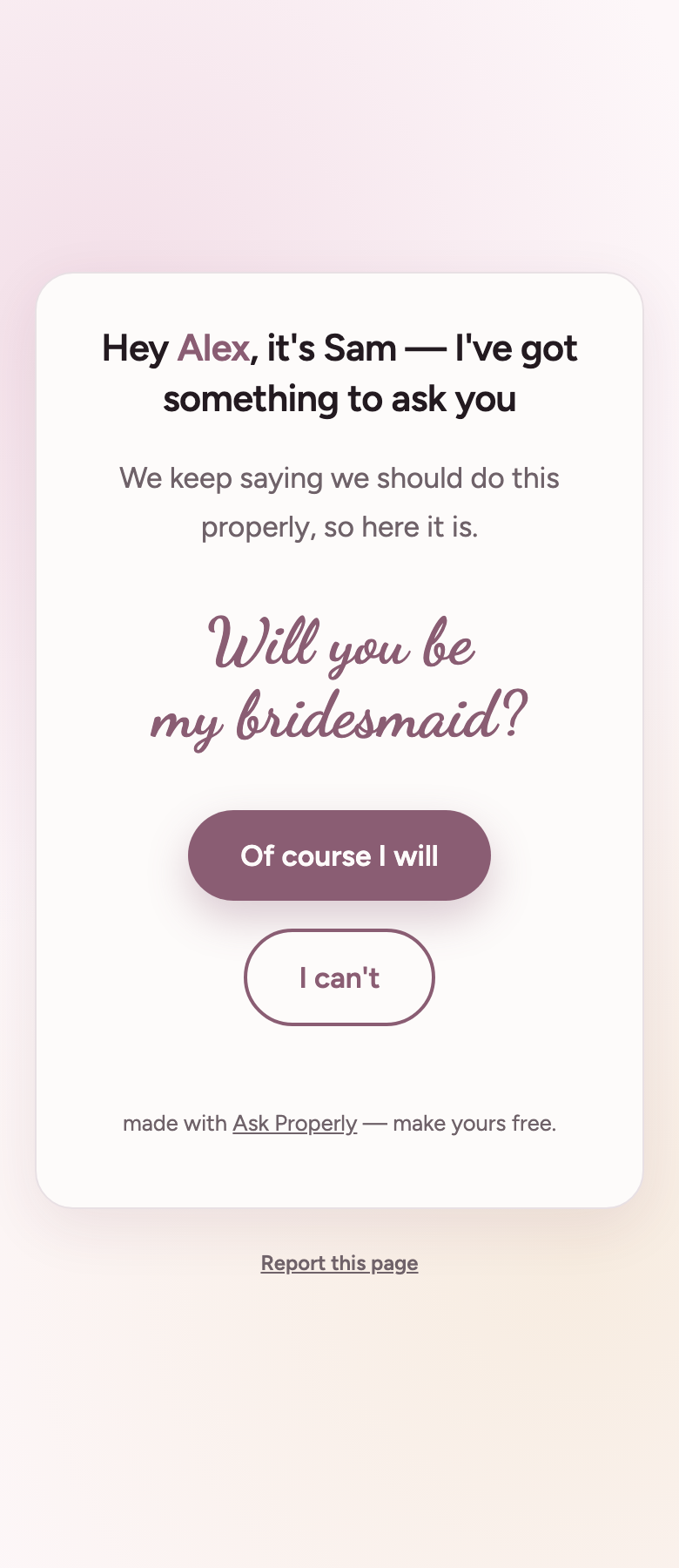
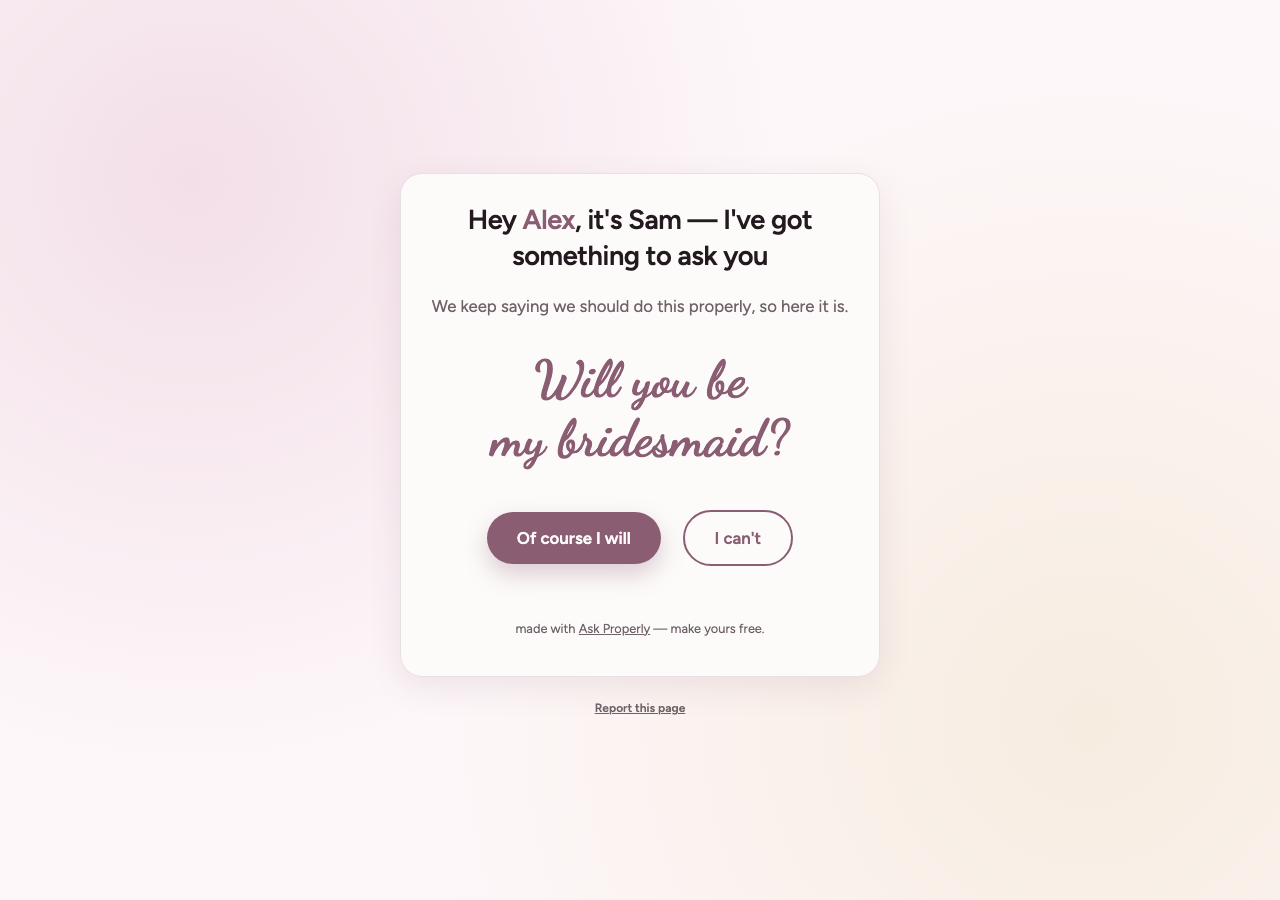
An ask page is a page with one question on it, at its own address, in nothing but the occasion’s colours. You make it in about two minutes and send one link. What she sees is the question and two buttons, and nothing else.
Over distance that frame is doing the job the coffee would have done. A message arrives between a delivery notification and a work thread, in the same typeface as everything else, and the format flattens it. A page is only this.
It leaves her something that stays, which is the thing distance otherwise removes. There is no photograph of being asked from three time zones away, and no object until the post arrives. The page is still there the next morning and it is hers to show whoever she likes.
Her answer is a tap rather than a paragraph she has to compose at midnight, and it comes back to you and to nobody else. That matters particularly here, because the friend who has to decline over cost or flights is the one who most needs to be able to say so privately.
And you can put a different line above the question for her than for anyone else — the thing that is true about the two of you specifically, which is exactly what a bought box cannot carry.
Tell her the cost before she answers, not after
For a bridesmaid who lives far away, saying yes means flights, time off, and probably two trips rather than one. That is a materially different ask from the one you are making of the friend down the road, and pretending otherwise helps nobody.
Put rough numbers in the first conversation. Approximate date, approximate location, whether there is a hen weekend and roughly where. She cannot answer honestly without them.
Say plainly that money and distance are allowed to be reasons. A friend who cannot afford two long-haul trips may say nothing and spend a year dreading it, and you can prevent that by naming it first.
Offer the smaller version out loud. A distant friend may want to be in the wedding and not be able to make the hen weekend, and saying that is fine in advance can make a yes possible.
And let her take a few days. Someone deciding whether to fly twice needs to look at dates and at her own calendar, and a pause is not a soft no — over distance it is simply what the question costs to answer.