What to say when you propose
It is easy to plan the location and improvise the words, which is backwards. The sentence is what gets repeated, at dinners and at the wedding and to people who were not there, and it is the one part of the evening that is entirely yours to decide in advance. The good news is that it is short. A proposal needs about three sentences, and the usual temptation is to make it longer than that. What follows is what those sentences are for, how to find your own, and the one thing most advice refuses to cover, which is what you say if the answer does not come back as an immediate yes.
Three sentences, and what each one does
The first says why now. Not why them — why this evening, this year, this point. “I have known for a while and I did not want to wait any longer” is a complete version of it. This sentence exists to explain the occasion, because without it they spend the next ten seconds working out whether this is really happening.
The second says the specific thing. Not that you love them, which they know, but the particular observed fact that only you could say: what you think about on the way home, the thing you save up to tell them, the version of yourself you are around them. This is the only sentence nobody else could have written, and it is the one that gets repeated.
The third is the question. Plainly, in the ordinary words, with nothing after it. “Will you marry me” is four words, and they need no improvement.
Then stop. Everything added below the question is you talking yourself out of having asked, and the silence you are trying to fill is the silence of someone deciding how to answer.
If you are kneeling, kneel on the third sentence rather than the first. Kneeling early turns the first two sentences into a speech delivered from the floor, and they will not hear a word of them.
Why the long version works against you
Length reads as nervousness, not as depth. A four-minute speech tells the person listening that you are frightened, which makes them frightened, which is not the state you want anyone in.
A long proposal also asks them to wait. Every sentence before the question is a sentence during which they already know what is coming and cannot respond to it. That is a strange and slightly cruel thing to extend.
You may not remember it anyway. Nerves are not kind to a page of notes, and the part most at risk is the end. Write the ending.
The specific beats the beautiful, every time. “You make the ordinary parts of the week worth having” is better than anything about forever, because it describes something true that happened rather than something promised that has not.
And avoid the inherited phrases, the ones you have read on greetings cards. They are not wrong so much as borrowed, and a borrowed sentence is the one place in a proposal where the person listening can hear that you are performing.
Finding your own second sentence
Answer this on paper: what is the thing you noticed about them in the first month that you still notice. That is often the sentence, almost verbatim, and it may be something small.
Or answer this one: what do you do differently because of them. Not grandly — what you cook, what you read, how you handle a bad week. Changes are evidence, and evidence is more convincing than adjectives.
Say it out loud before the day, to nobody. The sentence that reads well and says badly is a real category, and you only find out by hearing it in your own voice.
Cut every clause that could apply to someone else. If the sentence would be true of your last relationship, it is not the sentence.
And keep the draft. Whatever you actually say on the night, the written version is worth having afterwards — for the wedding, or for a card a decade later — and it cannot be reconstructed from memory.
Saying it on a page, if your voice will not hold
Some people know their voice will go. That is not a failure of nerve; it is a thing that happens to specific people in specific moments, and planning around it is more sensible than hoping.
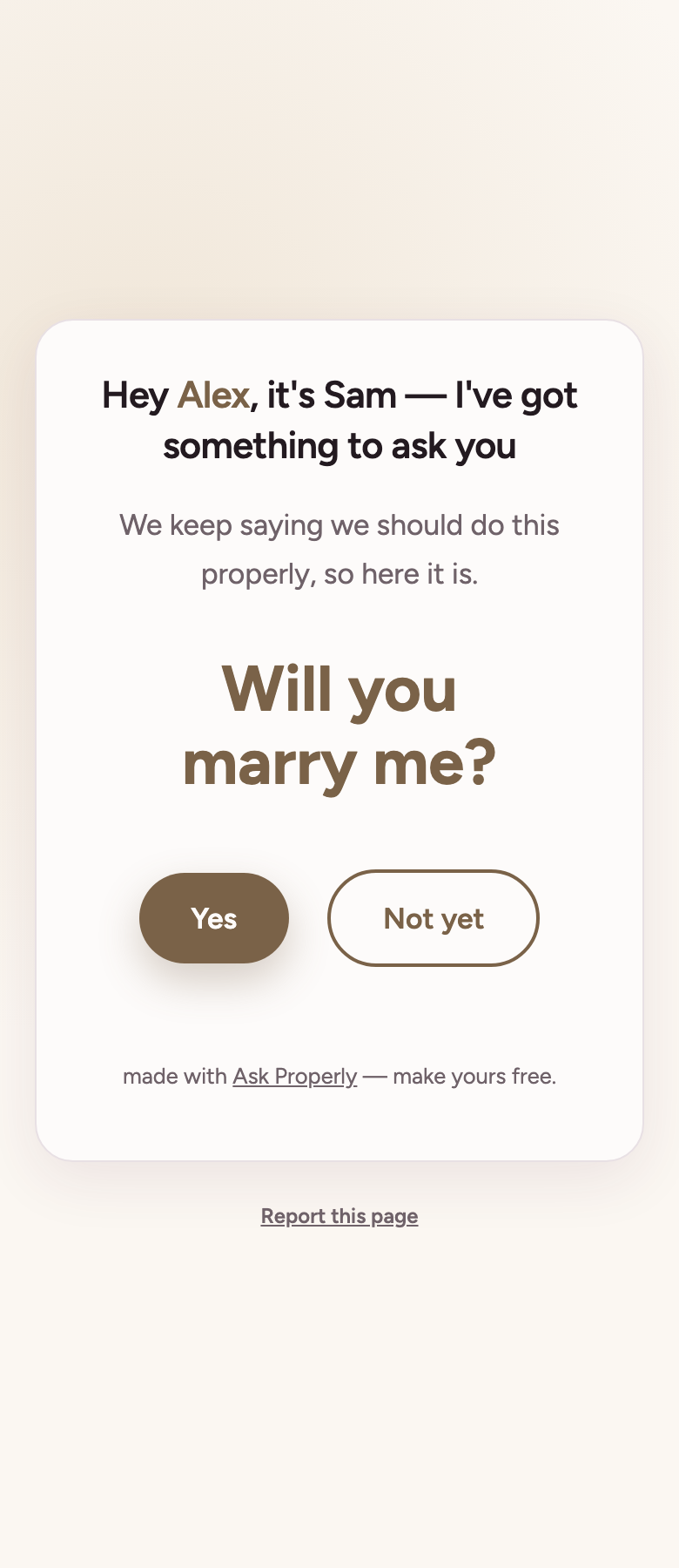
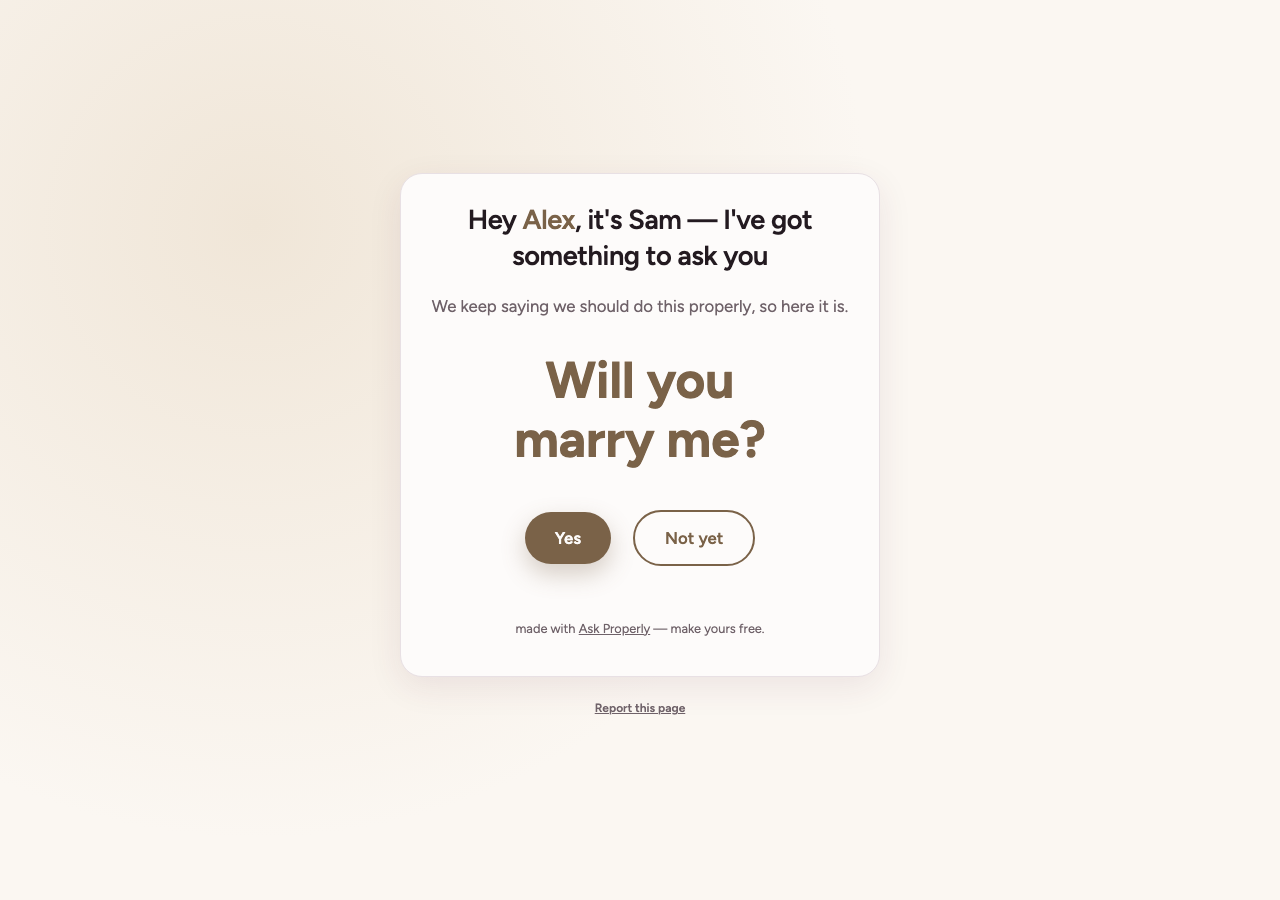
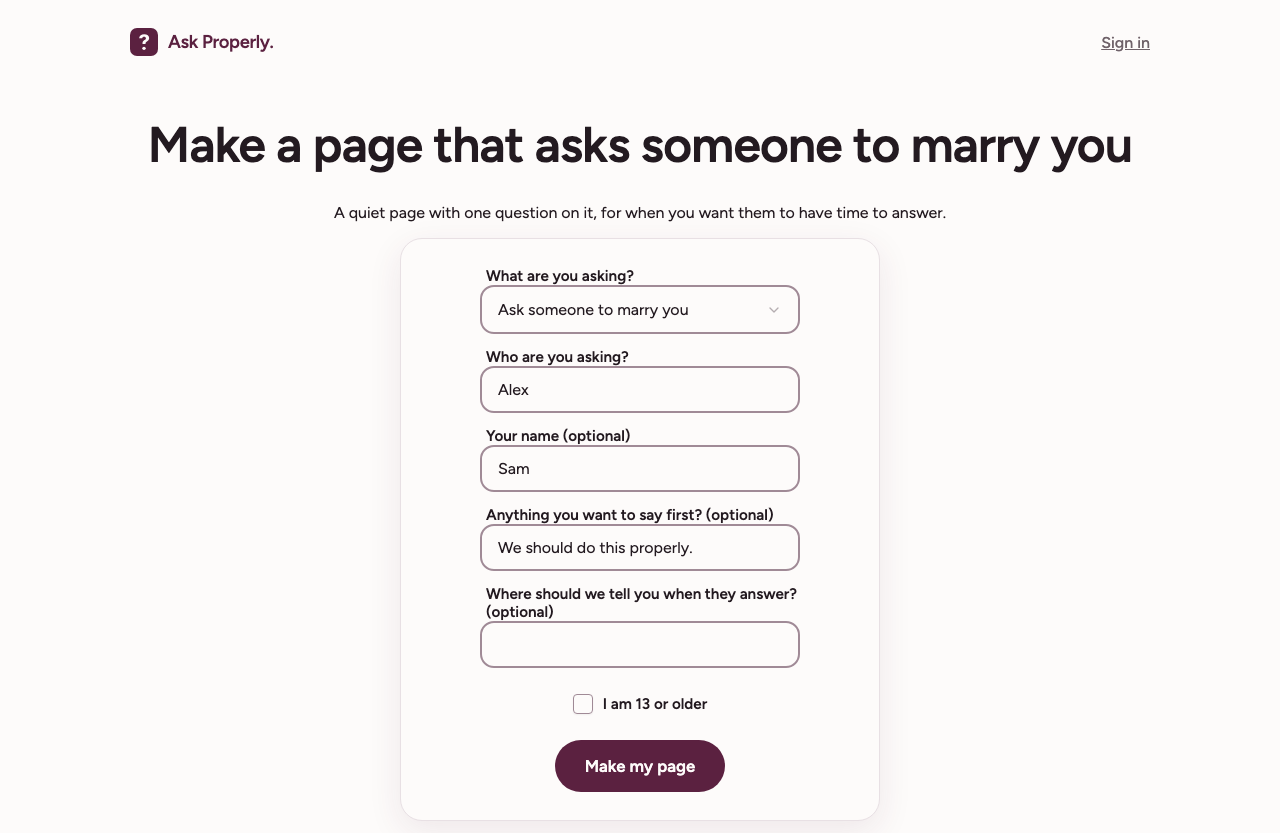
An ask page is a page with one question on it, at its own address. You write the line you want to say first, you make the page in about two minutes, and you send one link. They read the question with nothing else on the screen, and answer with a tap.
The advantage here is exact: the sentence arrives as you wrote it. No voice cracking in the middle of the clause you worked hardest on, and no sentence lost because you went straight to the question out of nerves.
It also gives them a second. Hearing a proposal and answering it are two things, and out loud they happen at once. Read on a page, they can be a few seconds apart, and for some people those seconds are the whole difference between being asked and being ambushed.
The ring still happens in person. The page carries the words; the room carries everything else.
If the answer is “not yet”
It is worth deciding what you will do before you need to. A delayed answer is not a rejection.
Say as little as possible in the first minute. The instinct is to withdraw the question, apologise for it, or start negotiating, and all three make it worse. “Okay. Take whatever time you want” is enough and it is true.
Ask what the hesitation is about, later rather than now. It may be a thing with a name — money, a visa, a parent, a job that moves next year — rather than a feeling about you, and a thing with a name can be worked on.
Do not ask again that week. The second asking is a different conversation and it should happen after the first has finished being a conversation at all.
This is also why the proposal page is built the way it is. Its second button says “Not yet” rather than “No”, because those are different answers and only one of them is an ending. An answer of not yet is recorded quietly, it goes to you and to nobody else, and there is no announcement and no audience to explain it to. Of everything a private proposal protects, that is the part worth protecting most.