Private proposal ideas, no audience
There is a particular kind of dread that has nothing to do with the answer. It is the thought of a restaurant going quiet, of a ring of phones coming up, of a stranger starting to clap. Plenty of people want to marry the person they are with and want no part of that, and an audience is not the point of a proposal. An audience is a choice, and it is a choice you can decline without giving up any of the occasion. What follows is how to actually subtract the witnesses, which turns out to be a logistics problem rather than a romantic one.
Public places are rarely as empty as you planned
The viewpoint at sunset is where everyone goes at sunset. The beach is busy in summer, the park is busy on a Saturday, and the quiet corner of a restaurant has waiters in it by design. Choose a place that is beautiful at exactly the hour everybody else also finds it beautiful, and you have chosen an audience.
Go at the wrong time on purpose. The same viewpoint at eight on a weekday morning is far more likely to be empty. Going early is a simple trick, and it costs nothing.
Go in the wrong season. A coastal path in February may have nobody on it. If the place matters more than the weather, take the weather.
Visit it first, at the hour you intend to use, and count the people. Not an estimate from memory — an actual look, on the same weekday, at the same time. Places have schedules, and the only way to learn one is to turn up.
And have a second place. The honest failure mode of an outdoor private proposal is arriving to find a coach party. If the plan has no alternative in it, you will either go ahead in front of forty people or not ask at all, and both of those are worse than a ten-minute walk to the fallback.
Indoors, the audience is staff
A restaurant cannot give you privacy, because its job is to attend to you. Somebody will arrive with water in the middle of your sentence. That is not bad service; it is service.
If you want to be indoors and alone, the options are somewhere you have rented outright, somewhere you live, or somewhere belonging to a friend who has gone out. There is no fourth option, and a quiet table is not one of them.
Telling the restaurant in advance makes the problem worse, not better. Staff who know are staff who are watching for it, and the kind thing they do next — the dessert with writing on it, the hovering — is precisely the public moment you came to avoid.
Hotel rooms work and are underrated. They are private by definition, they are somewhere neither of you has to tidy, and nobody you know will walk in. The cliché attached to them is about surprise parties and rose petals, and you are not obliged to do either.
Home is the strongest version of indoors, for the reasons its own article sets out. If the room you live in is available to you, the privacy problem is already solved and you can spend your planning on the question instead of the venue.
The three people who make a private proposal public
The first is the photographer. A hidden photographer is a witness you hired, and the pictures are genuinely lovely, and you cannot have both that and an empty place. Decide which one you actually want rather than assuming you can have both.
The second is the friend who knows. One person told in advance becomes two by the weekend, and the risk is not that someone spoils it but that someone turns up to watch. If you need to tell someone, tell them after.
The third is a parent asked for permission, if that is something you are doing. It is a kind tradition and it is also one more person who knows, and that person may tell someone else. If you ask, ask close to the date.
Nobody has to be told anything beforehand. The case for telling people is often about their feelings rather than the proposal, and those feelings are entirely satisfied by a phone call afterwards.
Write down who knows. If the list is longer than two, the proposal is not private any more and you should plan it as a semi-public one rather than discovering the difference on the day.
Ask on a page, so the asking has no room in it
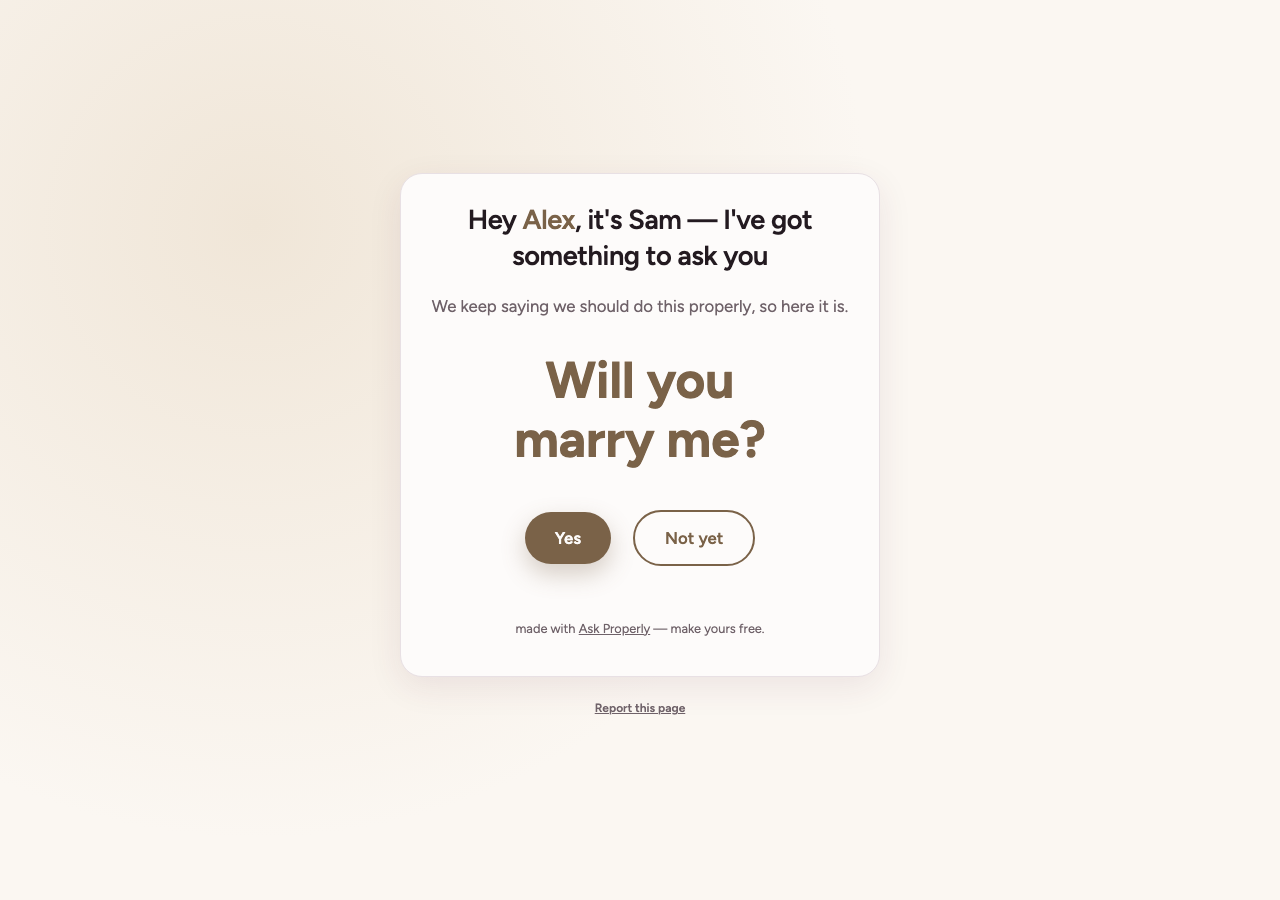
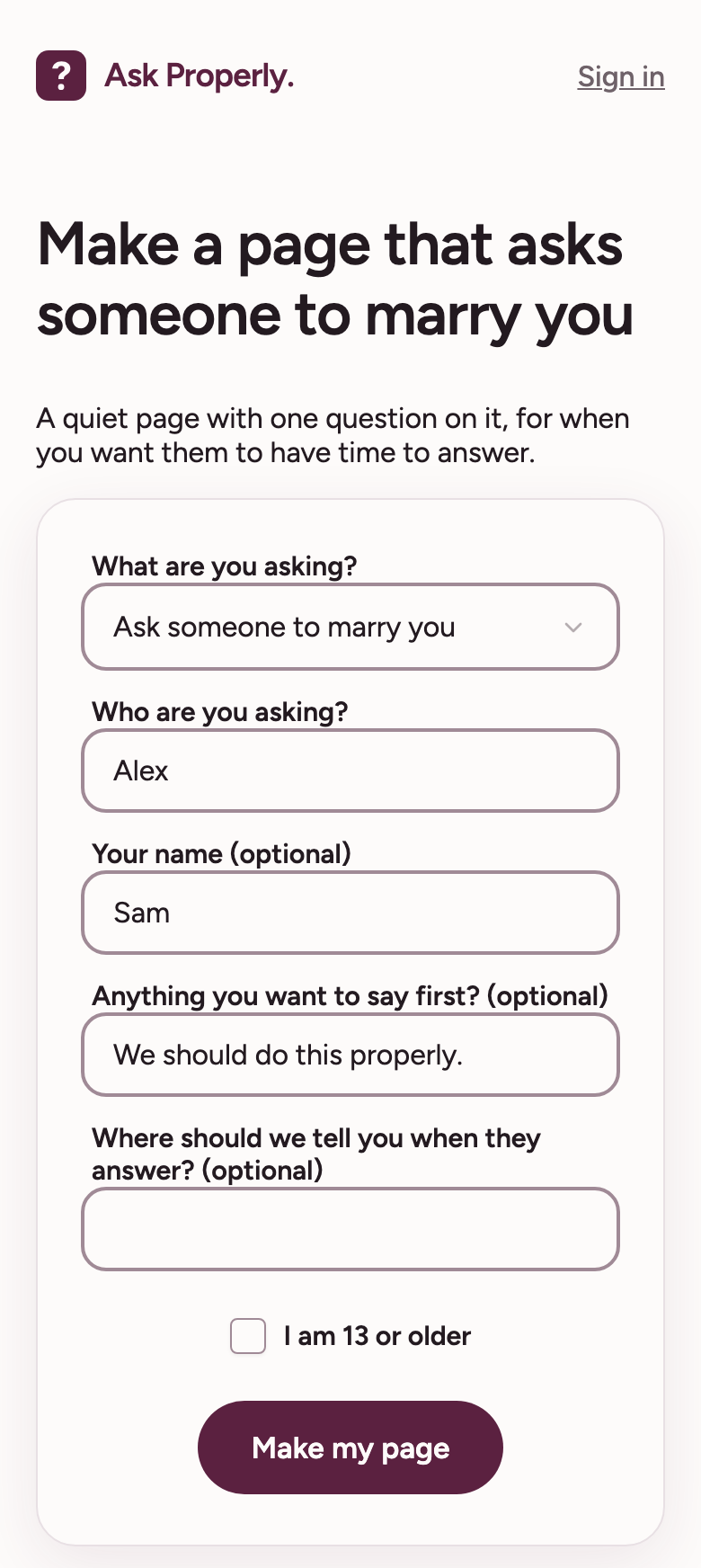
An ask page is a page with one question on it, at its own address. You make it in about two minutes, you send one link, and what they see is the question and two buttons and nothing else. No app, no account, nobody else in the room even if there are people in the room.
That last part is the reason it belongs here. A page makes a private moment out of a public place, because nobody standing nearby can see what is on the phone. The viewpoint can have strangers on it. They are not in this.
It also gives them somewhere to answer that is not out loud. Saying yes in a voice that other people can hear is a separate act from deciding yes, and some people find the first one much harder than the second. A button is a way through that.
The page does not replace the in-person part. The ring, the kneeling if there is kneeling, the holding on to each other afterwards — all of that still happens where you are standing. The page is what makes the sixty seconds before it begin.
And it leaves something behind, which a private proposal otherwise does not. If you decided against a photographer, it may be the only record there is. A free page stays up for 30 days, so screenshot it if you want to keep it.
What you give up, honestly
You give up the photographs. No hidden photographer means no picture of their face at the moment, and that is a real loss, and you may feel it later rather than at the time. You can partly recover it by taking a photograph yourselves in the minutes after, which is not the same and is better than nothing.
You give up the shared story. Part of what people enjoy about a public proposal is the retelling, and a private one has only the two of you to tell it. Some people find that a loss and some find it the entire point.
You give up the applause, which is either a relief or a disappointment, and only you know which. It is worth checking that the person you are asking agrees with you about that, because quiet is not automatically what they wanted either.
What you keep is the thing that matters most: they get to react honestly. Nobody managing their face, nobody performing delight for a watching room, no obligation to be photogenic in the hardest sixty seconds of their year.
And you keep the ability to stop. A proposal with no audience can be paused, restarted, or moved to tomorrow because they came home ill. That is not available once there is a table of people waiting, and it is the quiet argument for doing it this way.