Proposal ideas for introverts
If you are reading this, the moment itself is probably not the part you are dreading. Plenty of quiet people can ask a question in a room with one other person in it. What they cannot face is the week that follows — the phone calls, the ring held up for inspection, the post you are expected to make, the forty people who want to know how you did it. Proposal advice tends to end at the yes. It should not, because for two private people the aftermath is the hard half, and it is entirely plannable. This is how to propose so that the following week belongs to you as well.
The moment is the easy part
Keep it to the two of you, somewhere you already are. No venue, no photographer, no friend hiding with a camera. A private proposal is one you can hold entirely in your own head beforehand, and that is what makes it survivable.
Do not give it a production. An evening with lighting and a playlist and a three-course meal is a performance, and if neither of you likes performing you will both be relieved when it is over, which is a poor description of a proposal.
Pick a time with nothing after it. Not before a dinner you have booked, not on the way out. The point of a quiet proposal is that nothing is waiting, and the hour afterwards has nowhere it has to be.
Say three sentences and then stop. Why now, the specific thing, the question. The long version is harder for both of you and adds nothing.
And decide in advance that you are allowed to move it. Private people are the ones most likely to push through a day that is going badly because cancelling feels like a fuss. It is not a fuss. Nobody else knows.
Plan the announcement before you ask
Agree who finds out first, and in what order, before the question happens. One way this goes wrong is not disagreement about the answer but a scramble in the first hour about who to ring, conducted by two people who have just been through something enormous.
Put a number on how long it stays private. A day, a week, until you have seen the people who matter in person. Any of these is reasonable and all of them are easier to hold if you agreed on them beforehand.
Decide what you will say when asked how it happened. You will be asked this perhaps forty times, and the answer can be nine words. Having a short one ready is the difference between a nice conversation and a retelling you did not want to give.
Tell the person most likely to broadcast it last. Everyone knows who this is in their own family. This is not unkind; it is scheduling.
And agree whether there is a post. Neither of you is obliged to put anything anywhere, and saying so out loud to each other removes the silent assumption that one of you is waiting for the other to do it.
The photograph problem, honestly
There will be no picture of the moment, because having a picture of the moment requires somebody watching the moment. That is a real cost and it tends to arrive later, when everyone else has one.
Take one straight afterwards, deliberately, before you ring anyone. Not a posed one — the two of you, in the room, five minutes after.
A photograph of the ring on the hand does most of the work for the people who will ask, and it requires nobody to have been present. It may also be the only picture you actually want to send.
Consider a photograph of the thing rather than the faces. The room, the table, the page the question was on. For two private people, an object is often easier to share than a face.
And accept that some of the record simply will not exist. That is the trade you made on purpose, and it is worth naming so that it does not feel later like something that went wrong.
Ask on a page, which is the quiet version
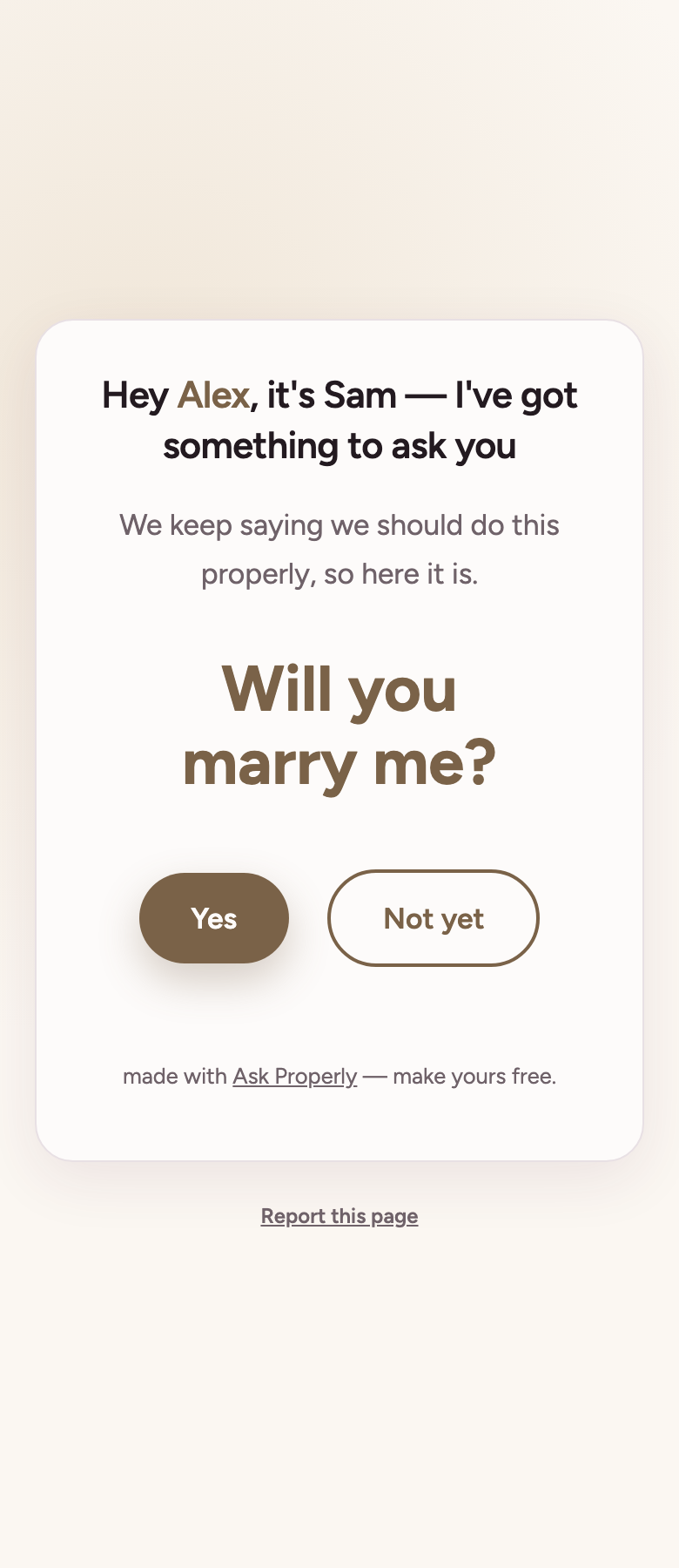
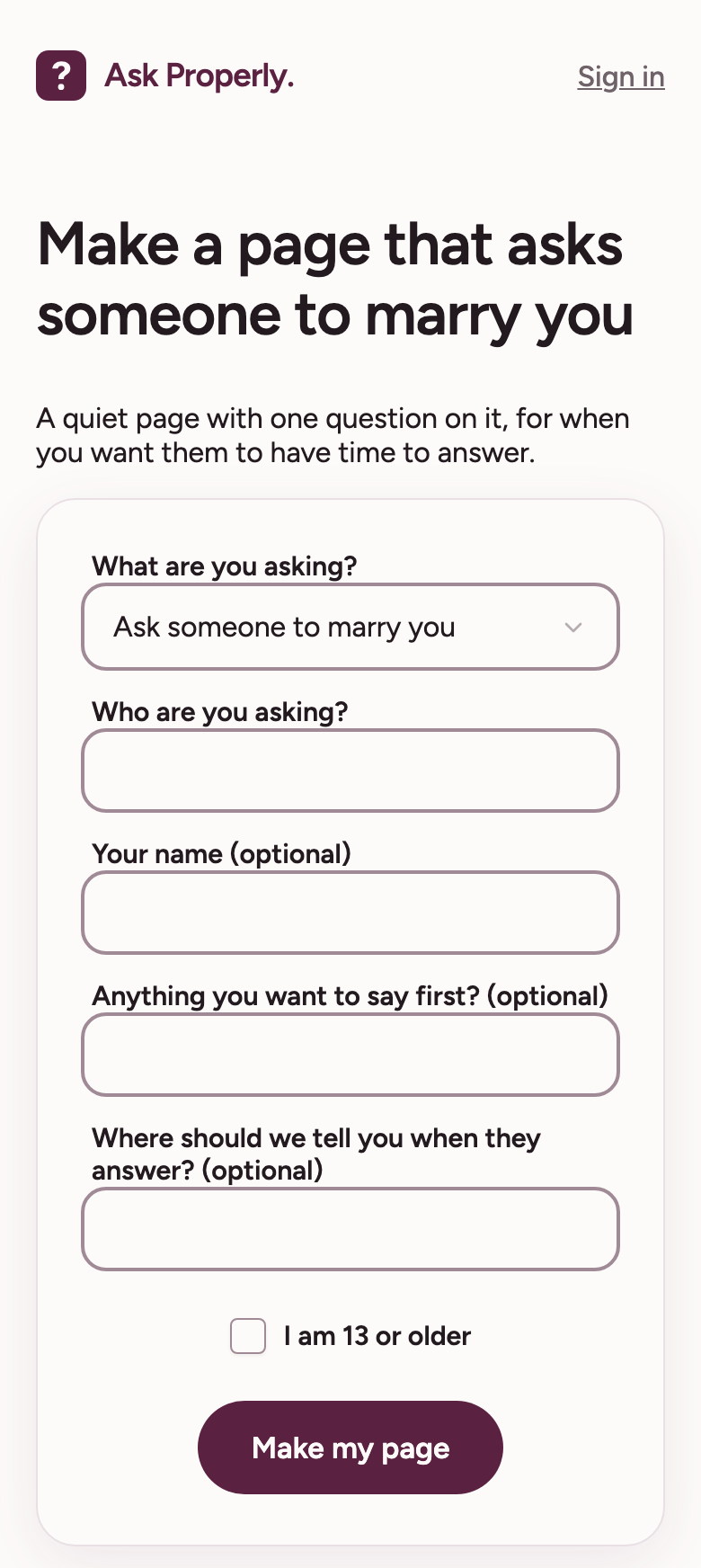
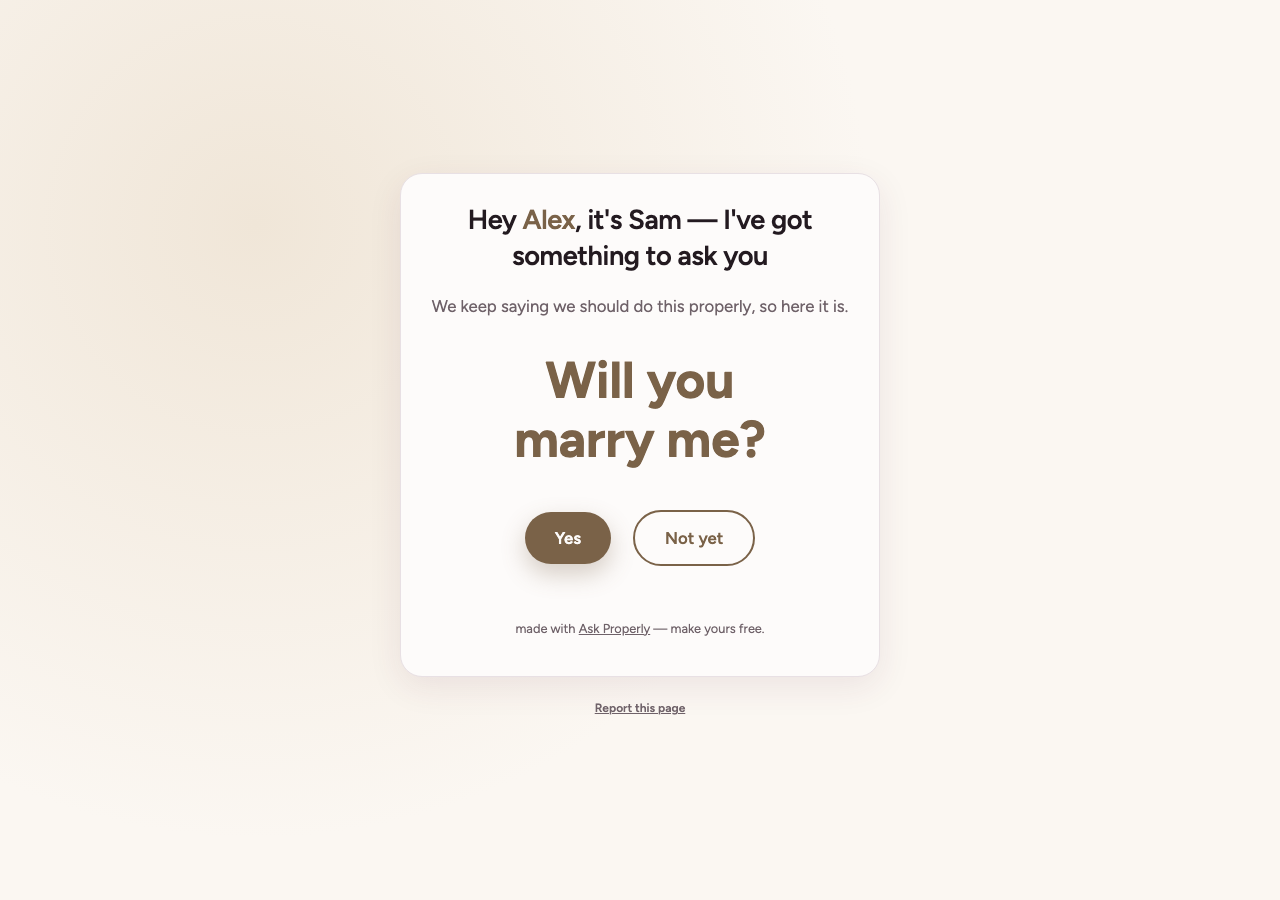
An ask page is a page with one question on it, at its own address. You make it in about two minutes, you send one link, and what they see is the question and two buttons, with nothing else on the screen.
For two private people, the useful part is that it keeps the asking between you. Nobody is watching, nothing is announced, and the answer is a tap rather than a sentence said out loud in a voice that has to hold. Some people find deciding easy and saying it hard, and a page separates those two things.
It also solves the photograph problem partly. There is a record, it is still there in the morning, and a free page stays up for 30 days, so screenshot it if you want to keep it. Showing it is a choice you make later rather than a thing that happened in public.
And it is the gentlest way to open the subject when neither of you is good at opening subjects. The page starts the conversation so that you do not have to find a sentence that gets you from the washing-up to a proposal.
The ring, if there is one, still happens between the two of you in a room. The page is the beginning, not the substitute.
The wedding question arrives immediately, and you can decline it
Soon after you tell anyone, somebody will ask when and where. The honest answer on day one is that you have not thought about it, and that is a complete sentence rather than an embarrassing one.
Agree a holding answer between you. “We are not doing any of that yet” works on everybody and ends the subject politely. Without one, you will each improvise differently and spend a fortnight correcting it.
Expect some of the pressure to be about size. For two private people the hard conversation may not be the date but the guest list, and it can start early.
Give yourselves a protected period where none of it is discussed — a fortnight, say. Being engaged and planning a wedding are separate activities, and collapsing them means you never get the first one.
And take the first evening back. Put the phones somewhere else for an hour after the yes. It is the only hour of the whole engagement that is purely the two of you, and it is the one most easily given away to other people’s excitement.