Creative proposal ideas at home
Most proposal advice begins by sending you somewhere else. A clifftop, a city you flew to, a restaurant with a booking made under a false name. Home gets treated as the version you settle for when the budget or the nerve runs out. It is usually the better one. The room you actually live in is the room they will picture afterwards, and it is the only location where nobody is watching, nothing is booked, and the whole thing can happen on a Tuesday because Tuesday was when it felt right. The difference between a home proposal that works and one that feels like an ordinary evening with a ring in it is not money. It is that one was planned and the other was hoped for.
Why home is the stronger location
Nobody is watching. That single fact removes what you may actually be nervous about, which is not the question but the audience. At home there is no waiter timing a dessert, no table beside you pretending not to listen, and no stranger filming.
They can react however they react. Crying, laughing, sitting down, asking you to say it again — all of that is available at home and none of it is available in a restaurant, where a person is managing their face for an audience at the same time as answering the largest question of their life.
The room already carries meaning you did not have to manufacture. The sofa where you watch the same programme every week does more work than a hired venue, because it is already loaded. You are not building an association; you are using one.
And you control the time completely. No reservation, no sunset, no last train. If they are late home or in a bad mood or coming down with something, the evening moves and costs you nothing. That flexibility is worth more than any view.
The weakness of home is the mirror image of its strength: because it needs no booking, it is easy to never quite arrange. Nothing forces the date. That is the one thing you have to supply yourself.
Build the evening backwards from one minute
Decide the minute first. Not the evening, not the dinner — the single minute where you ask. Everything else is scaffolding around it, and if you plan forwards you will spend all your attention on the food and arrive at the question unprepared.
Pick the room and the spot in it. Standing in the kitchen doorway is a different proposal from sitting on the end of the bed. Choose deliberately, then set that spot up so nothing has to be moved out of the way at the moment it matters.
Work out what happens immediately before. The minute needs an edge, or it never starts. Handing them something, putting music on, asking them to sit down, saying their name differently — any of these is enough. Without one, you will circle the subject for ten minutes waiting for a gap that does not come.
Then shorten everything else. A home proposal can fail by being too long: a three-course meal you cooked while anxious, followed by a tidy-up, followed by nerves. Make the evening small enough that you still have your nerve when you reach the minute.
Write the first sentence down and keep it somewhere you can see it. Not the speech — the first sentence. The rest arrives once you have started, and starting is the only part that goes wrong.
Ideas that use the room you already have
Rebuild a specific evening you both remember. The same meal, the same film, the same terrible wine. It works because it is particular to you and impossible to copy, which is the opposite of a hired photographer at a landmark.
Use the last page of something. A book you both read, the final episode of a series you saved, the end of a playlist you made. Arriving at the end of a thing is a natural edge, and edges are what a home evening lacks.
Cover one wall in photographs of the years you have had. Cheap, slow to make, and it means the room has changed when they walk in, which announces that something is happening without you having to announce it.
Cook the first thing you ever cooked for them, badly if that is how it went. Shared history beats production value every time, and a slightly burnt dish you both remember is better than something impressive neither of you has eaten before.
Give it to them as a question they open rather than hear. A letter on the table, a page on their phone, something sealed. This is the version that works when you know your own voice will go, and it is the one that gives them a second to arrive before they answer.
And consider doing it in the morning. Proposals default to evening for no reason except that films do. A Saturday morning in a kitchen, with the whole day afterwards still free, is a better shape than a late night that ends in going to sleep.
Ask before you kneel
The hardest part of a home proposal is that you are both already comfortable, so there is no moment that starts it. One way to supply that moment is to let the question arrive before you say it out loud.
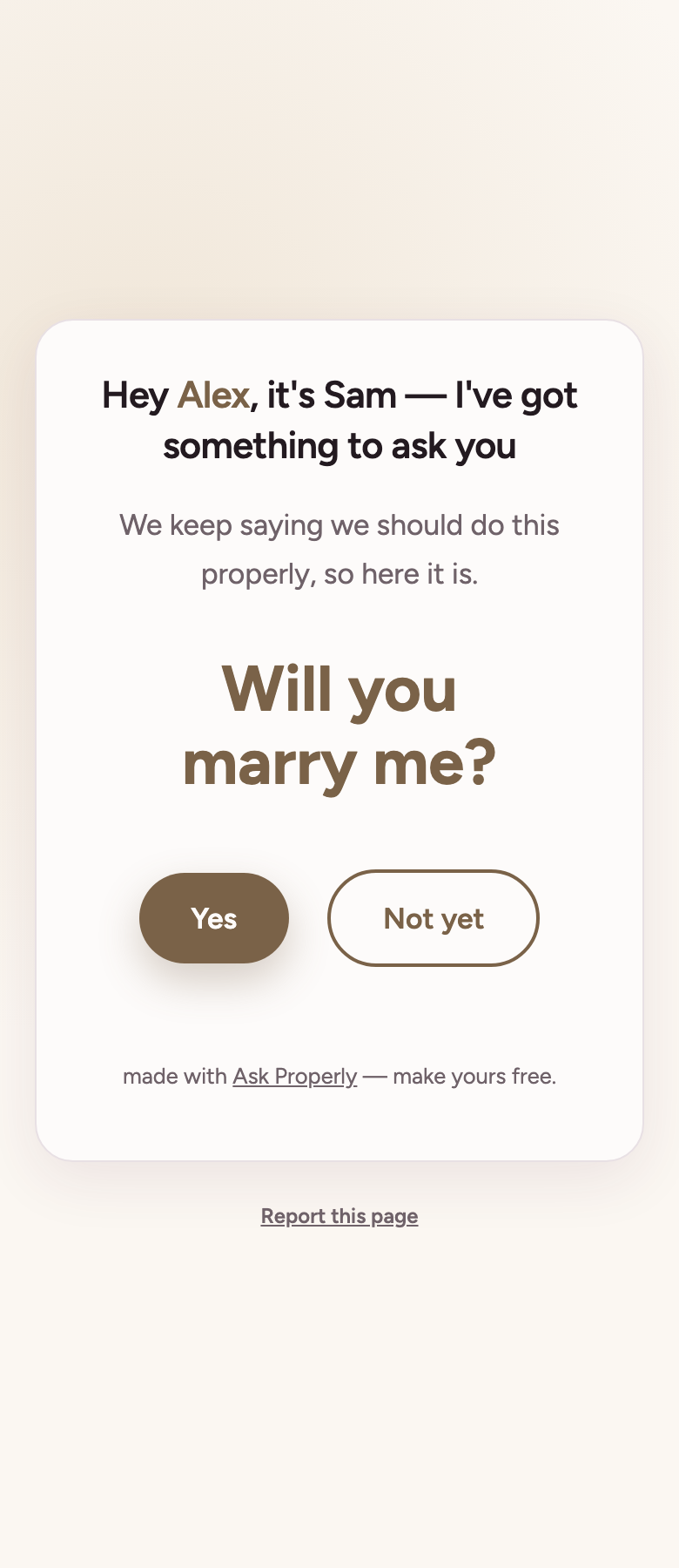
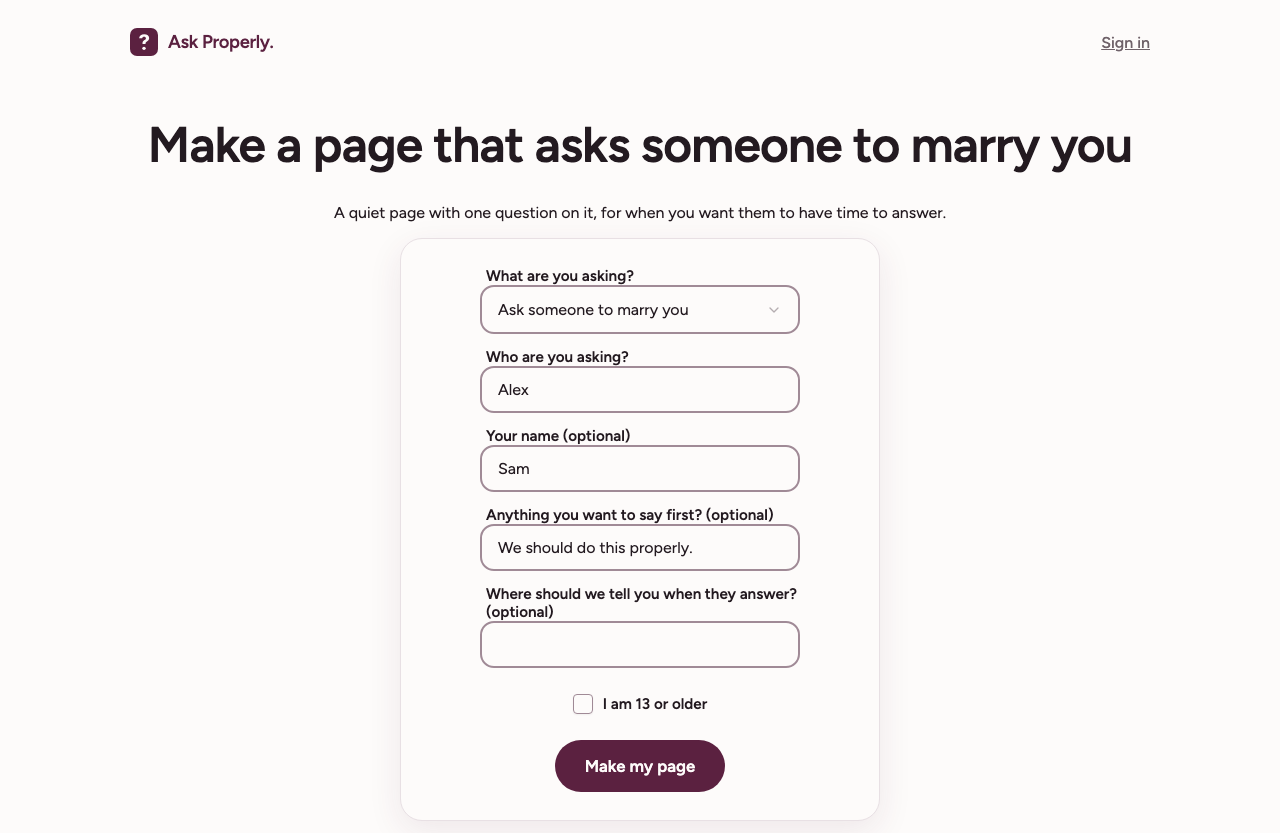
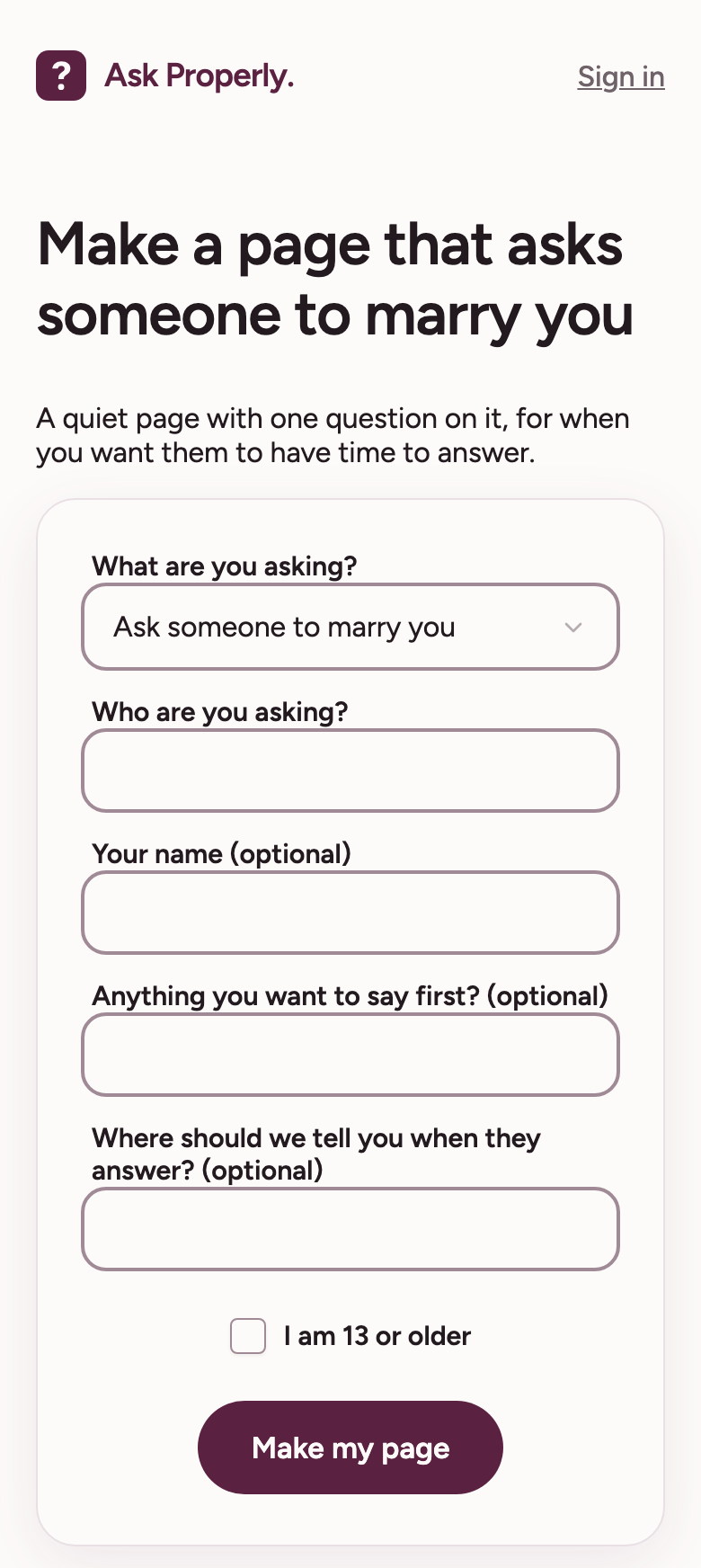
An ask page is a page with one question on it, at its own address, in nothing but the question’s own colours. You make it in about two minutes, you send one link, and the only thing on their screen is what you are asking. It does not replace the evening. It starts it.
There are two ways to use it at home. You can send it an hour ahead, so the person is sitting on the sofa having already read it when you come in — which means you walk into a room where the question is already true, instead of having to manufacture a beginning. Or you can open it on a phone or a laptop in the room, hand it over, and let them read it in silence while you wait.
Either way the ring still happens in person, and so does the kneeling if you are kneeling. The page is the frame. It is the thing that makes the next sixty seconds different from the hour before it, and at home that frame is the one piece you otherwise have to build from nothing.
It also gives them something that stays. A home proposal leaves no photograph unless someone was hiding with a camera, and you may not want someone hiding with a camera. A page is still there the next morning, and it is theirs to show whoever they want to show.
The hour after, which nobody plans
Decide in advance who you are both telling, and when. One way a good proposal sours in its first hour is one of you phoning a parent while the other had assumed the evening was still private.
Protect the first hour from the phone entirely if you can. The urge to announce it is strong and it is the only part of the evening you cannot get back, because once the messages start the two of you are managing other people’s excitement rather than having your own.
Have something small ready for afterwards. Not another course — a bottle in the fridge, a walk you both like, the thing you would do on an ordinary good evening. The hour after a yes is strange and long, and having somewhere for it to go helps.
Do not plan the next day. You may surface from a proposal wanting to book a venue by Sunday, and the week after is soon enough for all of it. The evening you built was for one question, and it is allowed to be only that.
And if the answer is not an immediate yes, home is still the right place to have asked. Nobody is watching, nothing has been announced, and there is no table of friends waiting for a photograph. That is worth saying plainly, because it is the strongest argument for the location.