Proposal ideas for long-distance couples
Every long-distance couple reaches the same argument with themselves. You could wait for the next visit and do it properly, in a room, with the ring. Or you could ask now, because now is when you know, and the next visit is in March. Neither answer is wrong and most advice refuses to pick, which is unhelpful when you are the one deciding. What is true is that the two versions fail in completely different ways, and knowing which failure you are risking is most of the decision. What follows is the case for each, and then the arithmetic, because that is the part of a long-distance proposal you can get completely right.
Wait for the visit, or ask now
Waiting gives you the room, the ring on the hand, and the hour afterwards together. Those are not small things, and if the next visit is six weeks away there is almost no argument for not waiting.
Waiting fails when the visit is far enough out that you start performing. Three months of knowing while pretending not to know is a long time, and the visit itself can feel strange if you arrive already exhausted by the secret.
Asking now gives them the knowledge immediately, which is the thing some people most want to give. It also means the visit becomes a celebration rather than a test, and you both get to spend the intervening weeks engaged rather than waiting.
Asking now fails when it is done badly — which, over distance, means done in a message thread between two other conversations. That is the failure this whole article is about avoiding, and it is avoidable.
There is a third shape: ask now, and keep the ring for the visit. The question happens when you know the answer to it; the object happens when you are in the same room. Nothing about a proposal requires those to be the same minute, and separating them is what the distance already did anyway.
The arithmetic, which is where these actually fail
Write their local time down rather than holding it in your head. It is an easy mistake to make, and an easy one to prevent.
Check the date as well as the hour. Far enough apart, your Friday night is their Saturday morning, and “this weekend” means two different weekends. Name the date out loud to yourself before you commit to it.
Watch for a clock change. The two countries may not move their clocks on the same weekend, and when they do not, the usual difference is wrong by an hour for a while. That is exactly long enough to ruin a plan made a month in advance.
Aim for their early evening. Day finished, phone in hand, somewhere they can sit down. Not their lunch break, not the ten minutes before a shift, and never their morning commute.
Account for your own hour too. If you ask at a time when their reply lands at four in the morning for you, you will be awake for it anyway, badly. Better to arrange it so the answer waits for you — leaving an email address when you build the page does exactly that, and it is the difference between finding out properly and finding out half asleep.
And do not ask in their exam week, their deadline, or the three days before something they are dreading. Over distance you cannot read any of that on their face, so the only way to know is to have asked first.
Build a shared hour, rather than sending a message
Arrange the time instead of ambushing them. “Are you free at eight on Thursday, there is something I want to ask you” sounds less spontaneous and works far better, because it puts both of you in the same minute deliberately.
Saying that you want to ask something is not a spoiler. It is what makes them sit down, put the laptop away and be present, which is the condition the moment actually requires.
Let them choose the hour if you can. Over distance, control of the clock is one of the few kindnesses available, and handing it over costs you nothing.
Protect the minutes on both sides. The worst version of a long-distance proposal is the one where somebody has to leave for work ninety seconds after answering. Leave room, and say that you have left room.
Keep the call for afterwards rather than during. You may find the asking easier to do on a page and the reacting easier to do face to face, in that order, with no gap between them.
Ask on a page, so the question is not a message
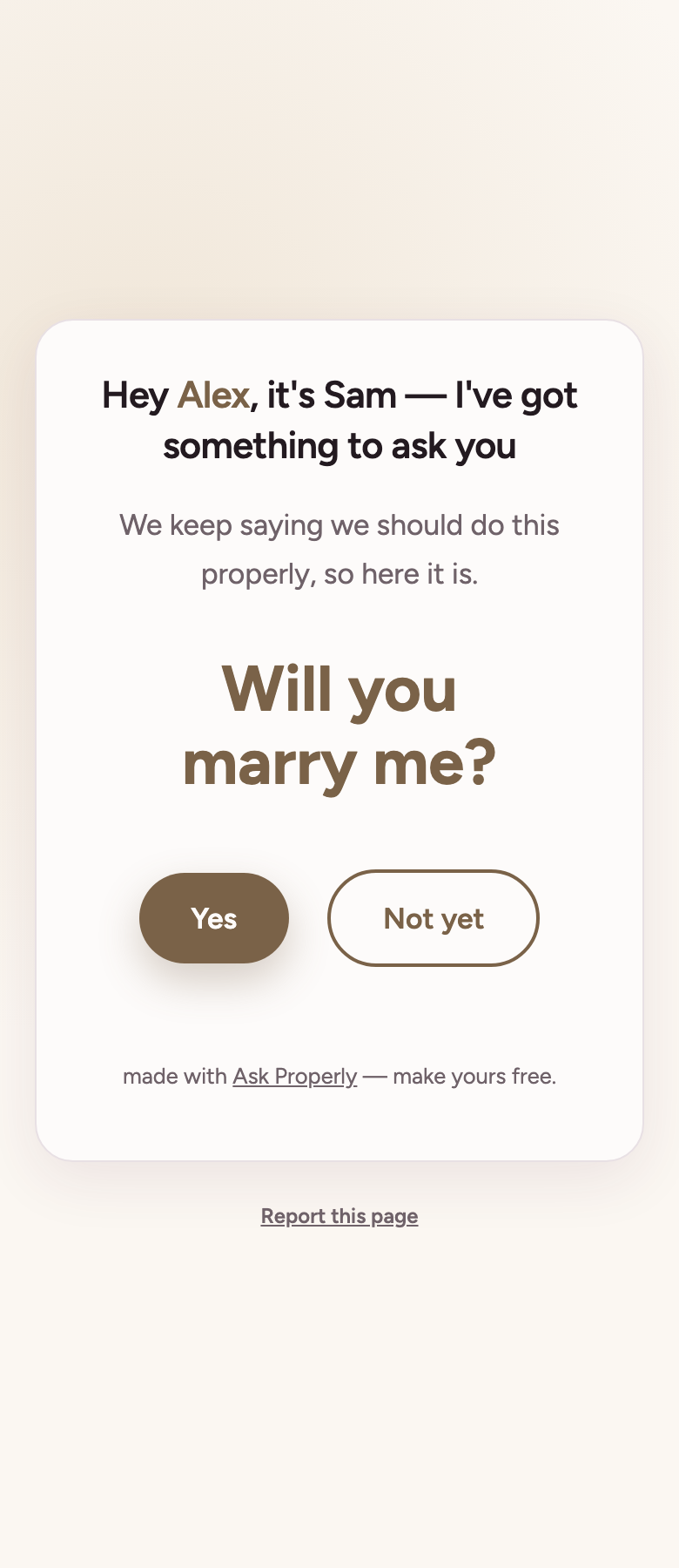
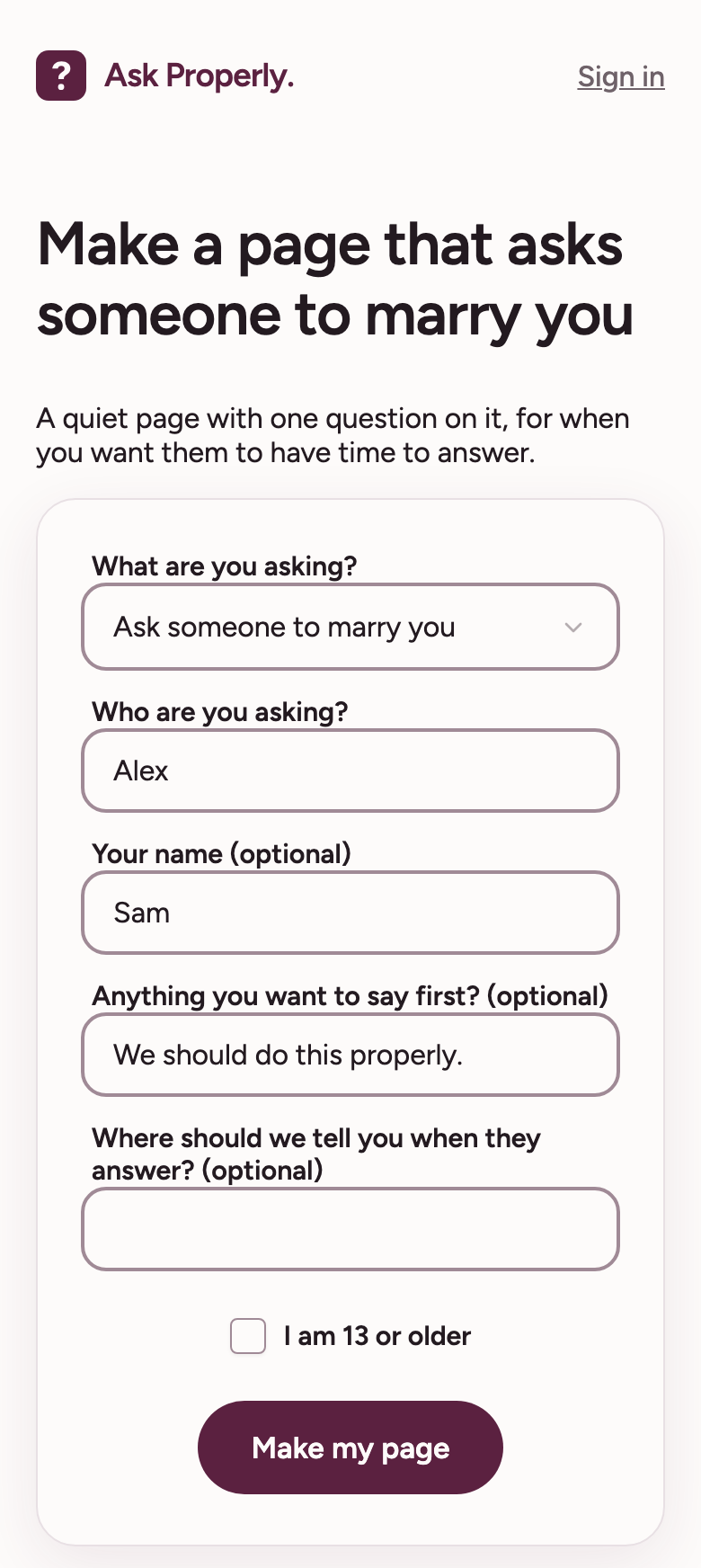
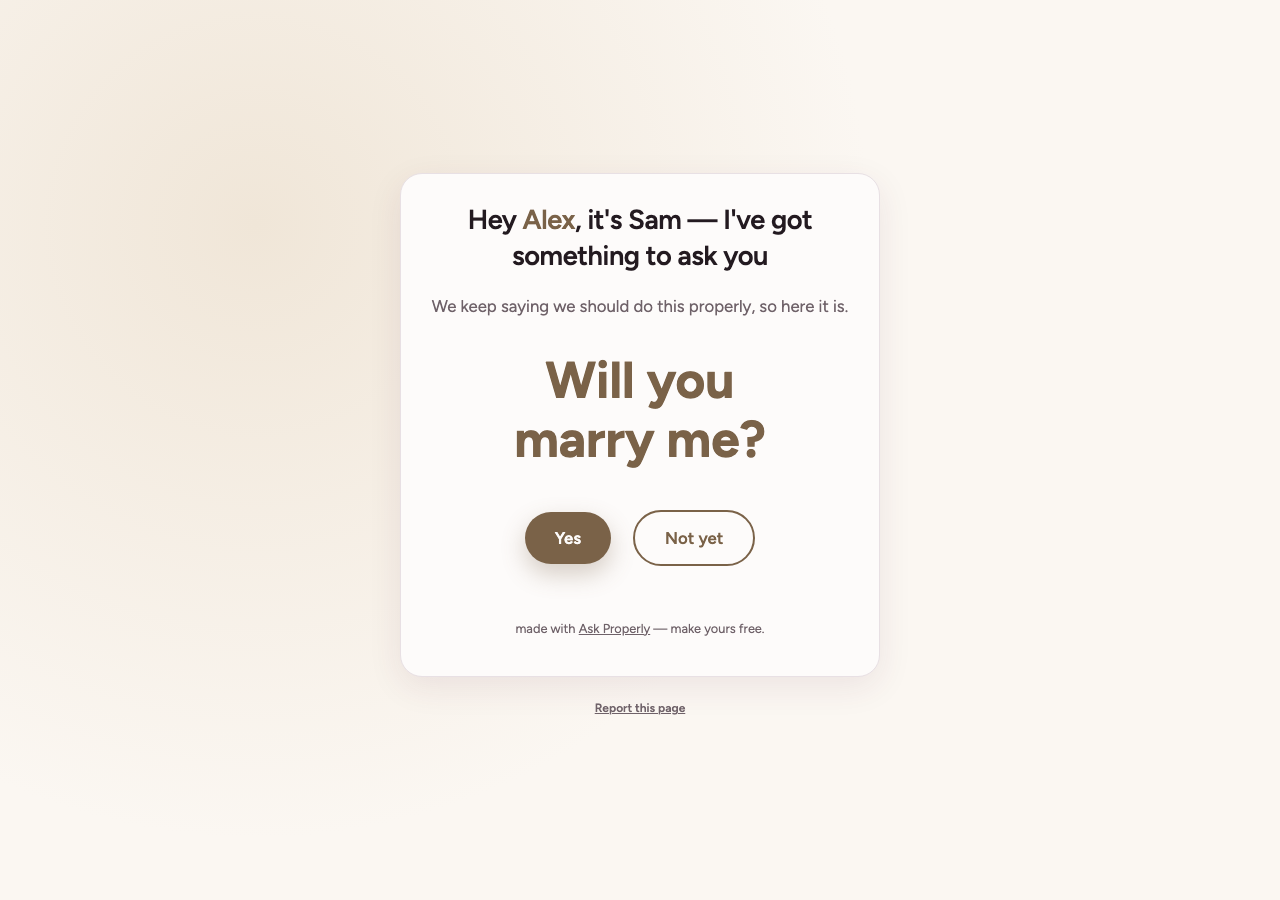
An ask page is a page with one question on it, at its own address, in nothing but the question’s own colours. You make it in about two minutes and send one link. What they see is the question and two buttons, with nothing above it and nothing below it.
Over distance that frame is doing the job the room used to do. A message arrives between a delivery notification and a group chat, in the same typeface as “can you send me that link”, and the format flattens it. A page does not, because a page is only this.
It also gives them something that stays. There is no photograph of a long-distance proposal and nothing to hold afterwards, so unless you make something, the whole event lives only in scrollback. The page is still there the next morning, and it is theirs to show whoever they want.
Their answer comes back as a tap rather than a paragraph they have to compose at midnight. That matters more than it sounds: asked by message, a yes has to be written, and writing it is a performance at the exact moment a person is least able to perform.
None of this replaces the ring or the visit. The page is the first half. It is the half that distance took away.
Things to arrange before you ask, not after
Work out what you are both telling people, and when. A long-distance engagement is announced across two sets of friends in two countries, and if one of you starts and the other has not, it becomes a mess within an hour.
Decide whether anyone is flying. People on both sides will ask immediately whether there are plans, and “we have not got that far” is a complete answer — but it is easier to give if you agreed on it beforehand.
Have something to do together straight afterwards, even at a distance. Starting the same thing at the same second — a film, a record, the same episode — gives the evening somewhere to go, and over distance a shared timeline is the thing that has to be made deliberately.
Do not send the ring in the post. A posted ring arrives next to the bins on a Tuesday or it arrives at customs, and neither is the moment. Keep it for the visit; the question does not need it.
And say the specific thing before you ask. The call you both stayed on too long. The hour you keep free without mentioning it. One line, early, then ask plainly and stop writing — over distance the temptation is to compensate with volume, and volume is what makes it read as a letter instead of a question.